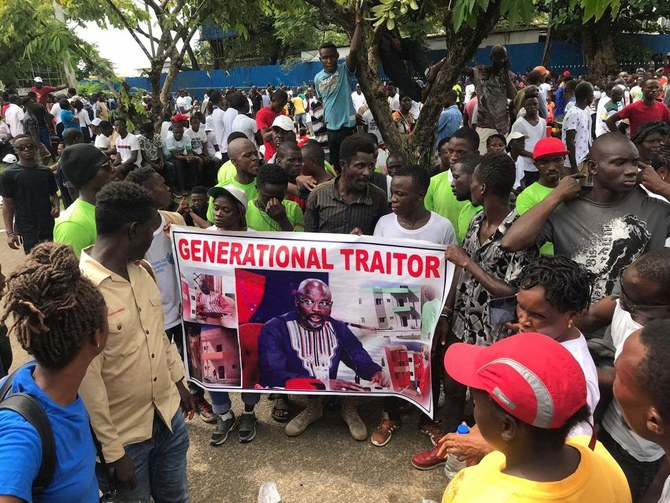
MONROVIA: Thousands of people took to the streets of Liberia’s capital Monrovia Friday to protest rising prices and corruption, posing a key political test for President George Weah.
The football icon is being challenged over the same issues on which he campaigned in his rise to the presidency of the impoverished West African state just 18 months ago.
About 10,000 people took part in the demonstration, according to an AFP count, while a police official put the turnout at around 4,000.
Some held aloft placards reading: “We are tired of suffering” and “We want better living conditions.”
The mood was upbeat, with people dancing and singing. But in a country traumatized by years of civil war, many braced for possible clashes, and some stocked up on food, fearing prolonged disruption.
Twitter and Facebook, widely used by protest organizers, were down.
“I am staying home to make sure that my kids don’t get in the streets. I have good reasons to be scared. In the history of this country all of our big crises started with demonstrations and ended in serious violence,” Mustafa Kanneh, 43, told AFP.
The UN’s special envoy to West Africa and the Sahel, Mohammed Ibn Chambas, said last month he feared the authorities did not have the means to successfully manage large-scale protests.
“The capacity of the Liberian state is still quite limited... There are serious logistics and financial challenges,” he told a local daily.
The coalition that organized the march, the Council of Patriots, comprises dozens of civil society groups as well as politicians.
On Thursday, Weah issued a statement defending his record, blaming past governments for the country’s entrenched problems and sternly warning the protest organizers.
“You can say whatever you want to, but be warned that cusses, insults and incitement of violence will never again be permitted under my administration,” he said.
Weah, 52, is revered in Liberia and beyond for blazing a trail for African footballers in Europe.
But he is struggling to revive a country that is one of the poorest in the world and still traumatized by back-to-back civil wars between 1989 and 2003 that claimed a quarter of a million lives.
Rising prices are a major source of discontent.
“Before, 500 LD (500 Liberian dollars — $2.5, 2.3 euros) was enough to adequately feed my family each day,” said Angeline Flomo, a 35-year-old housewife and mother-of-four.
“Now, 1,000 LD can’t feed us. This is how bad things have become. A bag of 25 kilos (55 pounds) of rice used to sell for 1,500 LD, now it is 2,800 to 3,000 LD. We are finding it difficult to make ends meet.”
Fingers are being pointed at past and present managers of the Central Bank of Liberia (CBL).
Last October, rumors swirled that newly-printed Liberian dollars worth US $102 million, intended for the CBL’s reserves, had disappeared shortly after arrival from abroad.
Charles Sirleaf — the son of former president and Nobel laureate Ellen Johnson Sirleaf — was detained in March with two other CBL figures.
An independent probe found no money was missing, but flagged “concerns regarding the overall accuracy and completeness of the CBL’s internal records.”
More irregularities came to light related to a cash injection of $25 million that Weah ordered in July 2018 to mop up excess Liberian dollars and bring inflation under control.
Weah says he is aware of the burden of ordinary people, and improvement to health, education and roads remain his priorities.
“We have done much over the short time to (address) bad conditions, which of course are not our making,” he said Thursday.
“We met the hardship and inherited all the bad conditions and without making excuses, we are solving them.”
Weah maintains Liberia will benefit from an International Monetary Fund aid program, but experts say IMF support typically comes with demands for reform and belt-tightening.


![]()

Thousands protest price hikes, corruption in Liberia
Thousands protest price hikes, corruption in Liberia
- The football icon George Weah is being challenged over the same issues on which he campaigned in his rise to the presidency of the impoverished West African state just 18 months ago
- Weah issued a statement defending his record, blaming past governments for the country’s entrenched problems and sternly warning the protest organizers

Latest updates


Recommended


© 2026 SAUDI RESEARCH & PUBLISHING COMPANY, All Rights Reserved And subject to Terms of Use Agreement.