Burning trash and factories belching smoke choke Iraqis

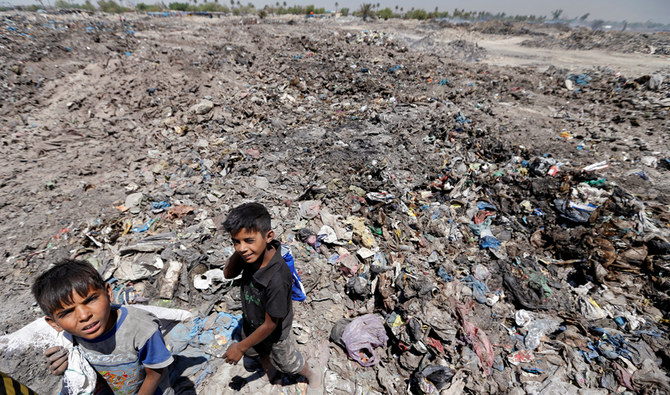
Boys collect recyclable materials at a rubbish dump Baghdad, Iraq on May 30. (Reuters)
Updated 07 June 2019
Follow

Burning trash and factories belching smoke choke Iraqis

  • Increasing pollution rates and other “environmental challenges” could be linked to rising rates of chronic diseases such as cancer and respiratory issues

BAGHDAD: As if life was not bad enough for Adnan Kadhim — he lives in a slum where municipal authorities dump Baghdad’s rubbish — now someone is setting the waste on fire, making his children sick.

As the UN marks World Environment Day on Wednesday, Iraq is suffering a pollution crisis, with trash piling up across the country and thick clouds of smoke produced by inefficient factories hovering above Baghdad.

“The dirt, our children are sick, our families are sick. My daughter has asthma, and I had to take my family to the hospital last night. We had to go at 2 a.m. to give her oxygen. What have we done wrong to deserve this?” asks the 48-year-old, with mountains of rubbish behind him.

No one in his unplanned neighborhood within Baghdad’s southeastern Zaafaraniya district knows who is setting the rubbish on fire, and their complaints to government and municipal authorities have fallen on deaf ears because they are technically not supposed to be living in the area.

“For about a week or 10 days now we have not been able to sleep or work. We just sitting around because of this smoke,” said Jabbar, a builder.

“Every day, it starts at sunset and does not stop until the morning. You can see the tractors (shoveling trash) in front of you. We are being destroyed. We implored the government, and no one did anything, we went to the municipality and still nothing,” he added.

Officials say Iraq suffers from the lack of a formal waste management system, but that they are working on introducing one which they hope will alleviate the country’s numerous environmental hazards which also include pollution from oil production.

“I am sorry to say there are no hygienic official landfills. All what we have are unorganized areas for waste collection,” said Deputy Environment Minister Jassim Humadi. “We are working hard today to issue legislation establishing the National Center for Waste Management.”

Increasing pollution rates and other “environmental challenges” could be linked to rising rates of chronic diseases such as cancer and respiratory issues, as well as birth deformities, he said.

Iraq is working with the international bodies on a plan to help it clean up, he added.

Change is costly

Business owners say they are doing what they can to operate in a more environmentally friendly manner but that it is too costly. The government needs to help them do so, they argue.

At a brick factory in Nahrawan, east Baghdad, ovens running on crude oil are releasing thick smoke, making it hard to breath, or see anything.

“Crude oil, if burned in an incorrect way, the way we burn it, of course has emissions. The new ovens which we are upgrading to will reduce these emissions by 60 percent, but that should not be the ceiling of our ambitions,” said Ali Rabeiy, the factory owner.

More environmentally friendly ovens can fashion bricks and produce only 5 percent of the current harmful emissions, and some even produce none, he said, but they cost anywhere between 4 and 6 billion Iraqi dinars ($3.2-4.8 million), which is not financially feasible for a business like his.


A look at Ramadan and how Muslims observe the holy month

Updated 57 min 58 sec ago
Follow

A look at Ramadan and how Muslims observe the holy month

  • Ramadan is the ninth month of the Islamic lunar calendar; the month cycles through the seasons
  • Ramadan is followed by the Islamic holiday of Eid Al-Fitr

CAIRO: Observant Muslims the world over will soon be united in a ritual of daily fasting from dawn to sunset as the Islamic holy month of Ramadan starts. For Muslims, it’s a time for increased worship, religious reflection and charity. Socially, it often brings families and friends together in festive gatherings around meals to break their fast.
Ramadan is followed by the Islamic holiday of Eid Al-Fitr.
First day of Ramadan expected around Feb. 18-19
Ramadan is the ninth month of the Islamic lunar calendar; the month cycles through the seasons.
The start of the month traditionally depends on the sighting of the crescent moon. This year, the first day of Ramadan is expected to be on or around Feb. 18 or 19. The actual start date may vary among countries and Muslim communities due to declarations by multiple Islamic authorities around the globe on whether the crescent had been sighted or different methodologies used to determine the beginning of the month.
This year, the start of Ramadan is expected around the same time as Ash Wednesday, a solemn day of fasting and reflection that signals the start of Lent, the most penitential season of the church calendar for Catholics and many other Christians.
Fasting is one of the pillars of Islam
Fasting is one of the Five Pillars of Islam, along with the profession of faith, prayer, almsgiving and pilgrimage.
Muslims see various meanings and lessons in observing the fast.
It’s regarded as an act of worship to attain piety and one of submission to God. The devout see benefits, including practicing self-restraint, cultivating gratitude and empathizing with people who are poor and hungry.
The daily fast in Ramadan includes abstaining from all food and drink — not even a sip of water is allowed — from dawn to sunset, before breaking the fast in a meal known as “iftar” in Arabic.
Muslims typically stream into mosques for congregational prayers and dedicate more time to religious contemplation and the reading of the Qur’an, the Muslim holy book.
Charity is a hallmark of Ramadan. Among other ways of giving, many seek to provide iftar for those in need, distributing Ramadan boxes filled with pantry staples, handing out warm meals alongside such things as dates and juice or helping hold free communal meals.
Muslims eat a predawn meal, called “suhoor,” to hydrate and nurture their bodies ahead of the daily fast.
Exemptions from fasting
There are certain exemptions, such as for those who are unable to because of illness or travel. Those unable to fast due to being temporarily ill or traveling need to make up for the missed days of fasting later.
Cultural and social traditions associated with Ramadan
Muslims are ethnically and racially diverse and not all Ramadan traditions are rooted in religion. Some customs may transcend borders, while others can differ across cultures.
Many social rituals center on gathering and socializing after the daily fast. Some Muslims decorate their homes, put out Ramadan-themed tableware and centerpieces or throng to markets and Ramadan bazaars.
In Egypt, Ramadan is typically a festive time. Colorful lanterns, in different shapes and sizes, dangle from children’s hands and adorn homes. Ramadan songs may be played to welcome the month.
Ramadan’s soundscape in Egypt has traditionally included the predawn banging on drums by a “mesaharati” who roams neighborhoods, calling out to the faithful, sometimes by name, to wake them up for the suhoor meal.
New TV shows and communal meals
A lineup of new television series is another social fixture of the month in some countries, and advertisers compete for viewers’ attention.
In various regions, some Muslims worry that the month is getting commercialized, and say an emphasis on decorations, TV shows, outings or lavish iftar banquets can detract from Ramadan’s religious essence. Others say that a balance can be struck and that, in moderation, such rituals are part of the month’s festive spirit.
In Indonesia, Ramadan rituals vary across regions, reflecting the diversity of cultures. In deeply conservative Aceh province, animals are slaughtered during Meugang festivities, the meat cooked and shared with family, friends, poor people and orphans.
Hundreds of residents in Tangerang, a city outside the capital, Jakarta, flock to the Cisadane River to wash their hair with rice straw shampoo and welcome the fasting month with a symbolic spiritual cleansing.
Across the island of Sumatra, after evening prayers, many boys and girls parade through the streets, carrying torches and playing Islamic songs.
In the United States, where Muslims make up a racially and ethnically diverse minority, gathering at mosques and Islamic centers when possible for iftar meals and prayers provides many Muslim families with a sense of community. Some Muslims also organize or attend interfaith iftar meals.