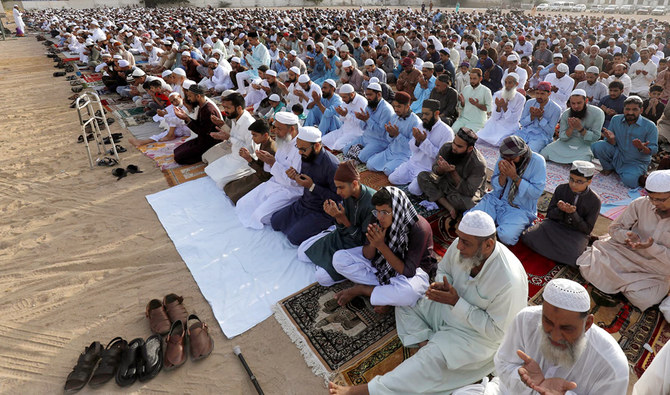
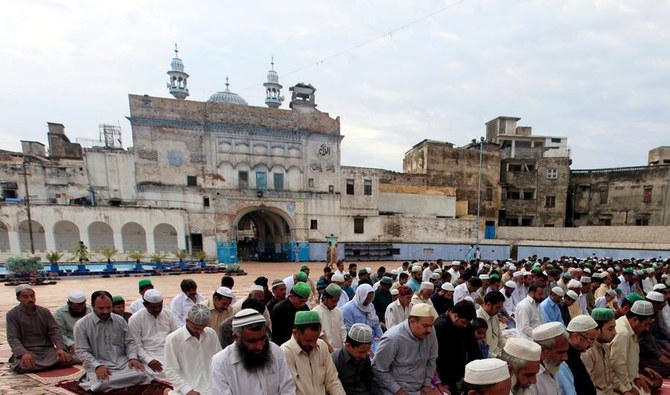
Special prayers for Pakistan as Eid celebrations mark end of Ramadan

1 / 10
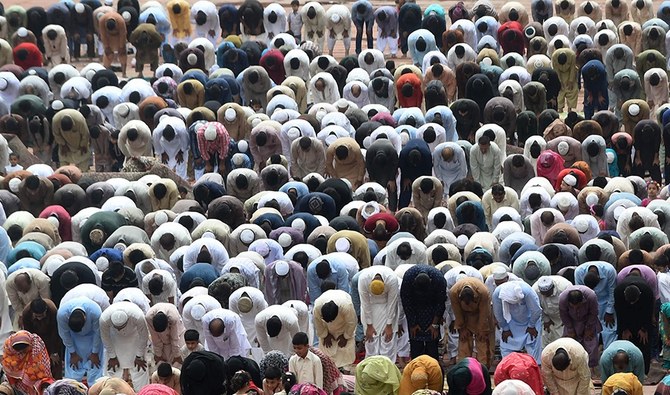
Worshippers offer prayers at the Badshahi Mosque in Lahore, 05 June 2019. — AFP
2 / 10
Men and women offer Eid-ul-Fitr prayers at the Badshahi Masjid in the Pakistani city of Lahore on Wednesday morning, June 5, 2019 (AFP)
3 / 10
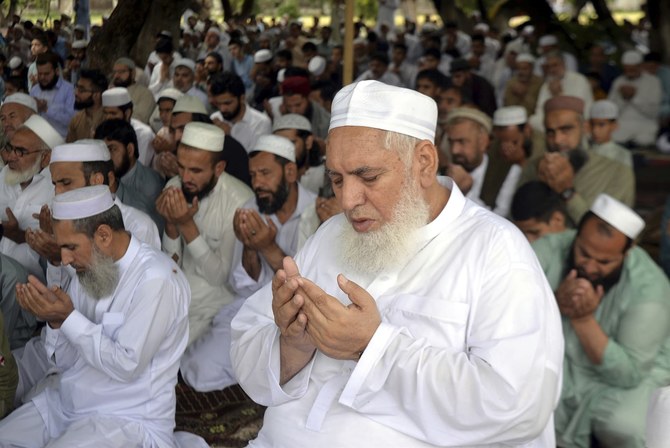
Eid prayers offered in Peshawar on Tuesday, 05 June 2019. — AP
4 / 10
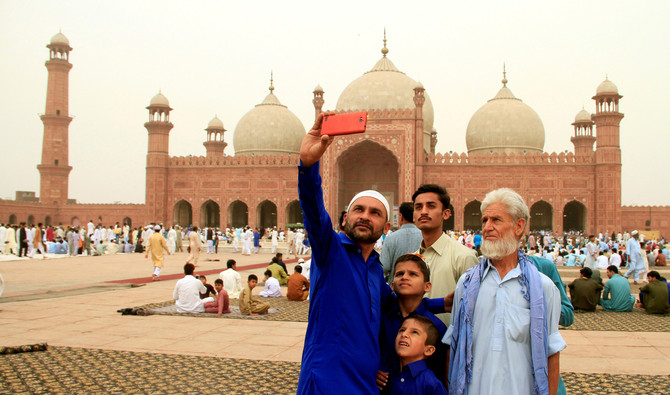
People take selfies as they attend Eid al-Fitr prayers at the Badshahi Mosque in Lahore, Pakistan June 16, 2018. (REUTERS)
5 / 10
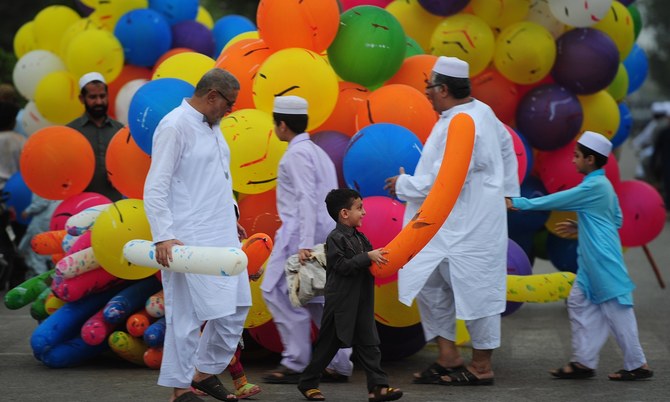
Children buy balloons after offering Eid-ul-Fitr prayers at a mosque in Pakistan's port city of Karachi on Wednesday, June 5, 2019. (AFP)
6 / 10
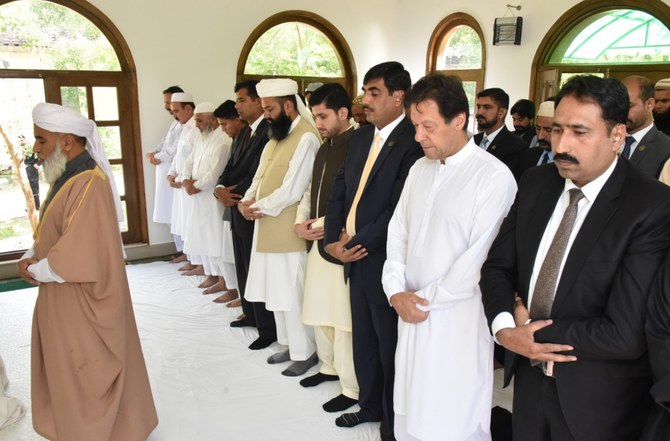
Pakistani Prime Minister Imran Khan offering Eid-ul-Fitr prayers in Islamabad on Wednesday, June 5, 2019.
7 / 10
Pakistani Prime Minister Imran Khan meets supporters after offering Eid-ul-Fitr prayers in Islamabad on Wednesday, June 5, 2019.
8 / 10
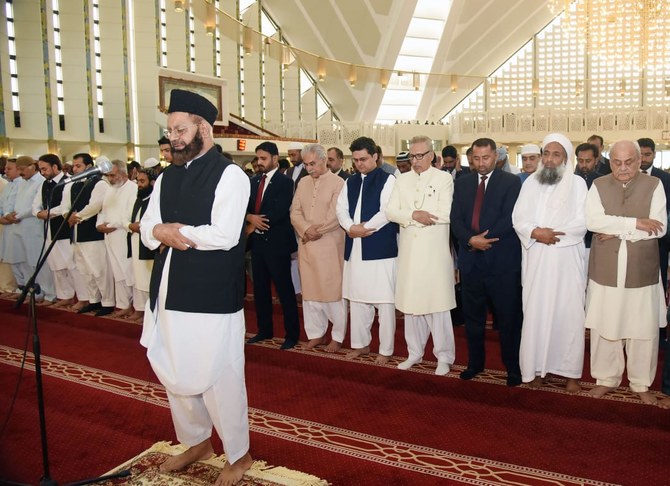
President Dr Arif Alvi offering Eid-ul-Fitr prayer at Faisal Mosque, Islamabad on June 5, 2019.
9 / 10
People offer Eid prayers in Karachi, 05 June 2019. (Reuters)
10 / 10
Muslims attend the Eid prayer at a mosque in Rawalpindi, Pakistan September 2, 2017. (REUTERS)
Updated 06 June 2019
Follow

Special prayers for Pakistan as Eid celebrations mark end of Ramadan

  • PM Khan offers Eid prayers in Islamabad, prime minister, president, army chief congratulate the nation on Eid-Al-Fitr holiday
  • The day began with early morning prayers at mosques and open-air enclosures around the country, and family visits and feasts

LAHORE: Muslims across Pakistan celebrated the Eid-Al-Fitr religious holiday on Wednesday, marking the end of Islam’s holy month of Ramadan, as the prime minister called for unity and brotherhood between Muslims.

The day began with early morning prayers at mosques, and open-air enclosures around the country, after which family visits and feasts began. State media reported that special prayers were offered in several major cities for the prosperity and progress of Pakistan, which is currently battling a worsening economic outlook.

The annual Eid-al-Fitr festival is traditionally a time for ordinary Pakistanis to splurge on new clothes and accessories. But this year’s Eid holidays, which began on Wednesday, has been more austere than in preceding years.

Prime Minister Imran Khan offered Eid prayers in Islamabad.

“Eid Mubarak to my Pakistanis. Wishing you all a Happy Eid,” Khan said in a Twitter post. “Let us all resolve to stand up as a united nation to overcome our economic crisis while putting the least amount of burden on the poorer section of our society.”

In a message to the nation, the PM urged compassion and called on Pakistanis to “share pleasures with the needy and poor.” 
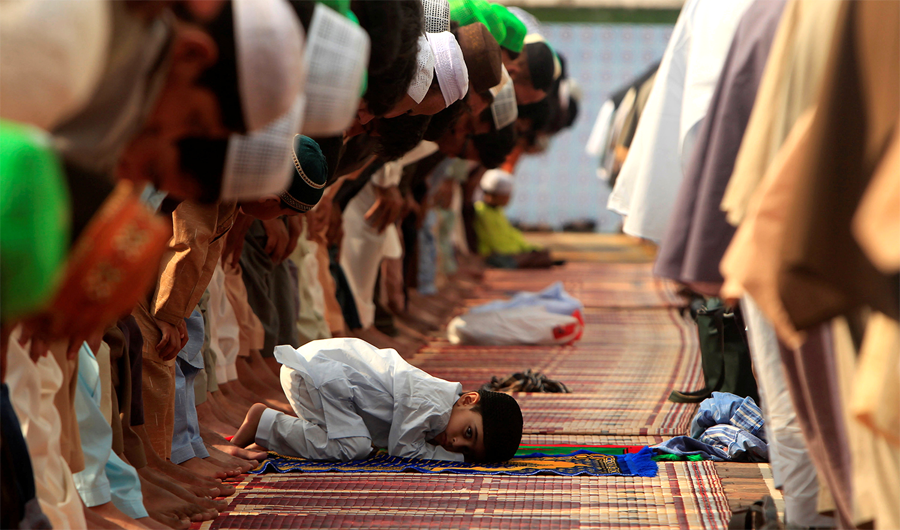


A boy attends Eid-Al-Fitr prayers at Jamia Masjid, Rawalpindi, in Pakistan on Wednesday, June 5, 2019. (Reuters)

“The objective of Eidul Fitr is to promote unity, brotherhood, sacrifice and generosity among Muslims,” Khan said in a statement. “People can only share [the] joys of Eid with others if they abide by the golden principles of Islam and promote generosity by doing away with negative behaviours including jealousy, greed and hatred.”

The PM reiterated that his government would “continue playing its responsible role for developing Pakistan into a real welfare state.”

President Dr Arif Alvi, parliamentarians and diplomats from other Muslim countries offered Eid prayers at the main congregation held at the grand Faisal Mosque in Islamabad.

In a message to the nation, the president also called upon people to “adopt fraternity and compassion in their ranks and work for the progress and prosperity of the country by rising above personal, regional and sectarian biases.”

“The festival of Eid-ul-Fitr carries the essence of Islamic values and traditions and also symbolises the religious ethos,” he said in a statement. “It is also a day of completion of the month-long training which Muslims undergo during the blessed month of Ramazan [Ramadan].”

Military spokesman Maj Gen Asif Ghafoor tweeted Eid greetings on behalf of the armed forces and Army Chief Gen Qamar Javed Bajwa: “Eid Mubarak with prayers for peace, progress and prosperity of Pakistan. Aamen.” 
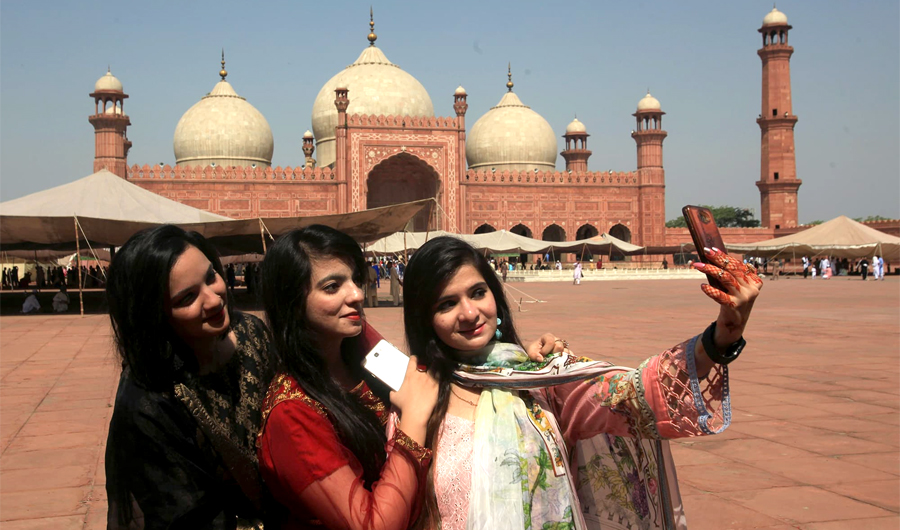


Girls take a selfie after attending Eid-Al-Fitr prayers at the Badshahi Mosque in Lahore, Pakistan, on Wednesday, June 5, 2019. (Reuters)

In a statement issued from Kot Lakhpat jail where former Pakistani prime minister Nawaz Sharif is spending a seven year sentence over graft, Sharif said: “I pray that Allah fulfils my supplications for the country and people. My Eid is dedicated to the poor people who are forced to live in destitution.”

The Pakistan cricket team offered their Eid prayers at a mosque in Nottingham on Tuesday, while South African cricketers Imran Tahir and Hashim Amla, accompanied with Pakistani umpire Aleem Dar, attended prayers at a Southampton mosque.

According to Geo News, Pakistan skipper Sarfraz Ahmed did not celebrate Eid with the team as he travelled to Bradford to visit relatives. Pakistan were to leave for Bristol later on Tuesday where they will play Sri Lanka on June 7 (Friday).

In the port city of Karachi, the day began with a 21 gun-salute, Radio Pakistan reported, with the main congregation being held at Gulshan-i-Jinnah (the old Polo Ground).

In Quetta, the main congregation was held at Eidgah Toghi Road. Most parts of the northwestern Khyber Pakhtunkhwa province kicked off Eid on Tuesday, following the announcement of the sighting of the Shawwal moon by a private Ruet Hilal committee based in Peshawar’s historic Masjid Qasim Ali Khan.


Too warm to freeze: Climate shift threatens ice hockey in Pakistan’s Hunza Valley

Updated 7 sec ago
Follow

Too warm to freeze: Climate shift threatens ice hockey in Pakistan’s Hunza Valley

  • Rising temperatures, falling snowfall disrupt community-run tournament dependent on natural ice
  • Scientists report shorter snow seasons across Hindu Kush-Himalayan region as climate risks grow

HUNZA, Pakistan: Aleena Gul used to watch the pool beside her home in Pakistan’s Hunza Valley freeze solid each winter, transforming it into a makeshift ice hockey rink.

This year, it barely froze at all.

“If we see, there’s a big difference between 2018 and now in 2026,” said Gul, a local player whose family has hosted the community tournament for eight seasons.

“Winter used to begin in November and everything would freeze, . It’s January now and the ice still hasn’t frozen properly,” said Gul, a local player whose family has hosted the community tournament for eight seasons.

The change has disrupted a small but growing winter sports tradition in the mountainous region near the Chinese border, where residents say colder, longer winters once provided reliable natural ice.

Scientists studying the wider Hindu Kush-Himalayan region have reported fewer extreme cold events and shorter snow seasons, with snowfall increasingly failing to settle. Weather data for Hunza shows winter precipitation down by about 30 percent since the late 2010s, with some recent winters two to three degrees Celsius warmer.

That is a challenge for a region reliant on visitors, where winter tourism depends heavily on snowfall and freezing temperatures.

The community-run ice hockey tournament in Hunza depends entirely on natural ice. When Gul’s pool failed to freeze properly this year, organizers scrambled to find an alternative venue nearly two hours north, in a town close to the Chinese border.

Even there, conditions were difficult.

“I expected better ice conditions, but when I saw the rink I felt a bit sad. Many of our players fell. The surface had too many bumps and wasn’t strong,” said Yahya Karim, another player.

Of three matches scheduled on the first day, only one went ahead.

“Today, we got ready at almost around 9 o’clock. When we got called for the match, we saw that the ice was not in a good condition. So, all these things are very unexpected for us. And this is a side effect of climate change,” Gul said.

Naseer Uddin, co-founder of the youth organization SCARF, said volunteers had worked for about a week preparing the arena.

“We worked on this arena for about a week. We had planned [a match] here. Then, suddenly, when the sun came out today, so we had to switch suddenly because the ice in this arena has been spoiled,” he said.

Sadiq Saleem, president of the Altit Town Management Society, said residents were witnessing a noticeable change.

“We are witnessing a sudden shift in Hunza’s weather pattern, [both] in the snowfall and freezing [temperature] here. We are seeing a big shift in the intensity of winter here,” he said.

The girls’ match eventually went ahead, and Gul’s team emerged victorious. But the uncertainty over ice conditions has left many wondering how long the tradition can survive.

Climate change has become a growing concern for Pakistan, which contributes less than 1 percent of global greenhouse gas emissions yet is frequently ranked among the countries most vulnerable to global warming.

This week, Pakistan’s National Disaster Management Authority warned of an elevated risk of glacial lake outburst floods in the north as rising temperatures threaten to accelerate snow and glacier melt. Seasonal forecasts point to higher-than-normal temperatures and possible early heatwave conditions in Gilgit-Baltistan and upper Khyber Pakhtunkhwa, regions that include Hunza.

For now, players in the valley are making do with what winter brings. But as temperatures rise, even a simple backyard rink is no longer guaranteed.