

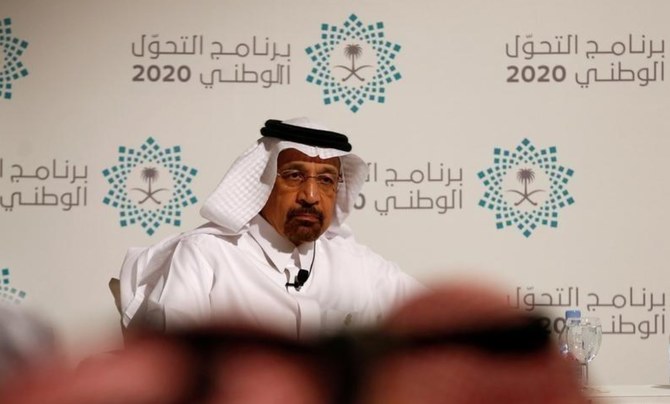

Saudi oil minister Khalid Al-Falih pledged “to do what is needed” to sustain oil market stability amid rising global trade tensions in a wide-ranging interview ahead of a key meeting of producers later this month.
After an initial positive reaction to the outcome of the recent meeting in Jeddah of the OPEC-Non-OPEC Joint Ministerial Monitoring Committee, which the Kingdom co-chairs with Russia, prices took a negative turn. Is this a sign that market fundamentals are weakening or that the effectiveness of the OPEC+ deal is gradually eroding? And if so, what are you doing about this, if anything?
Of course, the Kingdom is closely monitoring recent developments in the oil market, which exhibited an elevated level of volatility in recent weeks. And these levels are totally unwarranted in light of both the current market fundamentals, which remain healthy, and the high levels of discipline by OPEC+ producers.
I would point out that the effectiveness of OPEC+ efforts has been well-proven over the course of almost 30 months, despite facing skepticism from the onset, which gradually gave way to credibility.
And I can tell you, from consultations with my colleagues, that the 24 countries in the group remain committed to the shared objective of balancing the oil market for the benefit of producers and consumers everywhere.
In fact, there’s an emerging consensus among OPEC+ countries, to continue their work towards market stability in the second half of the year, and Saudi Arabia will surely continue to play its central role alongside its OPEC+ partners in this endeavor.
We have previously stated our commitment to do whatever it takes to stabilize markets and we have delivered on those promises.
And I am making that commitment again.
The OPEC+ Ministerial Meetings are around the corner. Given the recent price drop, will the current agreement be extended?
First, we do not target specific prices. … Prices are determined by the dynamic interaction of multiple forces, some of which are not even fundamental – such as geopolitical headlines and financial speculation.
As you can appreciate, there is a thorough process of analysis and consultation through which we make such crucial decisions.
So, when we meet in Vienna, we will review current and prospective economic and oil market conditions, and their implications for supply and demand balances, and inventory trends.
Guided by this review, we will deliberate the best course of action, and work on reaching a consensus.
And I would like to reiterate my confidence, based on my discussions with several key producers, and on our track record, that we will do what is needed to sustain market stability beyond June.
To me, that means drawing down inventories from their currently elevated levels.
How do you plan to deal with the specter of a potential full-blown trade war between the US and China threatening oil demand?
Increasing trade friction and potential barriers would certainly have a negative impact on the global economy and oil demand growth.
But the direction of the negotiations is hard to predict.
So, we intend to make our decisions based on thorough and holistic analyses. …
This includes the impact of the trade conflict on oil demand, as well as a multitude of other factors, some of which I have referred to earlier.
Ultimately, we will make our best judgment, in consultation with our partners, about the need for production changes, their magnitude, pace and timing.
But you can be sure that we will be responsive.
You will be heading to Russia in the next few days. Is the purpose of the visit to agree on actions in the upcoming OPEC+ meeting?
The collaboration between the Kingdom and Russia in our mutual efforts to stabilize global oil markets is no doubt a cornerstone of this important oil relationship.
But the Kingdom’s relationship with Russia extends beyond oil and OPEC+.
From the PIF’s collaboration with the Russian Direct Investment Fund … to industrial investments in petrochemicals in Russia and the Kingdom … to joint research in the energy field, manifested in the establishment of the Saudi Aramco research center in Moscow University … to potential wheat imports to the Kingdom.
In fact, I would emphasize that some of the premier Russian companies are considering investments in the Kingdom, as well as Aramco and SABIC are considering investments in promising gas and petrochemical projects in Russia.
For example, Russia’s largest integrated petrochemicals company, SIBUR, is exploring the construction of a $1 billion natural rubber and specialty rubber joint-venture plant in Saudi Arabia, together with Saudi Aramco and Total of France.
Also, some leading Russian energy services companies are looking to invest in the Kingdom to reach growing oil and gas markets in the region.
So, this is a relationship that has both breadth and depth and one with tremendous potential.


