

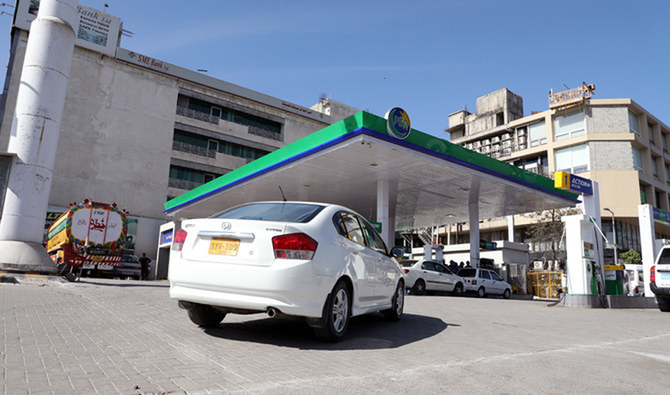

KARACHI: As the international oil market slumped over three percent this week and posted its biggest monthly drop in six months, Pakistan’s federal government on Friday increased the prices of petroleum products by 1.7 to 3.9 percent, or from Rs1.5 to 4.5 per litter, for the month of June 2019.
Pakistan’s ministry of finance also announced new prices for high-speed diesel (HSD), increasing them by 3.6 percent from Rs122.32 per litre to Rs126.82, an increase of Rs4.5 per litre.
Globally, brent futures fell $2.58, or 3.7 percent, to settle at $66.87 a barrel, while US West Texas Intermediate crude dropped $2.22, or 3.8 percent, to close at $56.59.
Inflation at its highest in more than five years has shocked many Pakistanis who voted for Prime Minister Khan and his promise to eradicate poverty, create jobs and build an Islamic welfare state. The latest price hikes are expected to keep consumers away from all but essential items as Eid-ul-Fitr rolls closer, economists have said.
Under the new price regime, the price of petrol will be increased by 3.9 percent from Rs108.42 Rs112.68 per litre; kerosene by 1.7 percent to Rs98.46 per litre from Rs96.77; and light diesel oil (LDO) by 1.9 percent to Rs88.62 per litre from Rs86.94 per litre, according to the government notification.
PM Khan, who has criticised price hikes of petrol under the previous government of Nawaz Sharif which he said was tantamount to “dropping a petrol bomb” on the public, has increased prices of petrol by Rs19.85 per litre, kerosine by Rs14.96, HSD by Rs20.25 and LDO by Rs12.66 per litre since September 2018. Khan’s government came to power in August last year.
The latest hike comes in the wake of a 13 percent general sales tax increase on petrol and high-speed diesel and 17 percent on kerosene.
On Wednesday, PM Khan faced “unprecedented economic crisis” as his government forecast growth of 4 percent for next year ahead of an austerity budget aimed at securing a $6 billion loan from the International Monetary Fund.
The new growth forecast for the fiscal year to June 2020, was approved during a meeting of the government’s National Economic Council that signed off on measures including a five-year economic plan.
The IMF agreement reached last month still requires approval from the Fund’s board in Washington but it has already stipulated that Pakistan must take painful measures to cut a fiscal deficit expected to top 7 percent of gross domestic product.
Under the IMF accord, Pakistan agreed to cut its primary budget deficit - not including interest payments - to 0.6 percent of GDP from a currently forecast 2.2 percent. With an economy of some $315 billion, that implies finding some $5 billion in extra revenue or spending cuts.
Economists say the increase in petroleum prices reflects the failure of the government to reach tax collection targets and prevent tax theft.
“The government has increased taxes on petroleum prices after falling short of tax collection target under International monetary Fund conditions to jack up revenue,” senior economist Dr Shahid Hassan Sidiqqui told Arab News on Saturday. “The expenditures of the government are also increasing.”
Siddiqui said following the price hike of petroleum products, rates of power, transportation and other utilities would also go up, fueling further inflation.
Pakistan’s inflation increased by 8.8 percent on a year-on-year basis in April, 2019 as compared to an increase of 9.4 percent in the previous month and 3.7 percent in April 2018. On a month-on-month basis, it increased by 1.3 percent in April 2019 as compared to an increase of 1.4 percent in the previous month and an increase of 1.8 percent in the corresponding month i.e. April 2018, according to the Federal Bureau of Statistics.
Consumers say they will bear the brunt of increasing prices of petroleum products.
“My salary is fixed but the price of almost everything else is going up. I am finding it extremely difficult to manage my expenditures,” security guard Ali Mehmood said.
Opposition parties have also criticized the latest hike in the rates of petroleum commodities.
“The prices of oil in international market are falling but in Pakistan they are being increased. Government’s steps are making it difficult for common citizens to live,” Shery Rehman, vice president of Pakistan People Party, said in a statement on Saturday. “It shows that the economy has been handed over to IMF.”


