Lyon bomb suspect had pledged allegiance to Daesh

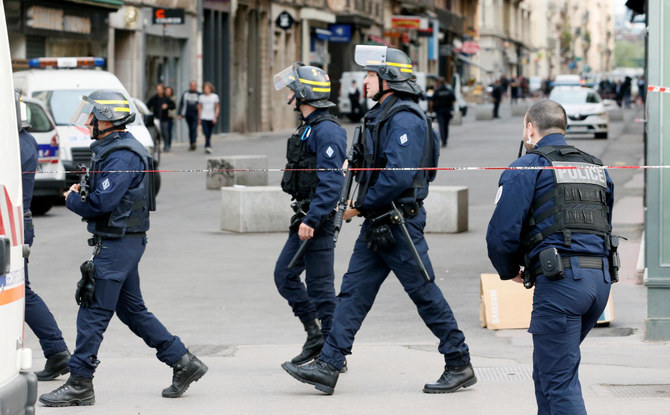
Police officers are seen near the site of a suspected bomb attack in central Lyon, France May 24, 2019. (Reuters)
Updated 31 May 2019
Follow

Lyon bomb suspect had pledged allegiance to Daesh

  • French President Emmanuel Macron had called the explosion an “attack” but no group has claimed responsibility for the explosion yet
  • France has been hit by a spate of attacks in recent years, some of them deadly, carried out by people ranging from extremist attackers to mentally unstable individuals

PARIS: The main suspect in the bombing last week in the French city of Lyon that wounded 14 people had pledged allegiance to Daesh, France’s counter-terrorism prosecutor said on Friday.
Remy Heitz said in a statement the 24-year-old man has admitted making the bomb and depositing the device in front of a bakery. He will be brought before an investigating judge.
The suspect, identified only as Mohamed Hichem M., was arrested on Monday. He arrived in France on a tourist visa in August 2017 but failed to leave again. Police did not give his nationality but some French media reported that he was Algerian. He was unknown to police services before the incident.
He could be charged with attempted murder, criminal terrorist conspiracy and manufacturing, possessing and carrying an explosive device in relation with a terrorist undertaking.
French President Emmanuel Macron had called the explosion an “attack” but no group has claimed responsibility for the explosion yet.
Last week, Heitz described video surveillance that showed a man heading toward the center of Lyon on a bike. He was seen arriving on foot, pushing his bike along a pedestrian-only street, then leaving a paper bag on a concrete block in the middle of the street. The suspect immediately returned to his bike and left the same way. One minute later, the explosion shattered the glass of a refrigerator in the bakery.
The suspect initially denied his involvement, then admitted “pledging allegiance to the IS deep down inside and dropping off the explosive device he had prepared beforehand,” Heitz said.
Data analysis of a computer used by the suspect until the end of last year also helped investigators establish he had an interest for “jihadi thesis and IS’s activities.”
The police probe also established that the suspect had ordered online a pack of 20 batteries corresponding to those that served to remotely trigger the device. Some traces found on evidence discovered at the scene also matched the suspect’s genetic profile, Heitz said.
The suspect was arrested along with his parents and brother, but they were released on Thursday without charges.
France has been hit by a spate of attacks in recent years, some of them deadly, carried out by people ranging from extremist attackers to mentally unstable individuals.


What is Trump’s ‘Board of Peace’?

Updated 6 sec ago
Follow

What is Trump’s ‘Board of Peace’?

  • The Board of Peace’s charter does not appear to limit its role to the occupied Palestinian territory of Gaza
  • Trump will be chairman but also “separately serve as inaugural representative of the United States of America”

BRUSSELS: US President Donald Trump’s government has asked countries to pay $1 billion for a permanent spot on his “Board of Peace” aimed at resolving conflicts, according to its charter seen by AFP.
The board was originally conceived to oversee the rebuilding of war-torn Gaza, but the charter does not appear to limit its role to the occupied Palestinian territory.
What exactly will it do? And who has been invited?

- To what end? -

The Board of Peace will be chaired by Trump, according to its founding charter.
It is “an international organization that seeks to promote stability, restore dependable and lawful governance, and secure enduring peace in areas affected or threatened by conflict,” reads the preamble of the charter sent to countries invited to participate.
It will “undertake such peace-building functions in accordance with international law,” it adds.

- Who’s boss? -

Trump will be chairman but also “separately serve as inaugural representative of the United States of America.”
“The Chairman shall have exclusive authority to create, modify, or dissolve subsidiary entities as necessary or appropriate to fulfill the Board of Peace’s mission,” the document states.
He will pick members of an Executive Board to be “leaders of global stature” to “serve two-year terms, subject to removal by the Chairman.”
He may also, “acting on behalf of the Board of Peace,” “adopt resolutions or other directives.”
The chairman can be replaced only in case of “voluntary resignation or as a result of incapacity.”

- Who can be a member? -

Member states have to be invited by the US president, and will be represented by their head of state or government.
Each member “shall serve a term of no more than three years,” the charter says.
But “the three-year membership term shall not apply to Member States that contribute more than USD $1,000,000,000 in cash funds to the Board of Peace within the first year of the Charter’s entry into force,” it adds.
The board will “convene voting meetings at least annually,” and “each member State shall have one vote.”
But while all decisions require “a majority of Member States present and voting,” they will also be “subject to the approval of the Chairman, who may also cast a vote in his capacity as Chairman in the event of a tie.”

- Who’s already in? -

The White House has said its members will include:
US President Donald Trump, chair
US Secretary of State Marco Rubio
Steve Witkoff, Trump’s special negotiator
Jared Kushner, Trump’s son-in-law
Tony Blair, former UK prime minister
Marc Rowan, billionaire US financier
Ajay Banga, World Bank president
Robert Gabriel, loyal Trump aide on the National Security Council

- Who’s been invited? -

The list of countries and leaders who say they have been invited include, but are not limited to:
Russia’s President Vladimir Putin
Canada’s Prime Minister Mark Carney
Egypt’s President Abdel Fattah El-Sisi
Argentina’s President Javier Milei
Jordan
Brazil
Paraguay
India
Pakistan
Germany
France
Italy
Hungary
Romania
Uzbekistan
Belarus
Greece
Morocco
Slovenia
Poland

- When does it start? -

The charter says it enters into force “upon expression of consent to be bound by three States.”