Lyon bomb suspect had pledged allegiance to Daesh

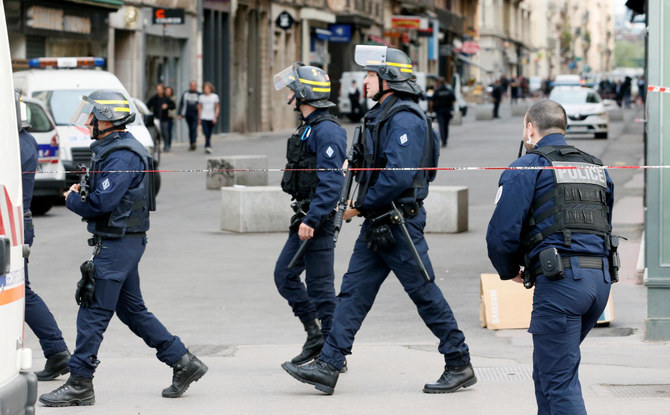
Police officers are seen near the site of a suspected bomb attack in central Lyon, France May 24, 2019. (Reuters)
Updated 31 May 2019
Follow

Lyon bomb suspect had pledged allegiance to Daesh

  • French President Emmanuel Macron had called the explosion an “attack” but no group has claimed responsibility for the explosion yet
  • France has been hit by a spate of attacks in recent years, some of them deadly, carried out by people ranging from extremist attackers to mentally unstable individuals

PARIS: The main suspect in the bombing last week in the French city of Lyon that wounded 14 people had pledged allegiance to Daesh, France’s counter-terrorism prosecutor said on Friday.
Remy Heitz said in a statement the 24-year-old man has admitted making the bomb and depositing the device in front of a bakery. He will be brought before an investigating judge.
The suspect, identified only as Mohamed Hichem M., was arrested on Monday. He arrived in France on a tourist visa in August 2017 but failed to leave again. Police did not give his nationality but some French media reported that he was Algerian. He was unknown to police services before the incident.
He could be charged with attempted murder, criminal terrorist conspiracy and manufacturing, possessing and carrying an explosive device in relation with a terrorist undertaking.
French President Emmanuel Macron had called the explosion an “attack” but no group has claimed responsibility for the explosion yet.
Last week, Heitz described video surveillance that showed a man heading toward the center of Lyon on a bike. He was seen arriving on foot, pushing his bike along a pedestrian-only street, then leaving a paper bag on a concrete block in the middle of the street. The suspect immediately returned to his bike and left the same way. One minute later, the explosion shattered the glass of a refrigerator in the bakery.
The suspect initially denied his involvement, then admitted “pledging allegiance to the IS deep down inside and dropping off the explosive device he had prepared beforehand,” Heitz said.
Data analysis of a computer used by the suspect until the end of last year also helped investigators establish he had an interest for “jihadi thesis and IS’s activities.”
The police probe also established that the suspect had ordered online a pack of 20 batteries corresponding to those that served to remotely trigger the device. Some traces found on evidence discovered at the scene also matched the suspect’s genetic profile, Heitz said.
The suspect was arrested along with his parents and brother, but they were released on Thursday without charges.
France has been hit by a spate of attacks in recent years, some of them deadly, carried out by people ranging from extremist attackers to mentally unstable individuals.


Trump says he asked Putin not to target Kyiv for 1 week during brutal cold spell

Updated 7 sec ago
Follow

Trump says he asked Putin not to target Kyiv for 1 week during brutal cold spell

  • “I personally asked President Putin not to fire on Kyiv and the cities and towns for a week during this ... extraordinary cold,” Trump said
  • Zelensky, for his part, thanked Trump for his effort and welcomed the “possibility” of a pause

KYIV: US President Donald Trump said Thursday that President Vladimir Putin has agreed not to target the Ukrainian capital and other towns for one week as the region experiences frigid temperatures.
There was no immediate confirmation from the Kremlin that Putin has agreed to such a pause.
Russia has been pounding Ukraine’s critical infrastructure, hoping to wear down public resistance to the war while leaving many around the country having to endure the dead of winter without heat.
“I personally asked President Putin not to fire on Kyiv and the cities and towns for a week during this ... extraordinary cold,” Trump said during a Cabinet meeting at the White House, adding that Putin has “agreed to that.”
Kremlin spokesman Dmitry Peskov was asked earlier Thursday whether a mutual halt on strikes on energy facilities was being discussed between Russia and Ukraine, and he refused to comment on the issue.
Ukrainian President Volodymyr Zelensky late Wednesday had warned that Moscow was planning another large-scale barrage despite plans for further US-brokered peace talks at the weekend.
Trump said he was pleased that Putin has agreed to the pause. Kyiv, which has grappled with severe power shortages this winter, is forecast to enter a brutally cold stretch starting Friday that is expected to last into next week. Temperatures in some areas will drop to minus 30 degrees Celsius (minus 22 Fahrenheit), the State Emergency Service warned.
“A lot of people said, ‘Don’t waste the call. You’re not going to get that.’” the Republican US president said of his request of Putin. “And he did it. And we’re very happy that they did it.”
Zelensky, for his part, thanked Trump for his effort and welcomed the “possibility” of a pause in Russian military action on Kyiv and beyond. “Power supply is a foundation of life,” Zelensky said in his social media post.
Trump did not say when the call with Putin took place or when the ceasefire would go into effect. The White House did not immediately respond to a query seeking clarity about the scope and timing of the limited pause in the nearly four-year war.
Russia has sought to deny Ukrainian civilians heat and running water over the course of the war, which began with Russia’s full-scale invasion on Feb. 24, 2022. Ukrainian officials describe the strategy as “weaponizing winter.”
Last year was the deadliest for civilians in Ukraine since 2022 as Russia intensified its aerial barrages behind the front line, according to the UN Human Rights Monitoring Mission in the country.
The war killed 2,514 civilians and injured 12,142 in Ukraine — 31 percent higher than in 2024, it said.