

‘Unite against terror,’ Organization of Islamic Cooperation forum told

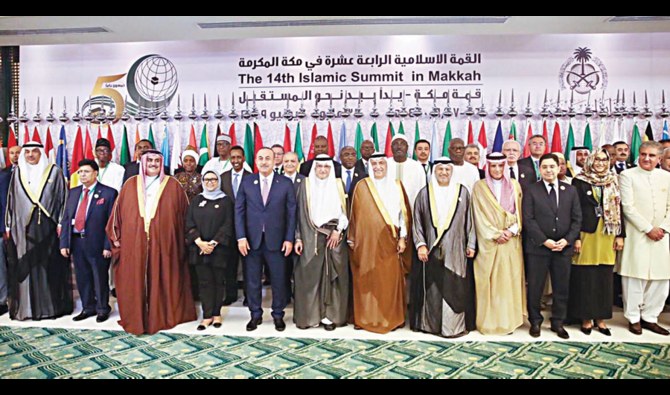
Arab and Islamic states foreign ministers gather for a group photo ahead of the Islamic Summit Conference, which begins in Makkah on Friday. (SPA)
Updated 31 May 2019
Follow

‘Unite against terror,’ Organization of Islamic Cooperation forum told

  • Al-Assaf said that the conflict with Israel remains the most important challenge facing the Islamic world

JEDDAH: The preparatory meeting of foreign ministers of member states of the Organization of Islamic Cooperation (OIC) kicked off in Jeddah on Wednesday under the chairmanship of Foreign Minister Ibrahim Al-Assaf.

The meeting, which coincides with the OIC’s 50th anniversary, is in preparation for the 14th ordinary session of the Islamic Summit Conference, which will begin in Makkah on Friday under the banner “Makkah Summit: Hand in Hand Toward the Future.”

In his opening address, Al-Assaf said the Islamic world faces extremely dangerous challenges and changes, including interference in the internal affairs of countries, rising numbers of refugees and displaced people, and the spread of terrorism, extremism and sectarianism.

Countries need to take a serious stand and study the issues from all sides, adopting the best possible approach to dealing with them through a unified position and efforts, he said.

Al-Assaf said that the conflict with Israel remains the most important challenge facing the Islamic world.

The Palestinian cause is the “first issue” of Saudi Arabia, he said, in particular the regaining of Palestinian people’s full legitimate rights and the establishment of an independent state with East Jerusalem (Al-Quds) as its capital in accordance with international resolutions and the Arab peace initiative backed by the decisions of consecutive Arab and Islamic summits.

“The international community must shoulder its political and moral responsibility to achieve this,” he said.

Al-Assaf said that the Kingdom attaches great importance to stability in Yemen and condemns a continuing coup by Iranian-backed Houthi militias against the legitimate authority, which is “a clear example of Iran’s continued interference in the internal affairs of countries, which must be rejected by OIC, as it is contrary to its charter and international charters.”

He also affirmed the Kingdom’s stand with Sudan and support for the transitional military leadership, along with measures taken in the interest of the Sudanese people.

The Kingdom backs sincere efforts to find a political solution that will preserve the unity and institutions of Syria and end the presence of sectarian terrorist groups, based on the Geneva outcomes, statements of the International Syria Support Group and relevant Security Council resolutions, Al-Assaf said.

He also affirmed the Kingdom’s firm support for the sovereignty and unity of Libya, its territorial integrity and the rejection of foreign interference, calling on all parties in the country to unite, block and fight terrorist groups.

In his speech, Yousef Al-Othaimeen, secretary-general of the OIC, expressed his gratitude to King Salman and Crown Prince Mohammed bin Salman for Saudi Arabia hosting the summit and its preparatory meetings.

Al-Othaimeen also praised Saudi Arabia’s support for the OIC and its generous contributions in serving Islamic causes.

He extended his thanks to Turkey for its hosting of the 13th summit and the outcome of the forum.

“There is no doubt that the unfortunate developments witnessed by some member states, and the deterioration of the security and humanitarian situation in some member states where there are conflicts urge us to intensify our discussions, and increase our efforts to establish security and peace in our region so as to ensure justice, decent life, development for present and future generations,” he said

“These unprecedented current developments in our modern history should in no way distract our attention from our central cause, the Palestinian issue,” he said.

Israeli policies and disregard for international legitimacy resolutions call for the OIC to further coordinate efforts to press for a global position toward consolidating peace, and put an end to the Israeli occupation and the suffering of the Palestinian people.

The OIC is closely following the situations in Yemen, Somalia, Libya, Syria, Afghanistan, Iraq, Mali, Sudan, Algeria, Guinea, Nigeria, Niger, Sierra Leone, Cote d’Ivoire, Djibouti, the Comoros and Central Africa along with others, he said.

“We are following with deep concern the bloody events against the security of the people of Jammu and Kashmir, the developments in the Nagorno-Karabakh region, the conditions of the Rohingya, the Muslim peoples of Turkish Cyprus, Bosnia and Kosovo and the situation of Muslim societies in the rest of the world,” he said.

Al-Othaimeen said that extremism and terrorism remain one of the greatest threats to the region’s security and stability, and to the whole world.

“Extremism and terrorism are aimed at undermining the cohesion of our societies, disrupting our member states’ growth, and depleting their energies and capabilities,” he said.

“Considering the dangers of these evil factors, we reaffirm the importance of coordinating our efforts in combating all forms of terrorism, in accordance with a comprehensive strategy that takes into account all the security, economic, cultural, social and intellectual dimensions associated with terrorism and extremism and the ways promoting for them or even leading to them.

“All in all, for our countries to avoid the risks of extremism and terrorism, we have to earnestly join hands to confront these evil acts.

“This can be achieved only in a framework of effective cooperation and solidarity among all Muslim countries, drawing on their noble values, strong civilizational ties and common interests,” he said.

He added that the convening of the Islamic summit during the holy month of Ramadan and on this holy land reflect Saudi Arabia’s concern for cooperation and coordination with the rest of the Islamic states to achieve these goals and to advance the reality of our Islamic world and put it in a place it deserves.

Pakistan’s Foreign Minister, Shah Mehmood Qureshi, told Arab News that his country’s message to the summit is that Muslims “should join hands, understand their individual concerns, and have a collective objective of peace and stability so that our region can develop like other developed part of the world.

“By not joining hands, how are we going to achieve what we want to achieve, if we do not sit and resolve our issues through diplomatic means? We should keep on joining hands as that is the only way forward,” he said.


Saudi House kicks off Davos with push on Vision 2030, AI platform and ‘humanizing’ tourism

At Saudi House, ministers and executives set out how the Kingdom sees the next phase of its transformation. (Supplied)
Updated 20 January 2026
Follow

Saudi House kicks off Davos with push on Vision 2030, AI platform and ‘humanizing’ tourism

  • Saudi ministers dominate pre-summit spotlight at Saudi pavilion, touting Vision 2030’s next phase and human capital as key to global edge
  • Ministry of Economy and Planning announced the SUSTAIN Platform which aims to accelerate AI-enabled, cross-sector collaboration for sustainable development

DAVOS: For regulars at the World Economic Forum, Monday in Davos is usually a chance to ease into the week, a time to reconnect, plan meetings and prepare for the intense schedule ahead.

This year, Saudi Arabia moved quickly to fill that lull, taking center stage with a packed program of panels ahead of Tuesday’s official opening.

At the Saudi House — the Kingdom’s official pavilion on the Promenade, returning after its debut as a standalone venue at the 2025 WEF Annual Meeting — Saudi ministers and global executives set out how the Kingdom sees the next phase of its transformation.

Monday’s speakers at the Saudi House included Minister of Finance Mohammed Al-Jadaan, Minister of Investment Khalid Al-Falih, Minister of Tourism Ahmed Al-Khateeb, and President and Vice Chairman of Meta Dina Powell McCormick. (Supplied)

Established by the Ministry of Economy and Planning, the venue is pitched as a platform for international thought leaders to tackle the challenges, opportunities and solutions shaping the global economy.

Opening a session on the Kingdom’s role at this year’s Forum and the next phase of Vision 2030 — now in its 10th year and roughly two-thirds complete — Princess Reema bint Bandar, Saudi Arabia’s ambassador to the US, said human capital “is the actual driver if you want a competitive, modern economy.”

She described one of the biggest achievements of the past decade as the emergence of a highly qualified cohort of young Saudis who could work anywhere in the world but “choose to come home, choose to build at home and choose to deliver at home,” calling this “the biggest symbol of the success of Vision 2030.”

Who can give you optimum access to opportunities while addressing risks? I contend that Saudi Arabia has been able to provide that formula.

Khalid Al-Falih, Saudi minister of investment

On the same panel, Minister of Finance Mohammed Aljadaan said this success is rooted in a “behavioral change” that has strengthened the Kingdom’s credibility with both international partners and its own citizens.

“Credibility comes from being very pragmatic, making sure that you maintain your fiscal policy discipline, but at the same time refocus your resources where it matters,” he said, warning that “markets will call your bluff if you’re not serious.”

The Saudi House, a cross-ministerial initiative led by the Ministry of Economy and Planning, is intended to underscore the Kingdom’s “commitment to global cooperation” by offering “a platform where visionary ideas are shared and shaped,” while showcasing opportunities and lessons from its “unprecedented national transformation.”

Lubna Olayan, Chair of the Corporate Board, Olayan Group

Echoing earlier comments to Arab News, Economy and Planning Minister Faisal Alibrahim said the Kingdom’s role as an anchor of stability has helped unlock its potential, stressing that while the objective is to decouple from reliance on a single commodity, “2030 is not the finishing line.”

Khalid Al-Falih, Saudi minister of investment, said Saudi Arabia has been able to enable access to opportunities while addressing major risks, arguing that few countries can match the Kingdom’s overall mix.

“No country has all of those to 100 percent,” he said. “But who can give you the mix that gives you optimum access to opportunities while addressing all of those risks?

Dr. Bedour Alrayes, Deputy CEO, Human Capability Development Program, Saudi Arabia

“I contend that Saudi Arabia has been able to provide that formula and the proof is in the pudding,” noting that local investment has doubled in recent years to reach levels comparable with India and China.

While societal transformation dominated the morning discussions, the afternoon turned to technology, tourism, sport and culture, four strategic sectors expected to spearhead Vision 2030’s next phase.

The Ministry of Economy and Planning used the day to announce the SUSTAIN Platform, due to launch in 2026, which aims to accelerate AI-enabled, cross-sector collaboration for sustainable development.

The ministry said SUSTAIN will translate the Kingdom’s public and private-sector coordination mandate into a practical national tool to help government entities, businesses, investors, academia and civil society identify credible partners, form trusted coalitions and move initiatives “from planning to implementation more efficiently,” addressing a global challenge where fragmented partnerships often slow delivery and blunt impact.

“We are in a moment in time where technology may well impact the face of humanity,” said Dina Powell McCormick, recently appointed president and vice chairman of Meta, welcoming the Kingdom’s “desire” to partner with technology companies and its embrace of innovation.

Minister of Tourism Ahmed Alkhateeb, discussing how technology is being deployed in his sector, underlined that “in travel and tourism, people are very important. We learn about other people’s culture through interacting with people. We digitalize the unnecessary and humanize the necessary.”

He added that while technological transformation is a priority, “we don’t want to replace this big workforce with technology. I think we need to protect them in Saudi Arabia, where we’re being a model. I’m an advocate of keeping the people.”

Throughout the week, Saudi House will host more than 20 sessions, including over 10 accredited by the WEF, across six themes: Bold Vision, Insights for Impact, People and Human Capability, Quality of Life, Investment and Collaboration, and Welcoming the World.

The pavilion will also launch “NextOn,” a new series of influential and educational talks featuring leading global voices.