

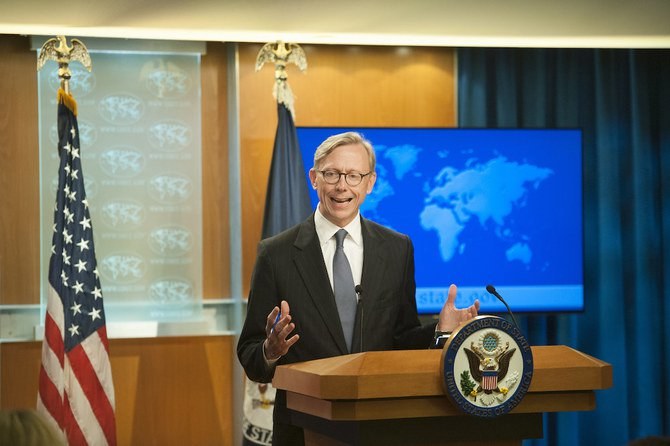

DUBAI: Iran needs to show more interest in talks than threats, a senior advisor to the US Secretary of State has said, adding that the US will respond with “military might” if its interests were attacked.
Brian Hook, the US Special Representative for Iran and Senior Policy Advisor to the Secretary of State, said a number of “military assets” had already been repositioned in response to intelligence that Iran was planning imminent attacks against American interests.
“We have made it clear that we will respond with military force if American interests are attacked by Iran,” Hook said at a press briefing on Thursday.
He said the US was awaiting the results of the investigations into the recent attacks on UAE, Saudi and Norwegian tankers in the region and said a “proper response” would then be discussed.
“We have been consistent in our messaging – Iran should show more of an interest in talks than threats and we have seen on an almost daily basis from the Iranian regime that they will not talk with the United States.”
“Iran faces a choice – they have to decide whether they want to be a normal country or a revolutionary cause,” he warned.
Hook said President Trump was open to negotiations, but he added that the US “maximum pressure campaign” was working “by nearly every measure.”
“The Iranian regime and its proxies are weaker today than when the (US) president took office over two years ago,” he explained.
Already, he said, Hezbollah’s leader Hassan Nasrallah had made a public call for support – “piggy banks have been placed in grocery stores in Lebanon to help raise funds,” while Hamas has enacted austerity plans to deal with a lack of funds from Iran.
He said Iran’s Shiite militia groups would have to “find new sources of revenue.”
And he said that the Assad regime today faced a fuel shortage crisis because the US had cut off the 1–3 million barrels per month that Iran had previously supplied.
Even Iran’s military spending has been cut, he said, adding that it peaked during the nuclear deal.
“Since we exited the deal, Iran’s military spending for the budget that they released in March was cut by 28 percent.”
He said Iran was in recession and once the US oil sanctions take full effect, with a policy of zero imports for Iranian crude oil – the sanctions will deny the Iranian regime $50 billion in revenue - that’s 40 percent of Iran’s annual budget.
Trump also said on Thursday that Iran’s economy is suffering from US sanctions and that the country is becoming a “weakened nation.”


