Tiny Irish village to welcome Trump with pride, not protest

1 / 7
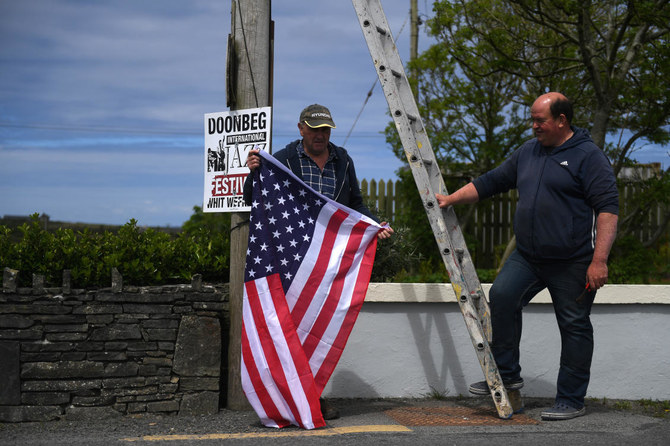
Tommy Haugh and Danny Buckley carry a ladder and a US flag to festoon the streets of Doonbeg village ahead of a visit by US President Donald Trump to his golf course in the County Clare village of Doonbeg, Ireland. (Reuters)
2 / 7
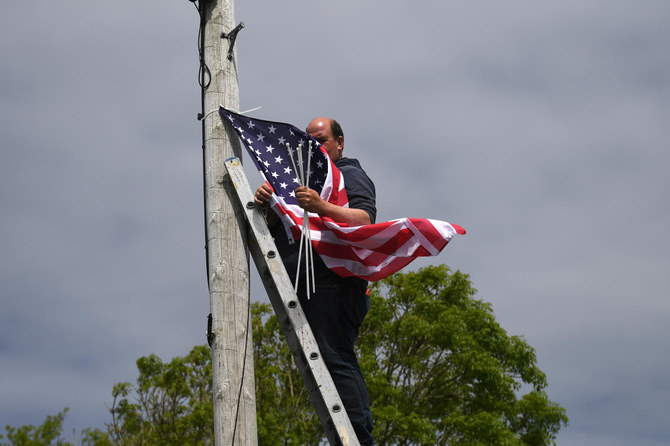
Danny Buckley places a US flag on an electricity pole to festoon the streets of Doonbeg village ahead of a visit by US President Donald Trump to his golf course in the County Clare village of Doonbeg, Ireland. (Reuters)
3 / 7
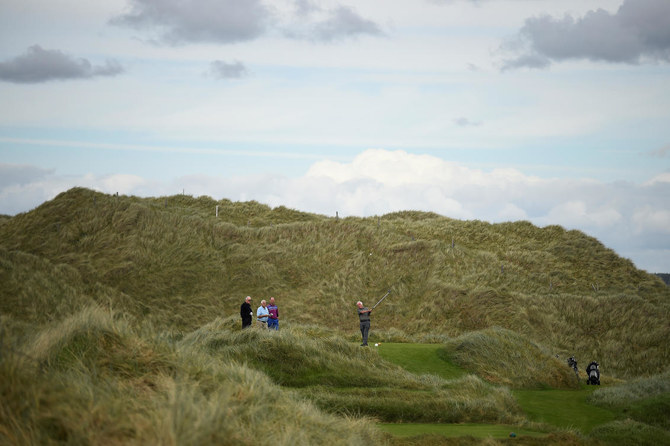
People play golf at US President Donald Trump’s Doonbeg Golf club with eroding sand dunes at the front of it ahead of his visit to the County Clare village of Doonbeg, Ireland. (Reuters)
4 / 7
Publican Tommy Tubridy helps to put up stars and stripes bunting to festoon the streets of Doonbeg village with U.S. colours ahead of a visit by U.S. President Donald Trump to his golf course in the County Clare village of Doonbeg, Ireland. (Reuters)
5 / 7
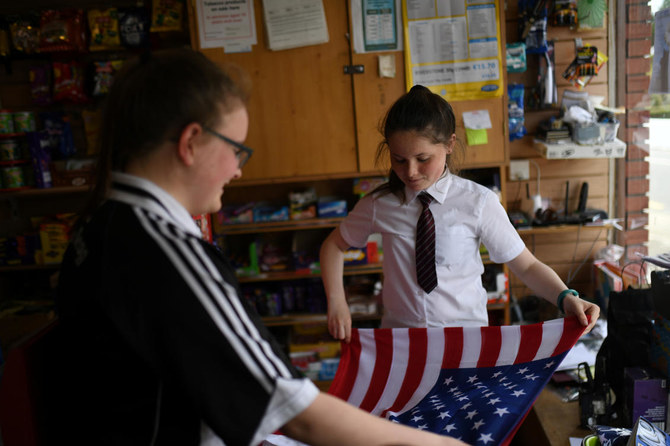
Emma Hayes, 13, and Anna Keane, 13, are seen in the local shop as they fold a U.S. flag that they will put outside the shop ahead of a visit by U.S. President Donald Trump to his nearby golf course in the County Clare village of Doonbeg, Ireland. (Reuters)
6 / 7
People play golf amongst the dunes on U.S. President Donald Trump's Doonbeg Golf course ahead of his visit to the County Clare village of Doonbeg, Ireland. (Reuters)
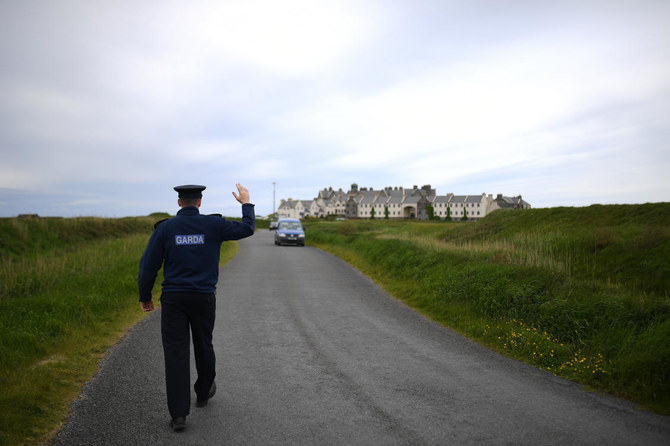
7 / 7
A member of An Garda Siochana (Irish Police officer) stops traffic at US President Donald Trump’s Doonbeg golf course for security checks ahead of an upcoming visit to his golf course in the County Clare village of Doonbeg, Ireland. (Reuters)
Updated 29 May 2019
Follow

Tiny Irish village to welcome Trump with pride, not protest

  • In Doonbeg, where residents credit Trump with securing their livelihoods when he bought the nearby golf resort five years ago, the tiny village is being decked out in American flags
  • Trump is expected to stay in his hotel for at least one night on June 5 in between visits to Britain and France, with security already stepped up in the area

DOONBEG, Ireland: In a small corner of Ireland’s west coast Donald Trump means jobs. And the locals are getting ready to line the street with the Stars and Stripes to express their gratitude when he visits next week.
Like in Britain, where Trump has been promised demonstrations on his first European stop, a number of Irish groups have called on people to protest against the president’s policies on issues such as immigration and climate change.
But in Doonbeg, where residents credit Trump with securing their livelihoods when he bought the nearby golf resort five years ago, the tiny village is being decked out in American flags and bunting in advance of his visit.
“There are over 300 employed here because of him, what else is around here?” Joe Pender said, as he and fellow locals Tommy Haugh and Danny Buckley were hanging flags from every lamppost in the one-street village.
“If we didn’t have the hotel, we’d have nothing here. It’d be a ghost town.”
Trump is expected to stay in his hotel for at least one night on June 5 in between visits to Britain and France, with security already stepped up in the area.
Pender, 60, remembers feeding cattle in the green fields where the Greg Norman-designed golf course was built in 2002 during Ireland’s “Celtic Tiger” boom years, promising to transform the local area.
He worked for the previous owners who placed the resort into receivership when Ireland’s boom turned to a spectacular bust a decade ago and unemployment in the region rocketed above 16 percent.
Trump, like many foreign investors, saw a potential bargain in Ireland and reaped the benefits as the economy grew faster than any other in Europe for five straight years, unemployment fell back below 5 percent and record numbers of tourists flocked to spots like Doonbeg, which overlooks the Atlantic Ocean.
“Nobody is perfect but if any place had what we had, they’d be on top of the world. He’s put bread and butter on the table,” said local priest Father Joe Haugh who, at the age of 87, still enjoys a round of golf — free of charge.
It is a top class course, according to Haugh, who is also flying an American flag outside his church for the visit.
But while Barack Obama was met by cheering crowds and struck public relations gold by sharing a Guinness with a distant cousin during the last presidential visit to Ireland in 2011, Trump should not expect a similar reception outside Doonbeg.
Irish Prime Minister Leo Varadkar opposed extending an invitation to Trump as a cabinet minister before changing his mind. He will meet the president at Shannon Airport, where a previous ministerial colleague was criticized by opposition politicians for greeting Trump on a red carpet on his last visit, as an investor, in 2014, before he was elected president.
Trump’s fans in Doonbeg are aware that he is a divisive figure, but it is still very difficult to find any among its population of 200 who will say a bad word against him.
“He has his own past but we didn’t elect the man. If our president went abroad and wasn’t welcomed, we’d be very upset. It’s courtesy,” said Ita Comerford, whose family have lived in the village for four generations.
Michael and Theresa McDermott, whose idyllic house overlooks the golf course, are in the security “red zone” and while they have identity passes to come and go next week, the one thing they cannot find is a US flag. The local shop is sold out.
With a night of Irish dancing and entertainment planned in the village while Trump is in town, local restaurant owner and publican Tommy Tubridy has been perfecting his Guinness pours, using careful tap skills to create the letters “T-R-U-M-P” in the creamy foam of the pint, just in case they get a visit.
“He’s a man that pulls a lot of surprises so you’d never know, he could pop down,” said Tubridy, who credits the hotel with keeping Doonbeg’s five pubs in business and even bringing home some of its emigrants hopeful of getting work again.
“He’s a non drinker though so he’d probably have a glass of the local spring water and that’d be grand.”


Blacklisted naphtha tanker from Russia enters Venezuelan waters while another diverts, ship data shows

Updated 56 min 28 sec ago
Follow

Blacklisted naphtha tanker from Russia enters Venezuelan waters while another diverts, ship data shows

  • Under U.S. sanctions related to Russia, the ship has a different sanctions profile than Skipper, the tanker that was seized by the U.S. on December 10

HOUSTON: A tanker subject to U.S. sanctions carrying some 300,000 barrels of naphtha from Russia entered Venezuelan waters late ​on Thursday, while another began redirecting course in the Atlantic Ocean, ship tracking data showed, a reflection of diverging last-minute decisions by ship owners after President Donald Trump ordered a "blockade" of oil tankers under sanctions bound for the OPEC country earlier this week.
The move ramped up pressure on Venezuelan president Nicolas Maduro by targeting the country's main source of income and followed the seizure by the U.S. of an oil tanker off the coast of Venezuela earlier in December.
Vessels that were not subject to sanctions began setting sail on Wednesday from Venezuelan waters after a week's pause, helping drain the country's mounting crude stocks.

HIGHLIGHTS

• Trump's 'blockade' aims to halt sanctioned oil tankers to Venezuela

• Hyperion's sanctions profile differs from seized Skipper tanker

• Venezuela condemns US actions as violating international law

Gambia-flagged medium tanker Hyperion docked on Friday at Amuay ‌Bay on Venezuela's ‌western coast, according to LSEG ship tracking data. It loaded near ‌Murmansk ⁠in ​Russia in ‌late November.
Under U.S. sanctions related to Russia, the ship has a different sanctions profile than Skipper, the tanker that was seized by the U.S. on December 10.
The U.S. can only seize vessels outside of its jurisdiction, or vessels that aren't heading to or from the country, if Washington has placed them under sanctions for links to groups it designates as terrorist, said David Tannenbaum, a director at consulting firm Blackstone Compliance Services that specializes in sanctions and anti-money laundering compliance.
Skipper, formerly called the Adisa, was under sanctions for what the U.S. says was involvement in Iranian oil trading that generated ⁠revenue for Iranian groups it has designated as foreign terrorist organizations.
With the Hyperion, though, sanctions were imposed to reduce Russian revenues from energy because of ‌its war with Ukraine.
"The Hyperion doesn't have known ties to ‍terrorism, and therefore unless they can prove it's subject ‍to the jurisdiction of the U.S., Washington can't grab it extraterritorially," said Tannenbaum, who previously worked with the ‍U.S. Treasury's Office of Foreign Assets Control that administers and enforces economic and trade sanctions.

REDIRECTS AND U-TURNS
The Angola-flagged Agate, another medium tanker under sanctions that loaded in Russia and had been sailing toward the Caribbean, was seen redirecting on Friday, according to LSEG ship tracking. The vessel was pointing towards Africa, but had not yet signaled a new destination.
Oman-flagged Garnet, also under sanctions ​and loaded in Russia, continued on its track, signaling the Caribbean as its destination on Friday.
Benin-flagged tanker Boltaris, under sanctions and carrying some 300,000 barrels of Russian naphtha bound for Venezuela, made ⁠a U-turn earlier this month and was heading for Europe without having discharged, according to LSEG vessel monitoring data.
Two very large crude carriers not subject to sanctions set sail for China on Thursday from Venezuela, according to sources familiar with Venezuela's oil export operations, marking only the second and third tankers unrelated to Chevron to depart the country since the U.S. seized Skipper.
The American oil major, which has continued to ship Venezuelan crude under a U.S. authorization, exported a crude cargo on Thursday bound for the U.S., LSEG data showed.
Secretary of State Marco Rubio on Friday said the U.S. was not concerned about the four vessels that sailed from Venezuela on Thursday, as those were not ships under sanctions.
"Sanctioned boats, we have the capabilities necessary to enforce our laws. We'll have a judicial order, we'll execute on those orders and there's nothing that will impede us from being able to do that," Rubio said.
Venezuela's government ‌called Trump's blockade a "grotesque threat" in a statement on Tuesday, saying it violates international law, free commerce and the right of free navigation.