

In makeshift homes, Rohingya recall Ramadan in Myanmar

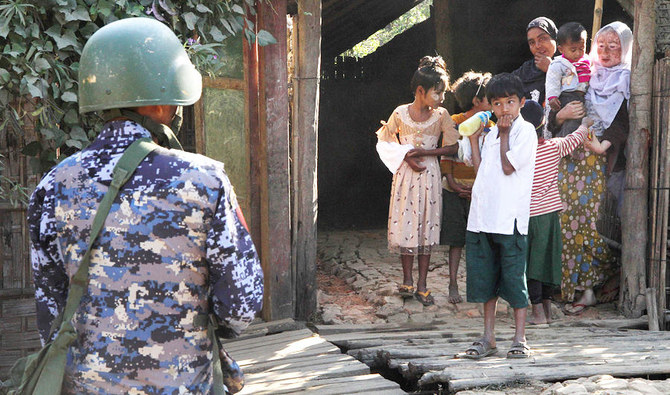
A Myanmar border guard policeman stand near a Rohingya Muslim family in front of their home in a village during a government-organized visit for journalists in Buthidaung townships in the restive Rakhine state on January 25, 2019. (AFP)
Updated 29 May 2019
Follow

In makeshift homes, Rohingya recall Ramadan in Myanmar

  • More than 1.1 million Rohingya are currently lodged at various refugee camps, with nearly 750,000 taking shelter in Bangladesh since August 2017 when the violence escalated in the northern Myanmar province of Rakhine

DHAKA: 
For the past two years, during Ramadan, an overwhelming sadness takes over 15-year-old Ahmed Kamal, a Rohingya refugee at the Cox’s Bazar camp in Bangladesh.
He says it is at this time, specifically during iftar, that he misses his mother, Halima Begum, the most.
Begum was brutally killed in September 2017 by the Myanmar army during a crackdown on thousands of Rohingya — many of whom fled to Bangladesh to escape the persecution.
“My mother used to prepare so many homemade foods during iftar and we all used to enjoy it. But everything is lost now,” Kamal told Arab News.
For many of the Rohingya living at Cox’s Bazar, Ramadan brings with it a sense of nostalgia and memories of days well spent.
“We used to have a get-together with relatives during Ramadan at our home in Mongdu township. All year, I used to wait for this Ramadan get-together with our maternal cousins, grandparents and uncles,” Saleha Khatun, a 13-year-old refugee girl from Kutupalang Rohingya camp, said.
“Some of our relatives were killed in September 2017, a few of them stayed in Rakhine and some fled to Cox’s Bazar. Our greater family is now completely scattered and I miss my relatives a lot in this Ramadan month,” she added.
More than 1.1 million Rohingya are currently lodged at various refugee camps, with nearly 750,000 taking shelter in Bangladesh since August 2017 when the violence escalated in the northern Myanmar province of Rakhine. For most of the Rohingya, this is their second Ramadan in Bangladesh since the great exodus.

BACKGROUND

• World Food Program steps up free food initiative for the displaced this month.

• More than 1.1 million living in world’s largest refugee camp in Bangladesh.

“Last year we didn’t get enough food for iftar to break the fast. Sometimes we had to drink only water but this year there is enough — we have received food from the World Food Program (WFP),” Rashid Khan, a refugee from Balukhali camp, told Arab News.
The WFP also distributed dates to families in refugee camps specifically for Ramadan, which were donated by Qatar.
Gemma Snowdon, the WFP’s communications officer at Cox’s Bazar, told Arab News: “We have scaled up our e-voucher food assistance system in time for Ramadan, which means families have access to a wider range of food. Using an electronic card, families can shop at one of the WFP e-voucher outlets in the camps, and access things such as fresh fruit and vegetables, eggs, dried fish, spices, and the usual staples.”
She added that the program gave the Rohingya a greater range of choice for Ramadan, as opposed to basic rice, lentils and oil they were previously receiving. There are also special offers on food from retailers who operate the WFP e-voucher outlets so people can receive more than they usually do.
“We believe quality food assistance needs to extend beyond just Ramadan, and for us to do this we rely on the generous support provided by donors around the globe,” said Snowdon.


Uganda army denies seizing opposition leader as vote result looms

Updated 5 sec ago
Follow

Uganda army denies seizing opposition leader as vote result looms

KAMPALA: Uganda’s army denied claims on Saturday that opposition leader Bobi Wine had been abducted from his home, as counting continued in an election marred by reports of at least 10 deaths amid an Internet blackout.
President Yoweri Museveni, 81, looked set to be declared winner and extend his 40-year rule later on Saturday, with a commanding lead against Wine, a former singer turned politician.
Wine said Friday that he was under house arrest, and his party later wrote on X that he had been “forcibly taken” by an army helicopter from his compound.
The army denied that claim.
“The rumors of his so-called arrest are baseless and unfounded,” army spokesman Chris Magezi told AFP.
“They are designed to incite his supporters into acts of violence,” he added.
AFP journalists said the situation was calm outside Wine’s residence early Saturday, but they were unable to contact members of the party due to continued communications interruptions.
A nearby stall-owner, 29-year-old Prince Jerard, said he heard a drone and helicopter at the home the previous night, with a heavy security presence.
“Many people have left (the area),” he said. “We have a lot of fear.”
With more than 80 percent of votes counted on Friday, Museveni was leading on 73.7 percent to Wine’s 22.7, the Electoral Commission said.
Final results were due around 1300 GMT on Saturday.
Wine, 43, whose real name is Robert Kyagulanyi, has emerged as the main challenger to Museveni in recent years, styling himself the “ghetto president” after the slum areas where he grew up in the capital, Kampala.
He has accused the government of “massive ballot stuffing” and attacking several of his party officials under cover of the Internet blackout, which was imposed ahead of Thursday’s polls and remained in place on Saturday.
His claims could not be independently verified, but the United Nations rights office said last week that the elections were taking place in an environment marked by “widespread repression and intimidation” against the opposition.

- Reports of violence -

Analysts have long viewed the election as a formality.
Museveni, a former guerrilla fighter who seized power in 1986, has total control over the state and security apparatus, and has ruthlessly crushed any challenger during his rule.
Election day was marred by significant technical problems after biometric machines — used to confirm voters’ identities — malfunctioned and ballot papers were undelivered for several hours in many areas.
There were reports of violence against the opposition in other parts of the country.
Muwanga Kivumbi, member of parliament for Wine’s party in the Butambala area of central Uganda, told AFP’s Nairobi office by phone that security forces had killed 10 of his campaign agents after storming his home.