

Gaza’s Omari Grand Mosque: A combination of civilizations

1 / 4
The Omari mosque. (Photo/Supplied)
2 / 4
The Omari mosque. (Photo/Supplied)
3 / 4
The Omari mosque. (Photo/Supplied)
4 / 4
The Omari mosque. (Photo/Supplied)
Updated 29 May 2019
Follow

Gaza’s Omari Grand Mosque: A combination of civilizations

  • It was the first mosque to perform Friday prayers in Gaza after the Islamic conquest

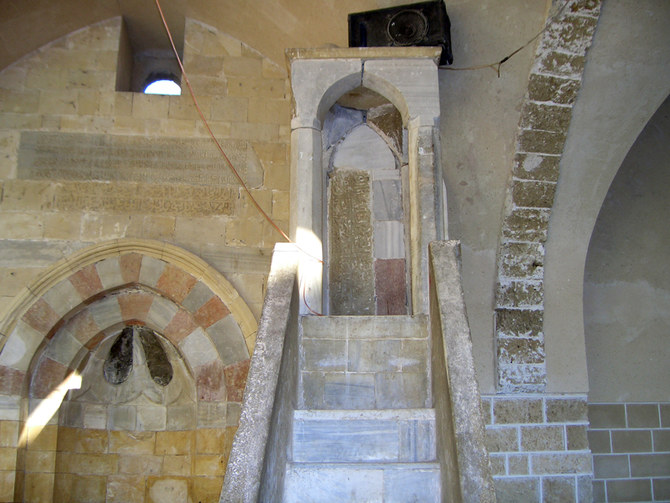
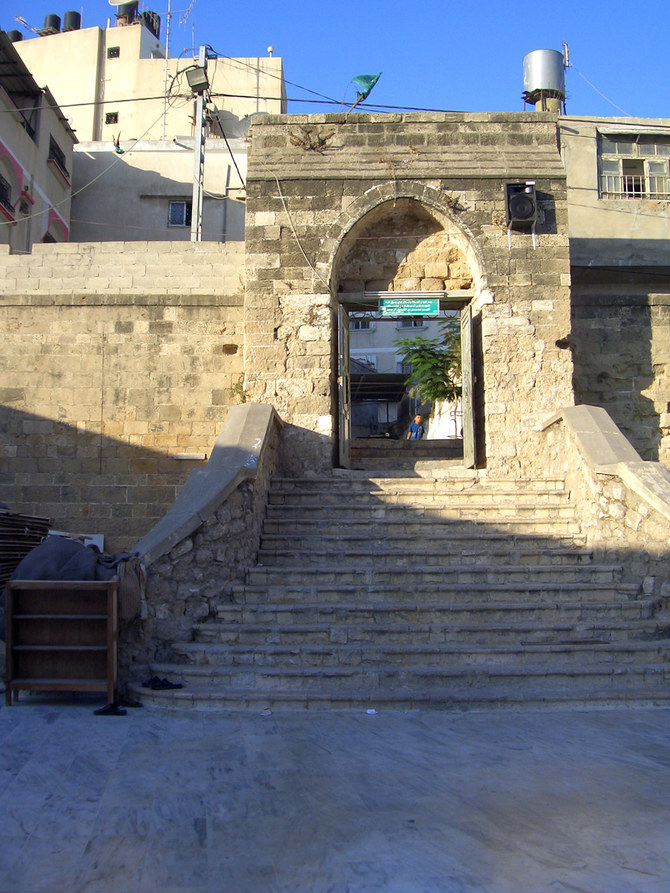
GAZA CITY: Previously a pagan temple and then a church, the Omari Grand Mosque in Gaza City was converted to a Muslim place of worship under Caliph Omar ibn Al-Khattab.

During Roman and Greek rule, the site was a temple to worship the god Marna, said Heyam Al-Bitar, head of the tourism and archaeology department at the Tourism Ministry in Gaza. It was built during the reign of Roman Emperor Hadrian.

The temple was converted to a church in 406 AD, and then into a mosque in 634 AD, said archaeologist Dr. Salim Al-Mubaid.

“It was the first mosque to perform Friday prayers in Gaza after the Islamic conquest,” he added.

During the Crusades, it was turned into St. John’s Cathedral in 1149 AD. It was converted back into a mosque in 1192 AD, but retained its Gothic architecture.

It was expanded by Mamluk Sultan Nasser Muhammad during Ottoman rule. Large parts of the mosque were destroyed during World War I, said Al-Mubaid. Historian Othman Mustafa Al-Tabbaa said it has 38 marble columns.

Al-Bitar said the mosque’s minaret, a model of Mamluk architectural style, is one of its most famous features. Its lower half is square and its upper half is octagonal.

The mosque’s library, built under Mamluk Sultan Al-Zaher Baybars, was a scientific beacon for scholars.

Having contained thousands of books and manuscripts on various sciences, the library was destroyed during the Crusades and World War I.

Today, it contains what books and manuscripts were not destroyed or looted. It is the oldest mosque library in the Gaza Strip.


Floods wreak havoc in Morocco’s farmlands after severe drought

An orchard of citrus trees stand in flood water in the Sidi Kacem region, in northwestern Morocco on February 5, 2026. (AFP)
Updated 7 sec ago
Follow

Floods wreak havoc in Morocco’s farmlands after severe drought

  • Morocco, where agriculture employs about a third of the working-age population, has seen seven consecutive years of drought
  • We have no grain left to feed our livestock, and they are our main source of income

KENITRA, Morocco: In the Moroccan village of Ouled Salama, 63-year-old farmer Mohamed Reouani waded through his crops, now submerged by floodwaters after days of heavy downpours.
Farmers in the North African kingdom have endured severe drought for the past few years.
But floods have now swamped more than 100,000 hectares of land, wiping out key crops and forcing farmers in the country’s northwest to flee with 
their livestock.
“I have about four or five hectares” of crops, Reouani said. “All of it is gone now.”
“Still, praise be to God for this blessing,” he added while looking around at the water.
Morocco, where agriculture employs about a third of the working-age population, has seen seven consecutive years of drought.
As of December, its dams were only around 30 percent full on average, and farmers have largely relied on rainwater for irrigation.
Now their average filling rate stands at nearly 70 percent after they received about 8.8 billion cubic meters of water in the last month — compared to just 9 billion over the previous two years combined.
Many like Reouani had at first rejoiced at the downpours.
But the rain eventually swelled into a heavy storm that displaced over 180,000 people as of Wednesday and killed four so far.
In his village, the water level climbed nearly 2 meters, Reouani said. Some homes still stand isolated by floodwater.
Elsewhere, residents were seen stranded on rooftops before being rescued in small boats.
Others were taken away by helicopter as roads were cut off by flooding.
Authorities have set up camps of small tents, including near the city of Kenitra, to shelter evacuees and their livestock.
“We have no grain left” to feed the animals, one evacuee, Ibrahim Bernous, 32, said at a camp. “The water 
took everything.”
Bernous, like many, now depends on animal feed distributed by the authorities, according to Mustapha Ait Bella, an official at the Agriculture Ministry.
At the camps, displaced families make do with little as they wait to return home.
“The problem is what happens after we return,” said Chergui Al-Alja, 42. 
“We have no grain left to feed our livestock, and they are our main source of income.”
On Thursday, the government announced a relief plan totaling about $330 million to aid the hardest-hit regions.
A tenth of that sum was earmarked for farmers and livestock breeders.

Rachid Benali, head of the Moroccan Confederation of Agriculture and Rural Development, said farming was “among the sectors most affected by 
the floods.”

But he said “a more accurate damage assessment was pending once the waters receded.”
Benali added that sugar beet, citrus, and vegetable farms had also been devastated by flooding.
Agriculture accounts for about 12 percent of Morocco’s overall economy.
The International Monetary Fund anticipates that the massive rainfall will help the economy grow by nearly five percent.
Authorities are betting on expanded irrigation and seawater desalination to help the sector withstand increasingly volatile climate swings.
While Morocco is no stranger to extreme weather events, scientists say that climate change driven by human activity has made phenomena such as droughts and floods more frequent and intense.
Last December, flash floods killed 37 people in Safi, in Morocco’s deadliest weather-related disaster in the past decade.
Neighboring Algeria and Tunisia have also experienced severe weather and deadly flooding in recent weeks.
Further north, Portugal and Spain have faced fresh storms and torrential rain.