Cannes winner ‘For Sama’ — a moving and vital documentary of Aleppo’s fall

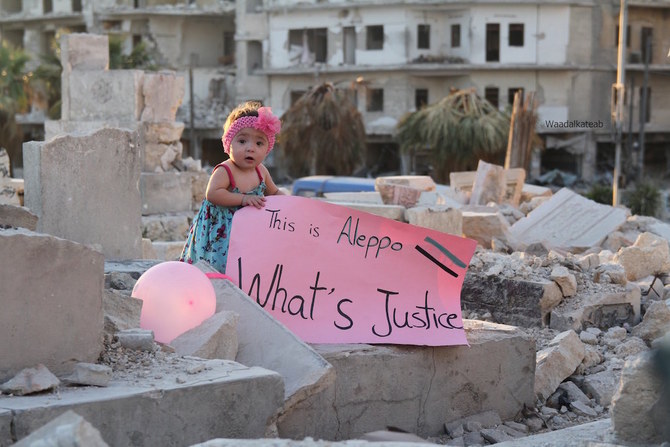
Sama pictured in September 2016, in the bombarded east of the city with a placard in response to US presidential candidate Gary Johnson’s infamous gaffe “What’s Aleppo?” (Courtesy of Channel 4, copyright Waad Al-Kateab)
Updated 03 July 2019
Follow

Cannes winner ‘For Sama’ — a moving and vital documentary of Aleppo’s fall

  • The movie won the Golden Eye Documentary Prize at Cannes
  • Filmmaker Waad Al-Khateab and her husband remained in Aleppo even after the birth of their daughter

DUBAI: At the heart of “For Sama” — the documentary about the fall of Aleppo by filmmakers Waad Al-Khateab and Edward Watts that just won the Golden Eye Documentary Prize at Cannes — is a scene that brought me to tears. Doctors are forced to perform an emergency cesarean section on a young woman who has sustained injuries from an airstrike. When the baby’s lifeless body is pulled from his mother, the doctors spend what seems like an eternity trying to save the child — pumping his heart, slapping his back, even shaking him.

In Alfonso Cuaron’s 2018 Oscar winner “Roma,” a similar scene plays out in fiction — the main character’s child is stillborn, and a long, excruciating attempt at resuscitation is unsuccessful. Watching “For Sama,” with a real life hanging in the balance, it’s hard to have hope for a better outcome. But just as you are about to force yourself to look away, to resent this film for making you watch a newborn slip from life, a miracle happens — the baby’s eyes open, he stirs to life, and cries. The mother and child are fine now, Al-Khateab, also the film’s narrator, assures us.

This newborn fighting to survive is right at home in Aleppo. Years after protests against the government began, years after extremists and airstrikes destroyed the massive Syrian city, many refused to flee. Al-Khateab explains that, in her view, abandoning their home would mean submitting to the will of a regime they aimed to resist.

Al-Khateab and her husband position themselves as activists, and that’s what unites them, even when it’s unclear what their views are, except for their rejection of both extremism and dictatorship. It’s unclear, too, when bombs are dropping over one’s head, whether one should be expected to think past that fact. Over the years that the film traces, it shows, in unflinching detail—many of those, men, women and especially children—who were lost to those bombs, soldiers. and sieges, until finally, with the city in ruins, her family were forced to flee themselves.

Sama, for whom the film is named, is Al-Khateab’s daughter, born during Aleppo’s slow crumble. The film is narrated directly to Al-Khateab’s infant — sometimes an apology, sometimes a time capsule, other times a direct justification for why they stayed so long in harm’s way with a small child. Al-Khateab, who kept her camera rolling for thousands of hours in order to capture every moment she could, believes her daughter needs to see not only the atrocities that were committed, but also the spirit of her home and its people, who clung to their city, and to their lives, until nearly the last man. The world needs to see that, too.


Nationalist Bollywood hit ‘Dhurandhar’ ignites India-Pakistan controversy

Updated 08 January 2026
Follow

Nationalist Bollywood hit ‘Dhurandhar’ ignites India-Pakistan controversy

  • Movie stars Ranveer Singh as an Indian intelligence agent who infiltrates alleged criminal networks in Karachi
  • Film has drawn sharp criticism from Pakistani officials while becoming one of the year’s biggest hits in India

A Bollywood spy thriller set in Pakistan has sparked heated debate across both countries over its portrayal of cross-border tensions, even as the film breaks box office records in India amid a surge in nationalist cinema.

“Dhurandhar,” starring Ranveer Singh as an Indian intelligence agent infiltrating criminal networks in Pakistan’s Karachi, has drawn sharp criticism from Pakistani officials and some international critics while becoming one of the year’s biggest commercial hits in India.

The 3.5-hour film, directed by Aditya Dhar, weaves real historical events including the 1999 plane hijacking, the 2001 Parliament attack, and the 2008 Mumbai attacks into a fictional narrative about an Indian spy’s mission to dismantle alleged links between Karachi gangs and terror networks.

Released Dec. 5 with minimal publicity, “Dhurandhar” has grossed more than 12.15 billion rupees ($134.76 million) in ticket sales, making it the highest-grossing Bollywood film last year. 

“It is a unique thing. Most films are set in India, but in this film, a RAW agent infiltrates Pakistan and is living there, hiding his identity, and the film portrays all of that through this setup, about Karachi and everything. That’s why it is such a good film. I mean, it is very important to watch this film,” said movie-goer Naresh Kumar.

The film represents a growing trend in Indian cinema toward nationalist blockbusters that align with Prime Minister Narendra Modi’s policies, following controversial hits like “The Kashmir Files” and “The Kerala Story” that sparked debates over historical accuracy while achieving commercial success.

In India, some film critics faced online harassment for negative reviews, prompting the Film Critics Guild to condemn “targeted attacks” against reviewers.

“Films that evoke patriotic fervor among audiences generally do well, but that is not to say that any film with this kind of subject would have done well,” said Bollywood film analyst Komal Nahta. “Everything seems to have gone right with the film.” 

The controversy highlights how cinema continues to reflect decades-old tensions between the nuclear-armed neighbors, who have fought four wars since partition in 1947. Fighting erupted between the countries in May following an attack on tourists in Kashmir that India blamed on Pakistan-backed militants.

In Pakistan’s Lyari neighborhood, which was depicted in the film, residents criticized the portrayal as inaccurate.

“It is a completely baseless movie because our neighboring country doesn’t know anything about our country,” said Mohammad Zohaib, a Lyari resident and burger shop owner. “They don’t know anything about Lyari, so how can they make a completely realistic film about someone?” 

The Pakistan Peoples Party filed legal action in a Karachi court last month over the film’s unauthorized use of assassinated former Prime Minister Benazir Bhutto’s image and its portrayal of party leaders as terrorist sympathizers.

“About 10 percent of what has been shown in the movie is reality, 90 percent is not real,” said Khizer Abdul Wahid, a Lyari resident and beauty salon owner.

Pakistan banned Indian films in 2019, but Bollywood remains popular there with audiences using VPNs or illegal downloads to watch new releases.

Theatre admissions in India have fallen 45 percent since their 2018 peak of 1.58 billion, according to Ernst and Young, as streaming services offer content that complements cheap mobile data available to most Indians.

Even global hits like the latest Avatar film struggled to secure screens due to “Dhurandhar’s” strong showing, analysts said.