Nobel Prize-winning physicist Murray Gell-Mann dead at 89

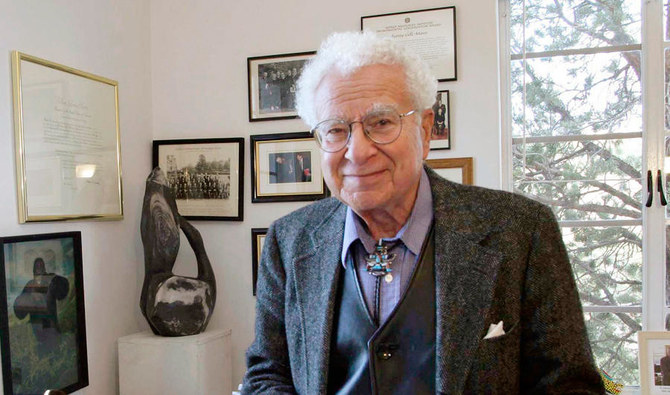
In this Nov. 14, 2003, file photo, Santa Fe Institute co-founder Murray Gell-Mann, winner of the 1969 Nobel Prize for physics, is seen Santa Fe Institute in Santa Fe, N.M. (AP)
Updated 27 May 2019
Follow

Nobel Prize-winning physicist Murray Gell-Mann dead at 89

  • Born in New York City on September 15, 1929, Gell-Mann was encouraged to study physics by his father, and earned a doctorate in the subject from Massachusetts Institute of Technology in 1951

WASHINGTON: Murray Gell-Mann, a physicist who theorized the existence of the quark and won a Nobel Prize for his method of classifying particles, has died at age 89, the California Institute of Technology (Caltech) said.
Considered among the most important physicists of the 20th century, the American scientist theorized in the 1960s that subatomic particles — protons and neutrons — were composed of paired subunits he called quarks.
Experiments later confirmed the existence of the particles, which are a continuing subject of study by physicists including those at the Large Hadron Collider, the world’s most powerful proton smasher straddling the French-Swiss border.
Amid an explosion of research into what makes up matter in the 1950s and 1960s, Gell-Mann came up with a criteria for putting particles in groups of eight based on characteristics like electric charge and spin.
He called it the “eightfold way,” Caltech said, and was awarded the 1969 Nobel Prize in Physics for the innovation.
Born in New York City on September 15, 1929, Gell-Mann was encouraged to study physics by his father, and earned a doctorate in the subject from Massachusetts Institute of Technology in 1951.
He taught at Caltech in Pasadena, California from 1955 until his retirement in 1993.
“Dr. Gell-Mann had this clear vision and penetrating insight to look through the large amounts of data that were coming from experiments and make sense of it,” Hirosi Ooguri, a professor at Caltech and director of the school’s Walter Burke Institute for Theoretical Physics, said in an obituary published by the university.
“He opened a new paradigm in particle physics.”


Thai coffee chains cut default sugar content in coffee and tea drinks in a new health push

Updated 11 February 2026
Follow

Thai coffee chains cut default sugar content in coffee and tea drinks in a new health push

  • The Health Department says Thais consume 21 teaspoons of sugar daily, far exceeding the World Health Organization’s recommended six teaspoons
  • Officials warn this increases obesity and diabetes risks. A survey found iced coffee and bubble tea contain high sugar levels

BANGKOK: For many Thais, a meal doesn’t feel complete without an iced coffee or tea so sugary it could pass for dessert. The government, concerned about the health consequences, wants them to dial it back.
Starting Wednesday, nine major coffee chains across the country have pledged to cut the default sugar content in some of their drinks by half in a government initiative aimed at tackling excessive sugar consumption.
According to the Health Department, Thais consume an average of 21 teaspoons of sugar per day, more than three times the World Health Organization’s recommended limit of six teaspoons. Health officials warn that such high intake increases the risk of obesity, diabetes and other diseases.
The initiative is the first significant step to change consumers’ sugar consumption behavior, said Amporn Benjaponpitak, the director general of the department.
Pakorn Tungkasereerak, the department’s deputy, said 2025 data show that about 45 percent of Thais aged 15 and older are obese, while 10 percent of the population has diabetes.
A survey by the Bureau of Nutrition found that a 22-ounce (650-milliliter) iced coffee contains an average of nine teaspoons of sugar, while a 10-ounce (300-milliliter) serving of bubble milk tea — an iced milk tea with tapioca pearls known as boba — can contain as much as 12 teaspoons.
Sirinya Kuiklang, an office worker, said she approves of the changes. She already orders her drinks at just 25 percent of the standard sugar level, but she is aware that many others consume too much sugar.
“It’s good for Thai people,” she said.
Another office worker, Porwares Tantikanpanit, said he has enjoyed his non-coffee beverages at their current sugar levels but is willing to adjust if shops reduce the sweetness.
However, putting the policy into practice may prove challenging. Officials have said each brand can apply the initiative as they see fit.
Some customers have expressed confusion in response to social media posts promoting the initiative, asking how to order drinks with the level of sweetness that they prefer. Several brands said that the reduction applies only to certain menu items.