PARIS: President Emmanuel Macron this weekend faces a critical test of his ambitions to reform France and champion a liberal Europe in European Parliament elections where his own party risks losing to the far-right.
The latest opinion surveys show the far-right National Rally (RN) outpolling Macron’s centrist Republic on the Move (LREM) by between 0.5-2 percentage points, after months where the two were neck-and-neck.
Analysts say that two years into his five-year term, the EU election represents a critical juncture for Macron and will influence whether the 41-year-old president can continue reforming in what he calls the “second act” of his time in office.
Macron has made no secret of the importance of the polls in France Sunday, telling regional newspapers this week the elections were the most important for four decades as the union faced an “existential threat.”
At stake is the youthful president’s vision of implementing further pro-business reforms in France, while emerging as a champion of more integration among EU member states.
Losing to Marine Le Pen’s RN — formerly known as the National Front — could be a glaring blow to those ambitions.
Sources close to Macron say a bad loss could prompt a major cabinet reshuffle, with the job of Prime Minister Edouard Philippe seen as being on the line.
“Symbolically, losing European elections in his own country would be seen as a repudiation of someone so pro-European,” said Sebastien Maillard, director of the Jacques Delors Institute think-tank.
“What is at stake for Emmanuel Macron is to have an influence in the future European parliament. This is not a given.”
Macron will find it tricky to challenge the dominance of the conservative European People’s Party (EPP) and the Socialists and Democrats (S&D) in the 751-seat parliament.
His European allies, grouped together in the Alliance of Liberals and Democrats for Europe (ALDE), may only end up with some 100 seats.
“If you don’t have a position in the European parliament then your European influence is limited,” said a French presidential official.
“This is what is at stake in the elections in the face of the nationalist risk.”
The elections also come at a prickly time in Macron’s relations with German Chancellor Angela Merkel, who is due to leave office in 2021 but who the French president wanted to cultivate as an ally in reforming Europe.
Merkel is unhappy with Macron challenging the EPP which she backs, while tensions have flared over Brexit, the choice of the next EU commission chief and France’s decision to increase its budget deficit.
“The European political landscape is very fractured, there is no leadership and Macron has not succeeded in imposing his,” said Jean-Thomas Lesueur, political scientist at the Franco-Belgian Thomas More Institute.
After an initial burst of optimism, the “Germans became disenchanted quite quickly,” he said.
The elections come with Macron still shaken after six months of sometimes violent anti-government protests by the “yellow vest” movement which prompted him to announce tax cuts for the working classes and a rise in the minimum wage.
The protests have shrunk in size, but Macron’s popularity ratings remain leaden with the president painfully aware his two predecessors both lasted only one term without leaving any major mark.
Sources said if the LREM falls behind the RN all eyes will be on the margin to determine the magnitude of the reaction.
“If there is nothing in it, behind or in front, I don’t see a reshuffle. But if we are three to four points behind the RN, or below 20 percent, people within the ruling party will start to ask questions,” said a person close to Macron, who asked not to be named.
“And this will require a change in personnel,” the source said.
A minister, also speaking on condition of anonymity, added: “If we are far behind the RN then things are going to shake. There will be a big reshuffle. I don’t see how we can lose the elections” and not change the prime minister.
For Brice Teinturier from the polling institute Ipsos in France, a victory for Macron’s party would give the government some “political oxygen” and capacity to allow reforms to continue.
“But if they are overtaken by the RN — and not just by 0.5 but two percentage points — this will be a failure and the capacity of the government to reform will be something that is merely hypothetical,” he said.


![]()

Macron’s ambitions face test in high-stakes EU polls
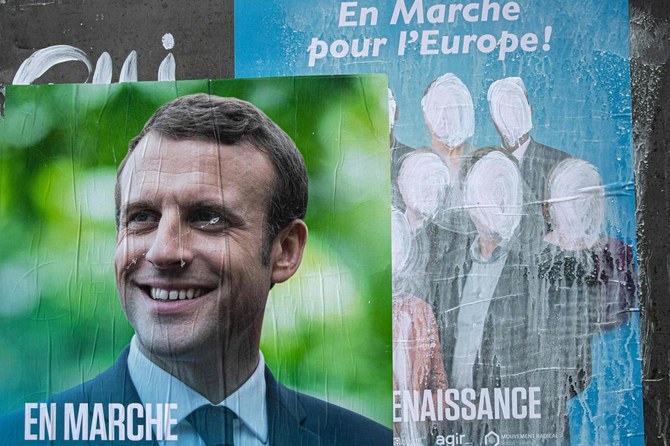
Macron’s ambitions face test in high-stakes EU polls
- The EU election represents a critical juncture for Emmanuel Macron
- Sources close to Macron say a bad loss could prompt a major cabinet reshuffle


Latest updates




© 2026 SAUDI RESEARCH & PUBLISHING COMPANY, All Rights Reserved And subject to Terms of Use Agreement.