



NEW DELHI: India’s governing Bharatiya Janata Party (BJP) on Thursday scored a landslide election victory, increasing its seats in Parliament after a bitter and divisive campaign.
The results amount to a massive blow for the 133-year-old Congress Party, which dominated India’s political life for more than 50 years after the country gained independence in 1947. Narendra Modi has made history by becoming India’s first prime minister in the last 40 years to be re-elected with a parliamentary majority.
The BJP on its own is expected to have a little over 300 seats in the Lok Sabha (lower house), more than it had in the outgoing chamber. The ruling National Democratic Alliance (NDA), of which the BJP is a part, will have nearly 350 MPs in the Lok Sabha.
The Congress Party is expected to finish with just 55 seats, albeit 11 more than its 2014 election tally. By most projections, the Congress-led opposition alliance will not even have 100 seats. Congress Party President Rahul Gandhi suffered a major personal setback in the family borough, the constituency of Amethi in northern India, where he lost to a Modi Cabinet minister. But Gandhi won his second seat in Wayanad in the south by a big margin. 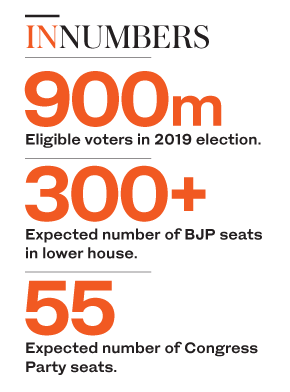
“I concede defeat and congratulate Prime Minister Narendra Modi for winning the elections,” Gandhi said on Thursday. He has offered to resign from his post in his party’s most powerful organizational body, the Congress Working Committee, but political analysts say it is highly unlikely that his resignation will be accepted.
The margin of the BJP’s victory has come as a surprise to many, with the party not only retaining its seats in the battleground states of northern and western India, but also expanding its footprint in two eastern states: West Bengal and Odisha. “Together, we’ll build a strong and inclusive India. India wins yet again!” Modi tweeted after the results showed the BJP sweeping to victory.
Shashi Shekhar, a New Delhi-based political analyst, told Arab News: “This is a phenomenal election victory that has stumped all the pollsters. The BJP was expected to face a big challenge from the opposition alliance in some of the crucial states, such as Uttar Pradesh and Maharashtra, which together account for 128 seats. But it seems the narrative of muscular nationalism propagated by the BJP overcame all challenges. There’s a now a genuine fear that if the BJP continues with its old policy of marginalizing religious minorities, India might turn into a majoritarian state. However, I hope Modi’s second term turns out to be more inclusive.”
Modi’s India can do its bit for Middle East and Gulf stability
Opinion
This section contains relevant reference points, placed in (Opinion field)
Sudheendra Kulkarni, a Mumbai-based political commentator, said: “The Congress Party failed to capture the imagination of the people. The party’s slogans didn’t click with voters the way the BJP’s did.”
Against this backdrop of an imminent decisive win, Modi began to receive messages of congratulations from world leaders on Thursday. Among them was Pakistani Prime Minister Imran Khan. “I congratulate Prime Minister Modi on the electoral victory of BJP and allies. Look forward to working with him for peace, progress and prosperity in South Asia,” Khan tweeted.
In his second term, in addition to addressing economic problems at home, Modi will need to keep a close eye on relations with neighboring Pakistan. Bilateral relations remain tense months after they came close to war following a deadly attack in Indian-administered Kashmir on paramilitary soldiers, and an Indian air raid deep inside Pakistan.
“There’s no alternative to dialogue,” said Kulkarni. “We should expect that with a renewed mandate (for Modi’s government), there should be a fresh attempt to engage with Islamabad.”


