ISLAMABAD: Pakistan on Wednesday signed an agreement with Kuwait Foreign Petroleum Exploration Company (KUFPEC) to begin hydrocarbon explorations in Makhad Block, which comprises the Pakistani districts of Attock, Mianwali and Chakwal in the country’s central Punjab Province and Kohat in the northwestern Khyber Pakhtunkhwa province.
Offshore exploration could boost Pakistan’s reserves, which have fallen in the last year as the country battles a ballooning economic crisis.
The agreement with Kuwait comes soon after news this weekend that a consortium exploring the Kekra-1 well off the coast of Pakistan was ending drilling operations after no reserves of oil and gas were found. The government of Prime Minister Imran Khan had pinned high hopes on offshore oil and gas discoveries to help with both the country’s chronic energy deficiencies and its ballooning trade deficit.
“The Government of Pakistan on 22nd May, 2019 executed Petroleum Concession Agreement (PCA) and Exploration Licence (EL) over Block No. 3371-19 (Makhad) to Kirthar Pakistan B.V., subsidiary of Kuwait Foreign Petroleum Exploration Company (KUFPEC) on Strategic partner basis (Government to Government basis),” the ministry of petroleum said in a statement.
KUFPEC is an international oil company engaged in exploration, development and production of crude oil and natural gas outside Kuwait, active in Africa, Middle East, Asia and Australia.
Pakistan’s Minister for Petroleum, Omar Ayub Khan, and the Chief Executive Officer of Kuwait Petroleum, Shaikh Nawaf Saud Al-Sabah, attended the agreement signing ceremony in Islamabad.
“Execution of the Exploration Licence and PCA will not only attract foreign direct investment in the petroleum sector but will also contribute in bridging the energy demand and supply gap,” the petroleum ministry statement said, quoting minister Khan.
Kuwait Foreign Petroleum Exploration Company will invest a minimum of $9.8 Million in one of its blocks called “Makhad.” Apart from the minimum firm work commitment, the company is obligated to spend a minimum of $30,000 per year in Makhad block on social welfare schemes, the ministry of petroleum said.
Pakistan is believed to have rich mineral resources, with conventional gas reserves estimated at 20 trillion cubic feet (tcf), or 560 billion cubic meters, and shale gas reserves, which are so far untouched, at more than 100 tcf.
The government is planning to offer dozens of new gas field concessions, hoping that improved security in recent years will reassure foreign investors who have been deterred in the past by the threat of militant violence.
Pakistan has been under mounting pressure to shore up its creaking energy infrastructure, both to provide more reliable supplies of oil and gas to its growing population of more than 200 million and to cut reliance on expensive foreign imports.
The country recently signed an accord for a $6 billion loan from the International Monetary Fund that has sent its rupee currency to an all time low and highlighted the need to cut import bills.
During a meeting between Kuwait Petroleum CEO Al-Sabah and PM Khan on Wednesday, the Pakistani PM said exploration had remained a neglected area in the past but the government was “working on a new petroleum policy offering incentives to foreign exploration and production (E&P) companies and removing impediments in way to undertaking smooth and profitable business ventures.”


![]()

Kuwait Petroleum, Pakistan sign hydrocarbon exploration deal
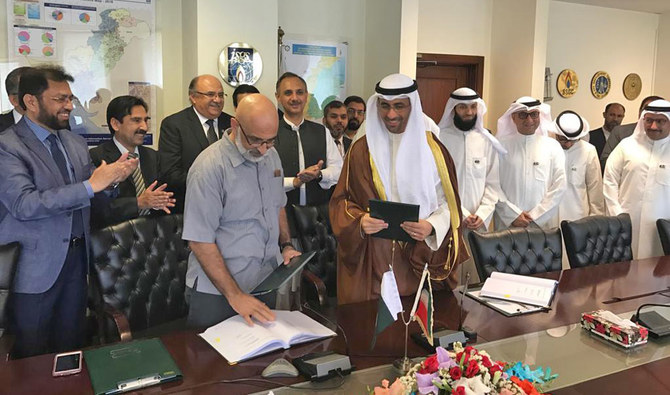
Kuwait Petroleum, Pakistan sign hydrocarbon exploration deal
- New agreement comes as consortium exploring Kekra-1 ended drilling after no reserves were found
- Offshore exploration could boost Pakistan’s reserves that fell drastically last year amid ballooning economic crisis
Latest updates





© 2026 SAUDI RESEARCH & PUBLISHING COMPANY, All Rights Reserved And subject to Terms of Use Agreement.