Progress in Afghan peace may lead to Trump-Khan meeting — Pakistan foreign minister

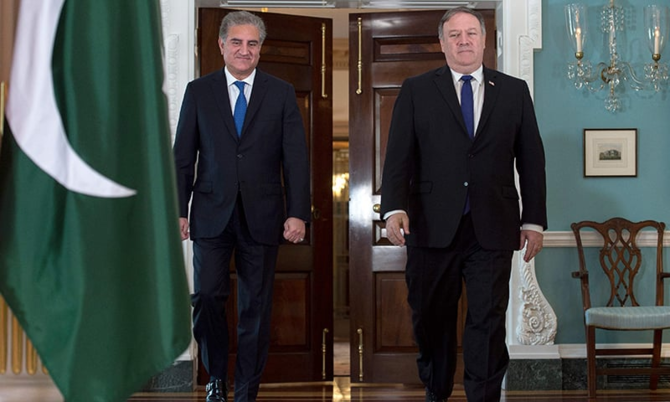
US Secretary of State Mike Pompeo meets Pakistani Foreign Minister Shah Mahmood Qureshi at the US State Department in Washington on Oct 2, 2018. (AFP Photo)
Updated 19 May 2019
Follow

Progress in Afghan peace may lead to Trump-Khan meeting — Pakistan foreign minister

  • Says breakthrough in US-Taliban negotiations not a precondition for meeting but would create ‘favorable’ environment
  • Pakistan will continue to stand by Saudi Arabia if it is threatened, Qureshi reiterates

ISLAMABAD: Pakistan’s Foreign Minister said on Friday that a meeting between Prime Minister Imran Khan and United States President Donald Trump could materialize if progress was achieved in ongoing talks between representatives from the Taliban and the United States to find a negotiated settlement to the long Afghan war.
Last year, the Donald Trump administration restarted diplomatic efforts to end the 18-year-old conflict in Afghanistan after it appointed a veteran diplomat, Zalmay Khalilzad, as special representative for reconciliation in Afghanistan and launched several rounds of direct negotiations with the Taliban, which have continued this year.
In 2018, Trump asked for Pakistan’s help with faltering Afghan peace talks in a letter to new Prime Minister Khan in which he made clear that Islamabad’s assistance was “fundamental” to the health of the two countries’ strained relationship.
In an interview to Urdu News on Friday. Foreign Minister Shah Mahmood Qureshi said progress in the ongoing talks in Doha could establish the grounds for a meeting between Khan and Trump.
When asked if progress in talks was a precondition for a Trump-Khan meeting, Mahmood said: “Don’t call it a precondition but I believe that if negotiations [between the Taliban and the US] move forward, then the environment will become favorable.”
“Negotiations [between the Taliban and the United States] are continuing in Doha,” he said. “Any headway in them can lead to a new opening in bilateral relations [between the US and Pakistan].”
Officially allies in fighting terrorism, Pakistan and the United States have a complicated relationship, bound by Washington’s dependence on Pakistan to supply its troops in Afghanistan, where the United States still has 14,000 troops, but plagued by accusations Islamabad is playing a double game.
US officials have long been pushing Pakistan to lean on Taliban leaders, who Washington says are based inside Pakistan, to bring them to the negotiating table. Pakistani officials deny offering safe havens to the Afghan Taliban and say their influence on the group has waned over the years.
In November 2018, Trump said Pakistan doesn’t “do a damn thing” for the United States despite billions of dollars in US aid. He defended cutting aid to Islamabad and also suggested Pakistani authorities knew Osama bin Laden’s location prior to his killing by US troops in a raid inside Pakistan in 2011.
Khan hit back by saying the United States should not blame Pakistan for its failings in Afghanistan.
“Both [PM Imran and President Trump] are important personalities, [and both are] deeply interested in [establishing] peace and stability in the region,” foreign minister Qureshi said.
Speaking about recent attacks on Saudi oil facilities, one on tankers off the UAE coast and another drone attack on pumping stations, Qureshi said: “Pakistan had stood by [the kingdom] whenever it was threatened and will continue to do so.”


On International Women’s Day, activist Abia Akram urges women with disabilities not to hide

Updated 6 sec ago
Follow

On International Women’s Day, activist Abia Akram urges women with disabilities not to hide

  • With over two decades of advocacy, Akram says disability is her identity to be celebrated
  • Women with disabilities face four times higher GBV risk, often overlooked by rights movements

ISLAMABAD: On this International Women’s Day, Abia Akram has a message for young women with disabilities: do not hide.

Born with a physical mobility impairment, the 40-year-old Pakistani activist has spent more than two decades advocating for the rights of women with disabilities while working with governments and international organizations to push for greater inclusion and a rights-based approach to disability.

For Akram, International Women’s Day is also an opportunity to challenge stigma and encourage women with disabilities to speak openly about their identities and experiences.

“I would say disability is nothing to worry about, and it’s not an issue that we need to address,” she said. “It’s just a thing to celebrate it, with all its diversity and impact. There’s no need to worry about disability, just enjoy life with it.”

Akram’s advocacy journey began in 1997, when public perceptions of disability in the region were often shaped by stereotypes representing two extremes.

“They are very close to Allah, so we have to respect them,” she said, recalling one such view. “Or on the other extreme, people were thinking they are a punishment.”

Activist Abia Akram speak to Arab News in Islamabad, Pakistan, on March 7, 2026. (AN photo)

As a woman from a developing country without a “strong background,” she said the fight for recognition and rights came with its own challenges.

In 2009, she founded the National Forum of Women with Disabilities, an initiative that helped bring attention to the challenges faced by women and girls with disabilities who were often overlooked even within their own families.

“Many parents used to pray that their daughters die before them, because there was no support system available,” she said.

Her own experience, however, was different. She credits her parents for encouraging her education and independence from an early age.

“My parents were really supportive because they were telling me like education is the most important thing. If you are qualified, if you are educated, then you have the world to contribute to.”

Today, Akram’s work extends beyond Pakistan. She serves as chair of the Global Forum on the Leadership of Women with Disabilities and is a trustee for Sightsavers, working with organizations including the UK’s Foreign, Commonwealth &

Development Office (FCDO) and humanitarian groups to promote a shift from a medical model of disability to a rights-based approach.

She is also currently chair of the Aging Disability Diversity Task Force, chief executive of the National Forum of Women with Disabilities and an executive member of the Commonwealth Disability Forum.

Akram says women with disabilities often face multiple layers of discrimination — within their families, in education, in employment and in public life.

According to advocacy data she cited, women with disabilities experience four times greater gender-based violence (GBV) and sexual harassment than women without disabilities.

Her work includes training programs that address systemic barriers and collaboration with government institutions such as Pakistan’s National Assembly, the Ministry of Human Rights and the National Commission on the Status of Women.

In recent years, Akram has also focused on using technology to address these challenges.

Last month at the Zero Project Conference in Vienna, she received a global award for “Noor AI,” an accessible mobile application designed to assist women with disabilities who are survivors of gender-based violence.

Akram argues that the difficulties often associated with disability arise not from individuals themselves but from environments that fail to accommodate different needs.

She illustrates the point with an analogy comparing wheelchairs to cars.

“Are you using a wheelchair? But you came in a car, which has the wheels and the chair. So, you are also using the wheelchair, but you park your wheelchair outside and mine is inside,” she said.

“It’s just about the diversity, accepting the diversity, not fixing the person.”

In Pakistan, she says there has been legislative progress in protecting the rights of persons with disabilities, pointing to the Rights of Persons with Disabilities Act 2020 in Islamabad and similar laws in Sindh and Balochistan.

However, she believes more work is needed in regions such as Azad Jammu and Kashmir and Khyber Pakhtunkhwa to strengthen legal protections and implementation.

Despite receiving international recognition, including the Zero Project Award and the Human Rights Award, Akram says such honors mainly reinforce her sense of responsibility.

She remains particularly focused on addressing what she describes as “double discrimination,” where women with disabilities are sometimes overlooked both within mainstream women’s movements and within male-dominated disability advocacy spaces.

As the world marks International Women’s Day, Akram says the goal must remain justice, empowerment and equality that includes everyone.

“Disability is my identity and I’m very proud of it. It’s about how we take that identity in a positive way, in a dignified way,” she said.

“It’s not about just celebrating, but also taking that positive initiative, the commitment, like how we can change the life of other people.”