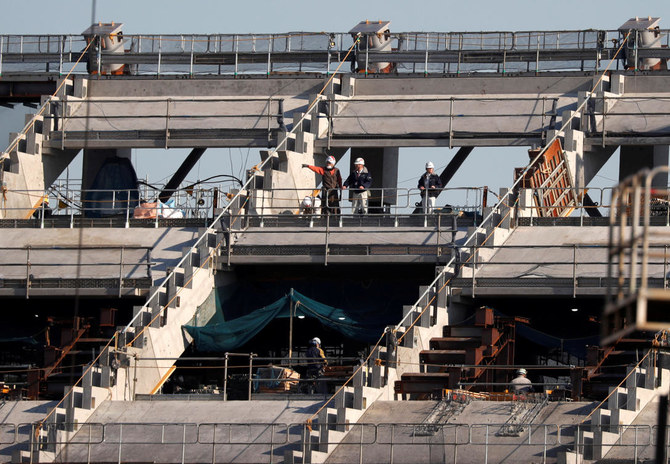
TOKYO: Construction workers are living in a ‘culture of fear’ and work for long hours in perilous conditions building Tokyo 2020 Olympic venues, according to a report from a leading international labor organization.
The Building and Wood Workers’ International (BWI) report, which is based on the organization’s interviews with workers, says they are dealing with dangerous conditions, long working hours and an inadequate complaint system.
BWI also noted two construction workers had died in connection with the Tokyo 2020 Olympics.
“The Tokyo 2020 Summer Olympics was Japan’s opportunity to address some of the long-running gaps within the construction industry in Japan; however, these problems have just got worse,” BWI General Secretary Ambet Yuson said in the report.
In 2017, the parents of a 23-year-old builder at the National Stadium petitioned the government to recognize his suicide as “karoshi” — or death by overwork, with media saying he worked 200 hours of overtime a month before his death.
A labor standards office eventually recognized his death as work-related.
The BWI report, released to the public Wednesday, says Japan’s acute labor shortage has put immense pressure on construction workers.
Builders at the Olympic and Paralympic athlete village reported working 28 days in a row; those working on the National Stadium reported working 26 days consecutively, the report said.
The report was submitted to Tokyo 2020, which is organizing the Games; the Tokyo Metropolitan Government; and the Japan Sports Council, which manages the National Stadium, on Tuesday.
“The JSC has been calling for efforts on the construction company to ensure the safety and health of workers and receiving reports regularly,” a JSC spokesman said via email on Friday. “However, as of today, we have not been able to identify cases written in the BWI report or other violations of law.”
The Tokyo Metropolitan Government acknowledged on Friday that it had received the report, but did not immediately respond to requests for comment.
Responsibility
Eight new venues are being built for the Games alongside older renovated venues in Tokyo.
The JSC manages the construction of the National Stadium, and the Tokyo Metropolitan Government is responsible for the remaining new venues.
Tokyo 2020 organizers are responsible for the temporary gymnastics venue, which is not mentioned in the report.
The organizing committee noted that it is not the “commissioning party” for any of the other projects.
“The Tokyo Organizing Committee... is now reviewing the contents of the report and will cooperate with related stakeholders to look into the alleged issue,” Tokyo 2020 spokesman Masa Takaya said in an email to Reuters.
Construction work on Tokyo’s new National Stadium, the centerpiece of the 2020 Summer Olympics, began in December 2016 after a delay of nearly a year.
The original design was rejected because of its high cost, but it is set to be completed in November.
Organizers have presented the 2020 Olympics as an opportunity to soften Japan’s work culture.
The country has few limits on overtime and pay. Employees at more than a fifth of companies exceeded a government threshold of 80 hours of monthly overtime, a white paper showed in 2016.
Last year, the infrastructure ministry predicted the Japanese construction industry would face a shortage of 470,000 to 930,000 workers by 2025.
The Summer Games begin on July 24, 2020.


![]()

International labor organization criticizes 2020 Olympics working conditions
International labor organization criticizes 2020 Olympics working conditions
- The report says they are dealing with dangerous conditions, long working hours and an inadequate complaint system
- The Summer Games begin on July 24, 2020


Latest updates


© 2026 SAUDI RESEARCH & PUBLISHING COMPANY, All Rights Reserved And subject to Terms of Use Agreement.