UK Brexit compromise talks fail

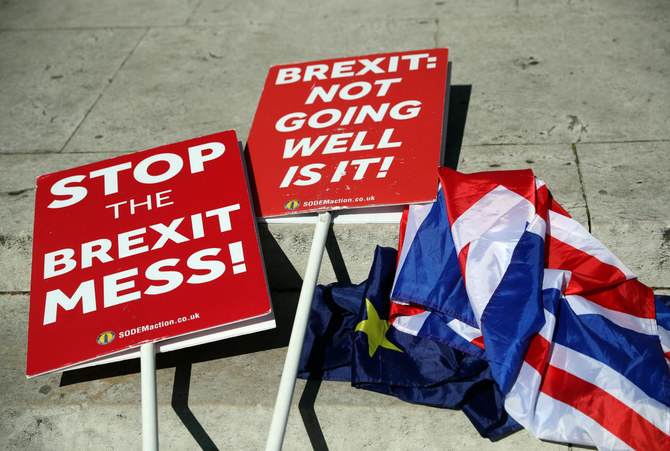
Anti-Brexit placards are seen on the floor outside the Houses of Parliament in London, Britain. (File/Reuters/Hannah McKay)
Updated 17 May 2019
Follow

UK Brexit compromise talks fail

  • Opposition Labour Party leader Jeremy Corbyn said the talks with Prime Minister Theresa May's Conservative government have "gone as far as they can"
  • The two sides have held weeks of negotiations to try to agree on terms for Brexit that can win support in Parliament

LONDON: Talks between Britain's government and opposition aimed at striking a compromise Brexit deal broke down without agreement Friday, plunging the country back into a morass of uncertainty over its departure from the European Union.
Opposition Labour Party leader Jeremy Corbyn said the talks with Prime Minister Theresa May's Conservative government have "gone as far as they can."
In a letter to May released by Labour, Corbyn said "we have been unable to bridge important policy gaps between us."
And with May set to announce within weeks that she plans to step down, Corbyn said the "increasing weakness and instability" of the government made striking a lasting agreement impossible.
The two sides have held weeks of negotiations to try to agree on terms for Brexit that can win support in Parliament. The talks began after lawmakers rejected May's divorce deal with the EU three times.
But the Conservatives and left-of-center Labour differ on how close an economic relationship to seek with the bloc after the UK leaves. Labour wants to stick close to EU rules in order to guarantee seamless trade, while the government wants a looser relationship that would leave Britain freer to strike new trade deals around the world.
Britain was due to leave the EU on March 29, but the bloc has extended the Brexit deadline until Oct. 31 amid the political impasse in the UK.
That deadlock has deepened this week with the breakdown of the cross-party talks and intensifying pressure on May from within the Conservative Party to quit.
Pro-Brexit Conservatives are furious that Britain hasn't yet left the EU, almost three years after voters backed Brexit in a referendum. Many blame May and want her replaced with a more staunchly pro-Brexit leader such as former Foreign Secretary Boris Johnson.
On Thursday, May agreed to set out a timetable for her departure early next month, raising the prospect that Britain will get a new prime minister before it leaves the EU.
Her resignation, when it comes, will trigger a party leadership contest in which any Conservative lawmaker can run. The winner will become party leader and prime minister without the need for a general election.
May plans to make a fourth attempt to get lawmakers' backing for Brexit terms by putting a withdrawal agreement bill to a vote during the week of June 3.
She says that if it passes, Britain could leave the EU in July, well before the October deadline set by the bloc.
But it's unclear how the government plans to persuade a majority of lawmakers to back May's EU divorce terms, since few legislators on either side of the Brexit divide seem prepared to change their positions.


UN chief launches first global, independent scientific panel on artificial intelligence

Updated 5 sec ago
Follow

UN chief launches first global, independent scientific panel on artificial intelligence

  • Secretary-General Antonio Guterres nominates 40 experts to serve on body ‘dedicated to helping close the AI knowledge gap and assess the real impacts of AI’
  • It will ‘help the world separate fact from fakes, and science from slop … at a moment when reliable, unbiased understanding of AI has never been more critical,’ he adds

NEW YORK CITY: UN Secretary-General Antonio Guterres on Wednesday formally launched what he described as the only global, independent scientific body focused on artificial intelligence, and submitted his recommendations for the experts to serve on it.

“It will be the first global, fully independent scientific body dedicated to helping close the AI knowledge gap and assess the real impacts of AI across economies and societies,” he told reporters in New York.

“And this could not be more urgent. AI is moving at the speed of light. No country can see the full picture alone.”

The Independent International Scientific Panel on Artificial Intelligence was established by the UN General Assembly through a resolution in August. Guterres said he has now submitted a list of 40 experts from all regions as his proposed candidates for the new body, which was mandated by world leaders under the UN’s Pact for the Future.

The panel is intended to provide authoritative, science-based analysis at a time when AI is developing rapidly and reshaping economies, governance and social life, but regulatory approaches remain fragmented.

Guterres underscored the need for shared understanding among countries to help develop effective safeguards, promote innovation for the common good, and strengthen international cooperation.

The UN said the panel would serve as a global reference point, helping policymakers and the public distinguish between reliable evidence and misinformation, and grounding debates on AI in independent scientific assessment.

The initiative comes amid growing concern over the societal, economic and security risks posed by unchecked technological competition.

“We need shared understandings to build effective guardrails, unlock innovation for the common good, and foster cooperation,” Guterres said.

“The panel will help the world separate fact from fakes, and science from slop. It will provide an authoritative reference point at a moment when reliable, unbiased understanding of AI has never been more critical.”

The proposed members of the panel were selected following an open global call that attracted more than 2,600 applicants, whose expertise spanned fields including machine learning, data governance, public health, cybersecurity, child development and human rights. The chosen candidates are expected to serve in a personal capacity, independent of governments, businesses or other institutions.

The panel will operate on an accelerated timeline, with its first report due in time to inform a Global Dialogue on AI Governance scheduled for July. UN officials said the findings were expected to support international efforts to build common ground on AI governance during a period of heightened geopolitical tensions and technological rivalry.

Guterres framed the initiative as part of a broader push to ensure that AI is shaped collectively, guided by scientific evidence and global solidarity, rather than allowing its development to outpace international cooperation.