

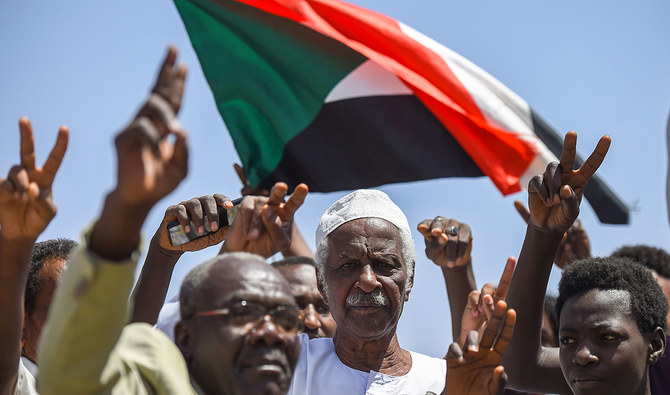

KHARTOUM: Sudanese army rulers and protest leaders Wednesday agreed on a three-year transition period for transferring power to a full civilian administration, even as negotiations over a new sovereign ruling body remain unfinished.
The protest movement is demanding a civilian-led transition following 30 years of iron-fisted rule by now deposed president Omar Al-Bashir, but the generals who toppled him have been holding onto a leadership role.
Talks between the two sides resumed earlier in the week but were marred by violence when an army major and five protesters were killed by unidentified gunmen at a long-running sit-in outside military headquarters in Khartoum.
The two sides announced early Wednesday after nearly 12 hours of negotiations that they had reached an agreement on the transition period.
“We agreed on a transitional period of three years,” Lt. Gen. Yasser Al-Atta, a member of the military council told reporters.
Atta said a final agreement on the sharing of power, including the forming of the next ruling body — the sovereign council — will be signed with the protest movement, the Alliance for Freedom and Change, within a day.
“We vow to our people that the agreement will be completed fully within 24 hours in a way that it meets the people’s aspirations,” Atta said.
He said of the transition period, the first six months will be allocated to signing peace accords with rebels in the country’s war zones like Darfur, Blue Nile and South Kordofan.
Protester Mohamed Abdullah told AFP that he was happy the way the negotiations had turned out so far.
“We will wait for tomorrow’s talks, but my only question is ‘Who will guarantee this agreement with the military council?’,” he said as thousands of demonstrators gathered for another sit-in overnight.
The army generals had initially insisted on a two-year transition period, while the protest leaders wanted four years.
Key negotiations however remain on the composition of the sovereign council, which will replace the existing ruling body made up solely of generals.
The generals say this should be military led while protest leaders want it to be majority civilian.
After the forming of the sovereign council, a new transitional civilian government will be formed to run the country’s day-to-day affairs and would work toward having the first post-Bashir elections after the end of the transition period.
Atta said that during the transition period parliament will be composed of 300 members, of which 67 percent will be from the Alliance for Freedom and Change and the rest will be from other political groups.
The Alliance for Freedom and Change meanwhile said the shootings on Monday were an attempt to “disturb the breakthrough” in talks.
On Tuesday, the United States blamed the army itself for the deaths.
They “were clearly the result of the Transitional Military Council trying to impose its will on the protesters by attempting to remove roadblocks,” the US embassy said on its Facebook page.
“The decision for security forces to escalate the use of force, including the unnecessary use of tear gas, led directly to the unacceptable violence later in the day that the TMC was unable to control,” it said.
Protest leaders, who on Monday had blamed the remnants of Bashir’s regime and allied militias, changed their stand on Tuesday.
“We put the whole responsibility on the military council for what happened yesterday because it’s their direct responsibility to guard and protect the citizens,” Mohamed Naji Al-Assam, a prominent figure in the movement, told reporters.
The latest round of talks which opened on Monday come after a break in negotiations that saw protest leaders threaten “escalatory measures” to secure their central demand of civilian rule.
The issue has kept thousands of protesters camped outside army headquarters around the clock ever since Bashir’s overthrow.
The sit-in has become the focal point for the protest movement, overtaking the near daily protests that had been held across Sudan while the veteran president remained in power.
But on Tuesday protesters in the capital’s twin city Omdurman also vented their anger on the streets.
Protesters gathered in the Abbassiya and Al-Arbaa districts, just across the Nile from the capital, with many chanting slogans against the military council, witnesses told AFP.
“Protect your homeland or prepare to die!” the protesters chanted.


