Lavrov and Pompeo urge closer US-Russia ties, still disagree over Iran nuclear deal

1 / 3
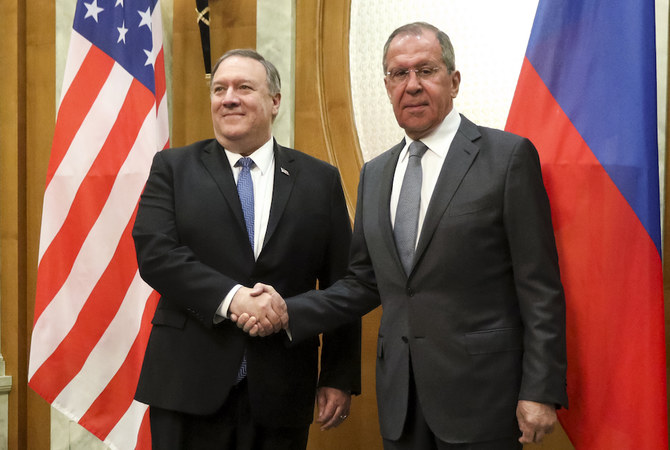
US Secretary of State Mike Pompeo (L) and Russian Foreign Minister Sergey Lavrov pose for a photo prior to their talks in the Black Sea resort city of Sochi, southern Russia, Tuesday, May 14, 2019. (Russian Foreign Ministry Press Service via AP)
2 / 3
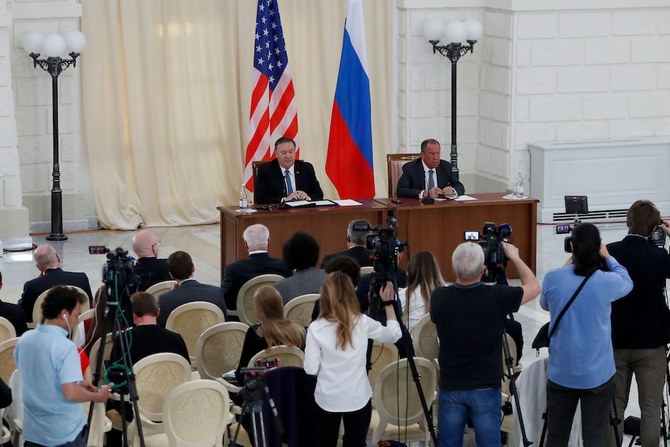
US Secretary of State Mike Pompeo and Russian Foreign Minister Sergey Lavrov attend a joint news conference after their talks in the Black Sea resort city of Sochi, Russia May 14, 2019. (Reuters)
3 / 3
Russian Foreign Minister Sergei Lavrov and US Secretary of State Mike Pompeo hold a joint press conference following their talks in Sochi on May 14, 2019. (AFP)
Updated 15 May 2019
Follow

Lavrov and Pompeo urge closer US-Russia ties, still disagree over Iran nuclear deal

SOCHI: Russia and the United States voiced hope for better ties Tuesday as President Vladimir Putin welcomed Secretary of State Mike Pompeo but tensions were laid bare in a clash over election meddling.
In a late-night encounter in Putin's forested dacha in the Black Sea resort of Sochi, Pompeo became the highest-ranking American to meet the Russian leader in 10 months.
"I would very much like your visit to Russia to benefit Russia-US relations and promote their development," Putin told Pompeo as he took a seat across from him in a sleek conference room, saying that they should "fully restore" relations.
Putin praised a two-year investigation by US special counsel Robert Mueller, despite its findings that Russia meddled extensively in the 2016 election on behalf of then-candidate Donald Trump, especially by manipulating social media.
But the probe found that his campaign did not collude with Russia -- lifting one cloud that has hung over Trump since his unexpected victory.
"Despite the exotic nature of Mr Mueller's commission, on the whole he conducted quite an objective investigation and confirmed the absence of any collusion between the US administration and Russia," Putin said.
Pompeo, speaking earlier at a joint news conference with Foreign Minister Sergei Lavrov, acknowledged deep differences on election meddling -- and warned Russia to stay out of next year's vote.
"Interference in American elections is unacceptable. If Russia engaged in that in 2020, it would put our relationship in an even worse place than it has been," Pompeo said.
"I conveyed that there are things that Russia can do to demonstrate that these kinds of activities are a thing of the past. I hope that Russia takes advantage of those opportunities," he said.
Lavrov hit back against "those who are inflating this topic" and saying of collusion: "It's clear that such insinuations are absolute fiction."
"We want and we are ready to deal with cybersecurity issues along with our American partners, without any politicisation," he said.
Pompeo nonetheless also voiced hope for a better future with Russia.
He said that his mission came from Trump, who has persistently praised Putin -- a loathed figure for virtually all of the US political class.
Trump, he said, wants the United States and Russia "to do everything we can" to create a future that is "more successful" for both countries and the world as a whole.
"Some of our cooperation has been excellent -- on North Korea, on Afghanistan, we've done good work -- (and) counter-terrorism work -- together. These are things we can build upon," Pompeo said.
Pompeo was the highest-ranking American to see Putin since July when the Russian leader met in Helsinki with Trump -- who shocked the US establishment by seeming to take at face value Putin's denials of election interference.
Putin's aide Yuri Ushakov said the president and Pompeo discussed Iran, Syria, Afghanistan and the situation in North Korea, following leader Kim Jong Un's first visit to Russia last month.
However in the 90 minutes of closed-door talks they did not touch on the Ukraine crisis and only briefly discussed sanctions imposed by Washington over Russia's backing of separatist rebels in the country.
They equally did not touch on Michael Calvey, a prominent American investor who has been behind bars in Moscow since mid-February on controversial fraud charges, Ushakov said.


2025 among world’s three hottest years on record, WMO says

Updated 14 January 2026
Follow

2025 among world’s three hottest years on record, WMO says

  • All eight datasets confirmed that the last three years were the planet’s three hottest since records began, the WMO said
  • The slight differences in the datasets’ rankings reflect their different methodologies and types of measurements

BRUSSELS: Last year was among the planet’s three warmest on record, the World Meteorological Organization said on Wednesday, as EU scientists also confirmed average temperatures have now exceeded 1.5 degrees Celsius of global warming for the longest since records began.
The WMO, which consolidates eight climate datasets from around the world, said six of them — including the European Union’s European Center for Medium-Range Weather Forecasts (ECMWF) and the British national weather service — had ranked 2025 as the third warmest, while two placed it as the second warmest in the 176-year record.
All eight datasets confirmed that the last three years were the planet’s three hottest since records began, the WMO said. The warmest year on record was 2024.

THREE-YEAR PERIOD ABOVE 1.5 C AVERAGE ⁠WARMING LEVEL
The slight differences in the datasets’ rankings reflect their different methodologies and types of measurements — which include satellite data and readings from weather stations.
ECMWF said 2025 also rounded out the first three-year period in which the average global temperature was 1.5 C above the pre-industrial era — the limit beyond which scientists expect global warming will unleash severe impacts, some of them irreversible.
“1.5 C is not a cliff edge. However, we know that every fraction of a degree matters, particularly for worsening extreme weather events,” said Samantha Burgess, strategic ⁠lead for climate at ECMWF.
Burgess said she expected 2026 to be among the planet’s five warmest years.

CHOICE OF HOW TO MANAGE TEMPERATURE OVERSHOOT
Governments pledged under the 2015 Paris Agreement to try to avoid exceeding 1.5 C of global warming, measured as a decades-long average temperature compared with pre-industrial temperatures.
But their failure to reduce greenhouse gas emissions means that target could now be breached before 2030 — a decade earlier than had been predicted when the Paris accord was signed in 2015, ECMWF said. “We are bound to pass it,” said Carlo Buontempo, director of the EU’s Copernicus Climate Change Service. “The choice we now have is how to best manage the inevitable overshoot and its consequences on societies and natural systems.”
Currently, the world’s long-term warming level is about 1.4 C above the pre-industrial era, ECMWF said. Measured on a short-term ⁠basis, average annual temperatures breached 1.5 C for the first time in 2024.

EXTREME WEATHER
Exceeding the long-term 1.5 C limit would lead to more extreme and widespread impacts, including hotter and longer heatwaves, and more powerful storms and floods. Already in 2025, wildfires in Europe produced the highest total emissions on record, while scientific studies confirmed specific weather events were made worse by climate change, including Hurricane Melissa in the Caribbean and monsoon rains in Pakistan which killed more than 1,000 people in floods.
Despite these worsening impacts, climate science is facing political pushback. US President Donald Trump, who has called climate change “the greatest con job,” last week withdrew from dozens of UN entities including the scientific Intergovernmental Panel on Climate Change.
The long-established consensus among the world’s scientists is that climate change is real, mostly caused by humans, and getting worse. Its main cause is greenhouse gas emissions from burning fossil fuels like coal, oil and gas, which trap heat in the atmosphere.