

NA passes bill to add more lawmakers from Pakistan’s tribal districts

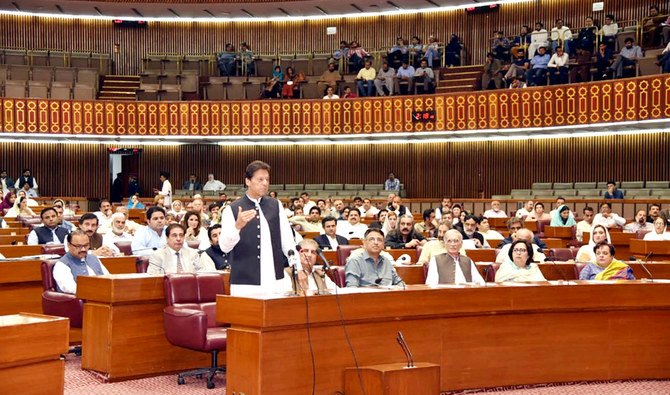
Prime Minister Imran Khan speaking at the National Assembly in Islamabad, May 13, 2019. (Credit: PID)
Updated 13 May 2019
Follow

NA passes bill to add more lawmakers from Pakistan’s tribal districts

  • Legislation approved after all parties reached a consensus on the matter
  • In 2018, similar move had allowed the merger of Khyber Pakhtunkhwa province with tribal areas

ISLAMABAD: Pakistan’s lower house of parliament on Monday passed a Constitution Amendment Bill seeking an increase in the number of seats for the National Assembly (NA) and Khyber Pakhtunkhawa (KP) provincial assembly, following a merger of the tribal areas with the province.
Mohsin Dawar, a MNA from the North Waziristan tribal district, tabled the 26th amendment bill which was unanimously backed by the government and the opposition.
Prime Minister Imran Khan, who attended the NA proceedings, thanked the political parties for reaching a consensus on the matter.
“Development should always be inclusive. Areas that are left behind should also be brought up,” he said, adding that there was a dire need for better facilities and infrastructure in the militancy-hit tribal districts.
Going forward, the legislation needs a final approval from the Senate and the president, as a constitutional formality.
Last year in May, the NA – through a constitutional amendment bill – had allowed the merger of the Federally Administered Tribal Areas (FATA) with the KP province.

Dawar's bill proposed to increase the number of National Assembly seats for representatives of tribal districts from six to 12, and Khyber Pakhtunkhwa assembly seats from 16 to 24.


Afghan interior minister welcomes Pakistani scholars’ ‘positive’ remarks about Kabul

Updated 5 sec ago
Follow

Afghan interior minister welcomes Pakistani scholars’ ‘positive’ remarks about Kabul

  • Pakistani religious scholars on Dec. 23 called for easing tensions between Islamabad and Kabul, resumption of trade
  • Sirajuddin Haqqani says Afghanistan is committed to regional peace, Afghans have “no intentions to threaten anyone”

PESHAWAR: Afghanistan’s Interior Minister Sirajuddin Haqqani recently thanked Pakistan’s Deputy Prime Minister Ishaq Dar and religious scholars from the country for expressing positive statements for Kabul despite tensions between the two countries. 

A meeting of religious scholars in Pakistan on Dec. 23, attended by Jamiat Ulama-e-Pakistan political party head Maulana Fazl-ur-Rehman, called for easing tensions between the two states. The scholars also called for allowing resumption of trade and movement of people between Pakistan and Afghanistan. 

Pakistani news media outlets reported on Saturday that Dar, who is also Pakistan’s foreign minister, praised Haqqani’s earlier statement in which the Afghan minister stressed resolving tensions between Islamabad and Kabul through dialogue. 

In a video statement on Sunday, Haqqani said Afghanistan is committed to peace and stability in the country and the region, adding that Afghans have “no intentions to threaten anyone.” He appreciated Rehman and religious scholar Mufti Taqi Usmani for speaking in a “positive” manner about Afghanistan in the Dec. 23 meeting.

“We are thankful and grateful for their approach and views,” Haqqani said. 

“Similarly, we really appreciate the positive remarks by Foreign Minister Ishaq Dar, who spoke in a positive way about Afghanistan.” 

The Afghan minister’s statement comes in the backdrop of increased tensions between Afghanistan and Pakistan amid a surge in militant attacks in the latter’s territory. 

Pakistan blames Afghanistan’s government for facilitating attacks by the Pakistani Taliban or TTP group. Islamabad accuses Kabul of allowing TTP militants to take shelter in sanctuaries in Afghanistan from where they carry out attacks targeting Pakistan. 

Kabul denies the charges and says it cannot be held responsible for security lapses and challenges in Pakistan. 

The two countries engaged in fierce border clashes in October that led to the killings of dozens of soldiers and civilians on both sides. Pakistan and Afghanistan subsequently agreed to a temporary ceasefire and have held three rounds of peace talks that remained inconclusive. 

Tensions persist as Pakistan has vowed to go after militants even in Afghanistan that threaten the lives of its citizens. Afghan officials have warned Pakistan of retaliation if it attacks Afghanistan.