KARACHI: The number of HIV positive patients surged to 393 on Monday, a jump from 157 cases reported since last week, with health officials anticipating a further increase in numbers even as screening continued in the Ratodera town of Pakistan’s southern Sindh province.
“The screening has been restarted and the number is expected to grow. So far 9,082 have been screened in Ratodero of whom 393 have been tested positive. Of them 312 are infants and children of different age groups,” Dr. Masood Solangi Director General Health told Arab News.
Authorities were first alerted to the burgeoning crisis after 18 children –from a town on the outskirts of Larkana city – tested positive for the virus last week. There is no cure for HIV, but antiretroviral treatment can help in limiting the spread of the virus. If left untreated, it can lead to AIDS.
The increase in the number of new cases reported in Pakistan is in contrast to a global decline, especially since the country of 208 million is considered a low prevalence nation for HIV.
Authorities have traced the spread of the virus to a paediatrician in Sindh province named Muzaffar Ghangharo, who allegedly used a contaminated syringe on several patients. He was arrested last week.
All of the 312 infected children are reported to be Ghangharo’s patients, with local police officer Sartaj Ahmed Jagirani saying that more than 300 patients would seek the doctor’s services, on an average, everyday.
“It’s still to be ascertained whether it was deliberate or inadvertent,” Jagirani said, adding that preliminary police investigations suggested that Ghangharo used the same syringe to inject at least five different children.
Solangi added that the reuse of tainted syringes was the major source of infection among the children. However, SSP Kamran Nawaz, a senior official tasked with investigating the matter, said that the probe was still underway. “We are investigating the case with help of doctors from every angle and will soon share our findings,” Nawaz told Arab News.
Dr. Sikandar Iqbal, a coordinator at the Sindh AIDS Control Programme, said that Ghangharo was an AIDS patient himself.
“There are...chances that Dr. Ghangharo, who is in the last stages of the disease, might have been infected by one of his patients, who mostly get treatment from quacks,” he said. Arab News could not independently verify Iqbal’s claims.
It is still unclear what the suspect’s medical qualifications are. His private clinic has been sealed following his arrest, and is yet to be reopened.
Meanwhile, the Sindh chapter of Pakistan’s Paediatric Association (PPA) has condemned Ghangaro’s arrest and called for his immediate release, reasoning that the police investigation had used a “non-professional approach causing to defame a respected doctor.”
Officials contacted by Arab News said that the number of victims was increasing rapidly, with several new cases reported on Saturday. Locals, however, said that the numbers were higher than those reported.
“They are concealing the figures,” Abdul Rasool who lives in a village near Ratodero, and whose son tested positive at a screening camp on Friday, said, adding that his “cousin’s three-year old son has also tested positive.”
Thus far four people have died from the condition, including a 10-month-old girl.
Jameel Ahmed, a Larkana shopkeeper who lost two infant daughters after they were treated in Ghangharo’s clinic, blamed himself.
“God gave me two daughters and both died because of my ignorance,” he said. “If you love your children, go to government or registered hospitals.”


![]()

Over 300 children test positive for HIV in southern Pakistan
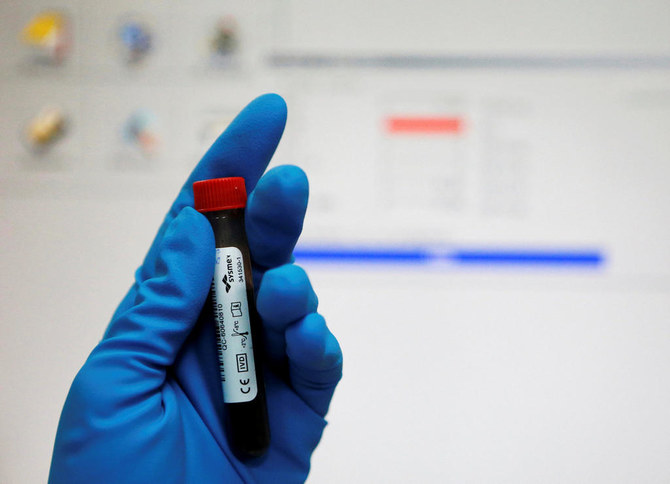
Over 300 children test positive for HIV in southern Pakistan
- More than 300 children diagnosed with condition in Ratodero subdivision of Larkana
- Authorities trace epidemic to pediatrician who used infected syringe on multiple patients
Latest updates


© 2026 SAUDI RESEARCH & PUBLISHING COMPANY, All Rights Reserved And subject to Terms of Use Agreement.