

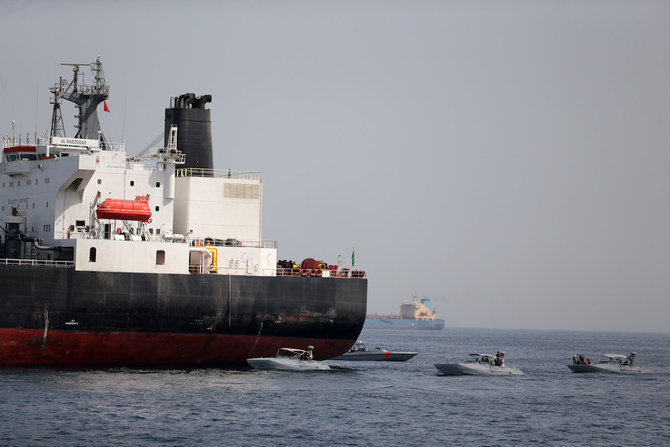

RIYADH: Saudi Arabia’s energy minister said on Monday that two Saudi tankers were targeted in a “sabotage attack” off the coast of the UAE, the Saudi Press Agency (SPA) reported.
Khalid Al-Falih said the two tankers were targeted off the coast of Fujairah. He explained that one tanker was en route to the Kingdom to be loaded with Saudi crude oil to send to the United States to supply Saudi Aramco customers.
“Fortunately, the attack didn’t lead to any casualties or oil spill; however, it caused significant damage to the structures of the two vessels,” Al-Falih said.
Al-Falih’s comments came as the US issued a new warning to sailors and the UAE’s regional allies condemned the reported sabotage of four ships off the coast of Fujairah.
------
RELATED: Four commercial vessels targeted by ‘sabotage’ near UAE waters: Foreign ministry
------
The Ministry of Foreign Affairs said that the Kingdom condemned the acts of sabotage that targeted commercial cargo ships near the territorial waters of the UAE.
“This criminal act poses a serious threat to the security and safety of maritime traffic and negatively affects regional and international peace and security,” the ministry said.
The UAE foreign ministry had reported on Sunday that four commercial vessels were targeted near its territorial waters.
The foreign ministry released a statement saying that the vessels - targeted at a distance of 115 kilometers from Iran - were “civilian trading vessels of various nationalities”, and that the UAE was investigating the incident with local and international bodies.
The UAE’s Minister of State for Foreign Affairs, Anwar Gargash, later tweeted that he welcomed the support of his country’s allies.
He said the investigation was being carried out in a professional fashion and that the truth would be revealed.
الدعم والمساندة الكبيرين لدولة الامارات إثر حادث التخريب المتعمد لأربع سفن في مياهنا الإقليمية أساسه مواقف الدولة الإيجابية في دعم السلام والإستقرار، صداقاتنا الكبيرة كسبناها بشفافيتنا ومواقفنا، التحقيق يتم بحرفية وستتضح الحقائق ولنا قراءاتنا وإستنتاجاتنا.
— د. أنور قرقاش (@AnwarGargash) May 13, 2019
On Monday, US President Donald Trump warned Iran, saying that if Tehran does "anything" in the form of an attack "they will suffer greatly."
The incident involving Saudi ships raised risks for shippers in a region vital to global energy supplies at a time of increasing tensions between the US and Iran over its unraveling nuclear deal with world powers.
Trump was asked about the sabotage, and responded: "It's going to be a bad problem for Iran if something happens."
He spoke to reporters in the Oval Office during a meeting with the prime minister of Hungary.
A US official says an American military team’s initial assessment is that Iranian or Iranian-backed proxies used explosives to blow large holes in four ships.
The official says each ship has a 5-to-10-foot hole in it, near or just below the water line. The US military team assesses that the holes were caused by explosive charges.
The UAE asked the US to help investigate the damage.
The official was not authorized to discuss the investigation publicly and spoke on condition of anonymity.
Rumors about ships inside the port being sabotaged were unfounded, the UAE ministry added.
The Arab League condemned the attacks, describing them as a "crime" and added that the league would stand by the UAE and Saudi Arabia in their efforts to defend their security.
The port of Fujairah continues to operate as normal and there were no victims of the sabotage incidentThe ministry added that targeting merchant ships and threatening the lives of crew members is a “dangerous development,” and that the government considers the acts of sabotage to be a threat to the safety and security of the UAE.
The statement came just hours after Iranian and Lebanese media outlets aired false reports of explosions at the city’s port.
The US has warned ships that “Iran or its proxies” could be targeting maritime traffic in the region. America is deploying an aircraft carrier and B-52 bombers to the Persian Gulf to counter alleged threats from Tehran.
However, Iran on Monday called attacks on ships in the Gulf “alarming”, after the UAE and Saudi Arabia said several vessels including oil tankers were damaged in acts of sabotage off the Emirati coast.
The incidents are “alarming and regrettable,” Iranian Foreign ministry spokesman Abbas Mousavi said in an English-language statement on the ministry’s website, calling for a probe into the attacks and warning of “adventurism” by foreign players to disrupt maritime security.
Meanwhile, the European Union’s foreign policy and security chief, Federica Mogherini, urged to avoid any escalation on Iran. Mogherini said that a discussion would be held on Monday how to continue backing full implementation of the nuclear deal.
Britain’s Foreign Minister Jeremy Hunt also warned of the risks of an unintended conflict between the US and Iran over the unraveling nuclear deal.
“We are very worried about the risk of a conflict happening by accident with an escalation that is unintended,” Hunt told reporters in Brussels, adding that it was crucial not to put Iran back on the path of re-nuclearisation.
(With AFP, AP, and Reuters)


