

The arts return to northern Syria’s former militant bastion

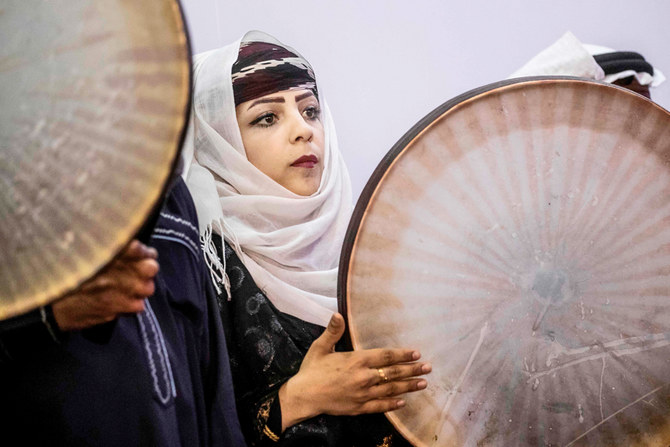
Members of a traditional music and dance group perform at the first cultural centre to open after Daesh rule ended in the Syrian city of Raqqa on May 1. (AFP)
Updated 12 May 2019
Follow

The arts return to northern Syria’s former militant bastion

  • Cultural and entertainment activities banned under Daesh flourish after group flees
  • Before Daesh arrived, the city had more than 20 cultural centers, the largest housing 60,000 books

RAQQA: More than a year after Daesh fled, Syrian boys and girls are finally back on stage — bobbing to the rhythm of drums in the northern city of Raqqa.

At the first cultural center to open since the militants’ draconian rule ended, sunlight floods into the brand new library, while books line shelves along a wall that still smells of wet paint.

After almost four years under Daesh, which banned music and the arts, US-backed forces expelled the last militants from Raqqa in October 2017. But it has taken a bit of time to resuscitate cultural life.

“I can’t describe how happy I am,” said Fawzia Al-Sheikh at the center’s opening earlier this month, in the still largely devastated city.

“After all this destruction, and no arts or culture, we finally have a center where we can listen to song and poetry again,” the Raqqa resident added.

In the Raqqa Center for Arts and Culture’s brightly lit gallery, paintings hang beside charcoal drawings, near sculptures of human figures.

In the concert hall, Malak Al-Yatim stepped off stage after performing — exhilarated to finally be able to sing in public again.

“I feel like a bird sweeping through the spring sky,” he said.

Yatim added that Daesh smashed his instruments and banned him from singing.

“We were like nightingales in a cage,” he lamented.

“If we did anything, they’d chop off our head or whip us.”

Daesh overran Raqqa in 2014, making the city its de facto Syrian capital.

Before Daesh arrived, the city had more than 20 cultural centers, the largest housing 60,000 books. But the extremists forced all these facilities to close, burning and destroying books and paintings.

But in the new center’s library, hundreds of volumes that survived the extremists adorn shelves.

“These books you can see — we saved them from the ruins,” said Ziad Al-Hamad, the center’s director. During Daesh rule, “residents hid them wherever they could,” added the 62-year-old, dressed neatly in a brown V-neck jumper over a stripy white shirt.

“When the city was liberated, they gave them back to us,” added Hamad, who also sits on the city council’s culture and antiquities commission.

The Kurdish-led and US backed Syrian Democratic Forces (SDF) expelled Daesh from the village of Baghouz, its last scrap of Syrian territory, in late March.

While the militants have continued to claim deadly attacks in areas controlled by the SDF — including Raqqa — local artists have returned to their easels.

In the cultural center’s gallery, painter Amal Al-Attar has work on display after returning from exile in Beirut.

Among her works is a painting of a white boat adrift on an ocean, and another of a home on the shoreline.

“It’s like a re-birth,” the 37-year-old said of the center’s opening, sunglasses perched atop her dark shoulder-length hair.

Attar used to run a studio for artists, but when Daesh overran the city they told her art was forbidden.

She left 50 works behind when she fled to neighboring Lebanon.

Daesh “burned them,” she said.

“I can’t forget what happened back then, but this cultural center will give us a new drive,” she said.


Decoding villains at an Emirates LitFest panel in Dubai

Updated 25 January 2026
Follow

Decoding villains at an Emirates LitFest panel in Dubai

DUBAI: At this year’s Emirates Airline Festival of Literature in Dubai, a panel on Saturday titled “The Monster Next Door,” moderated by Shane McGinley, posed a question for the ages: Are villains born or made?

Novelists Annabel Kantaria, Louise Candlish and Ruth Ware, joined by a packed audience, dissected the craft of creating morally ambiguous characters alongside the social science that informs them. “A pure villain,” said Ware, “is chilling to construct … The remorselessness unsettles you — How do you build someone who cannot imagine another’s pain?”

Candlish described character-building as a gradual process of “layering over several edits” until a figure feels human. “You have to build the flesh on the bone or they will remain caricatures,” she added.

The debate moved quickly to the nature-versus-nurture debate. “Do you believe that people are born evil?” asked McGinley, prompting both laughter and loud sighs.

Candlish confessed a failed attempt to write a Tom Ripley–style antihero: “I spent the whole time coming up with reasons why my characters do this … It wasn’t really their fault,” she said, explaining that even when she tried to excise conscience, her character kept expressing “moral scruples” and second thoughts.

“You inevitably fold parts of yourself into your creations,” said Ware. “The spark that makes it come alive is often the little bit of you in there.”

Panelists likened character creation to Frankenstein work. “You take the irritating habit of that co‑worker, the weird couple you saw in a restaurant, bits of friends and enemies, and stitch them together,” said Ware.

But real-world perspective reframed the literary exercise in stark terms. Kantaria recounted teaching a prison writing class and quoting the facility director, who told her, “It’s not full of monsters. It’s normal people who made a bad decision.” She recalled being struck that many inmates were “one silly decision” away from the crimes that put them behind bars. “Any one of us could be one decision away from jail time,” she said.

The panelists also turned to scientific findings through the discussion. Ware cited infant studies showing babies prefer helpers to hinderers in puppet shows, suggesting “we are born with a natural propensity to be attracted to good.”

Candlish referenced twin studies and research on narrative: People who can form a coherent story about trauma often “have much better outcomes,” she explained.

“Both things will end up being super, super neat,” she said of genes and upbringing, before turning to the redemptive power of storytelling: “When we can make sense of what happened to us, we cope better.”

As the session closed, McGinley steered the panel away from tidy answers. Villainy, the authors agreed, is rarely the product of an immutable core; more often, it is assembled from ordinary impulses, missteps and circumstances. For writers like Kantaria, Candlish and Ware, the task is not to excuse cruelty but “to understand the fragile architecture that holds it together,” and to ask readers to inhabit uncomfortable but necessary perspectives.