

Crime, eggshells and the unexpected artistry of one Pakistani cop

Karachi police officer Adeel Uddin works on egg art under lamplight at his Karachi home on May 8, 2019 (AN photo)
Updated 12 May 2019
Follow

Crime, eggshells and the unexpected artistry of one Pakistani cop

  • Policeman Adeel Uddin began weaving thread calligraphy on eggshells at height of violence in 90’s Karachi
  • The artist has sold over 75 pieces and exhibited his work across Pakistan and in London and Dubai

KARACHI: In 90’s Karachi, when killings over political and ethnic rivalries had reached new heights, armed gangs and drug barons carved out turfs and people woke up daily to sacks of dead bodies dumped in the streets, a young police officer found his escape.
Reeling from the grief of losing friends and fellow cops to the seemingly unending violence, Adeel Uddin turned to a unique art passed down to him by his father: thread calligraphy on the most delicate of canvases, eggshells.
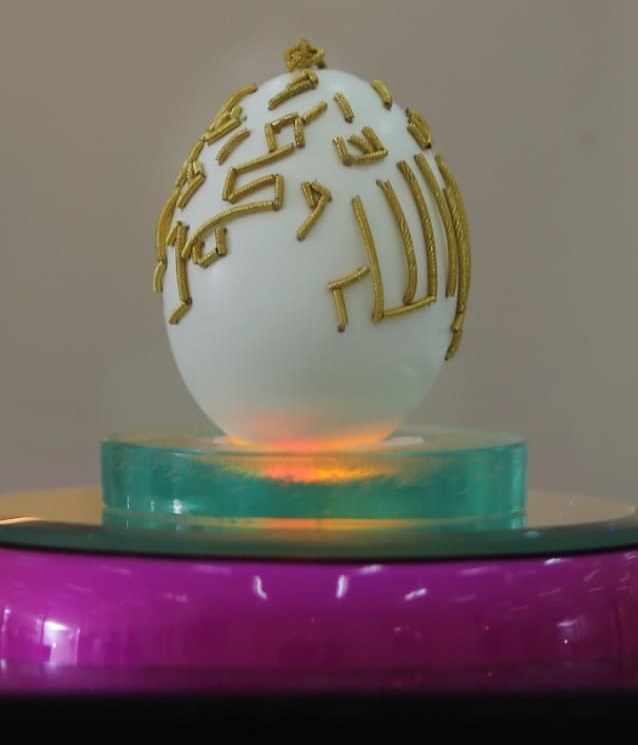


Islamic calligraphy on an eggshell by Karachi police officer Adeel Uddin who inherited the skills from his father. May 8, 2019 (AN Photo)

For hours each night, Adeel would sit by lamplight, pricking minute holes into the fragile surface of eggs and then needling rich threads through the perforations until they formed words.
He is now a senior inspector posted in Karachi’s upmarket Clifton area, and his craft, he says, has seen him through years of bloodshed in a city that has held the grim distinction of being one of the country’s deadliest.
“My life has been equally about dealing with gun shells and eggshells,” Adeel, 53, told Arab News at his home in Karachi, a teeming port city on the shores of the Arabian Sea. “Several of my colleagues were killed during those violent days. There was so much stress for policemen and our families.”
Amid the chaos, Adeel’s father, an insurance man and himself an acclaimed calligrapher who has presented his work to the likes of Saudi King Faisal bin Saud, US President Dwight D. Eisenhower and Pakistani President Ayub Khan, told him: “Son, your police job must not stop you from mastering this art, and passing it on to my grandchildren.”
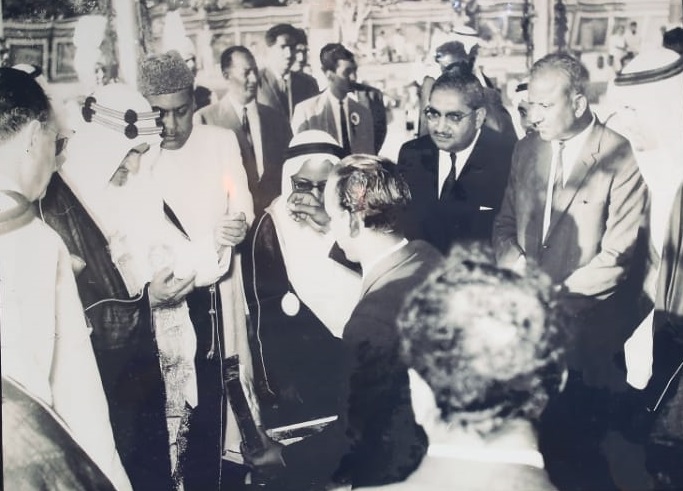


A photograph, taken on May 8, 2019, of Vakil Uddin, an insurance man, presenting a special eggshell to Saudi King Faisal Bin Saudi at Frere Hall Karachi in 1966. His son Adeel Uddin carried on the craft after him. (Photo provided by Adeel Uddin)

And so by day, Adeel fought crime in a city awash with armed gangs but by night, he worked under lamplight in his bedroom, intricately inlaying thread into the enameled surface of eggshells and preparing piece after piece of ‘egg art,’ each one more intricate than the last.
It takes around 36 hours to complete one eggshell, Adeel said, adding that it was impossible to work longer than six hours consecutively on the form of calligraphy he practiced.
To date, Adeel has held five exhibitions in Pakistan and one each in Dubai and London. One piece, he said, could go for anywhere between $200-700.
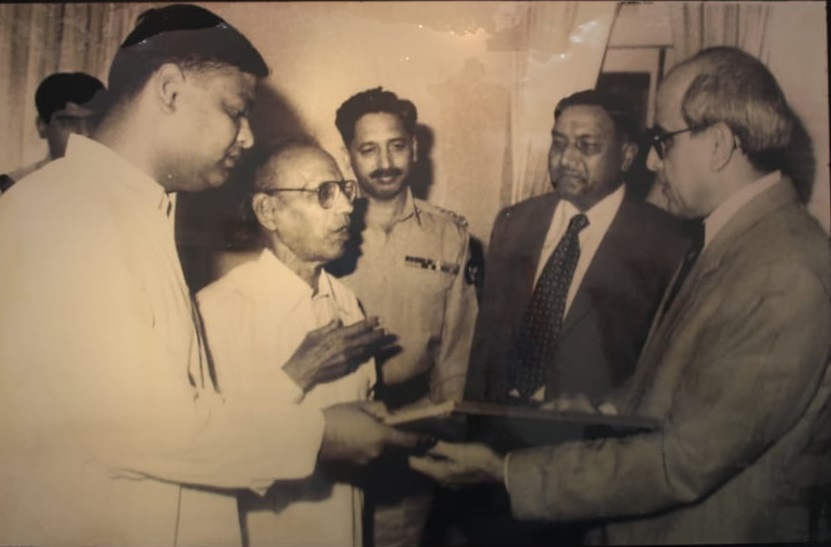


A photograph, taken on May 8, 2019, of Vakil Uddin and his son Adeel Uddin presenting a decorated eggshell to the President of Pakistan, Farooq Ahmed Khan Leghari at the State Guest House Karachi in August 1997 ( Photo provided by Adeel Uddin)

“It is my passion but I’m doing it commercially also,” he said. When he retired from the police force in seven years, he added, he would devote himself to calligraphy full time.
Of the 75 eggs Adeel said he had sold so far, one sale was particularly memorable. In London, a woman bought an egg he had painted bright red and woven with a verse from the Qur’an in Arabic that read: “They are your garment, and you are a garment for them.” She wanted to gift it to her husband.
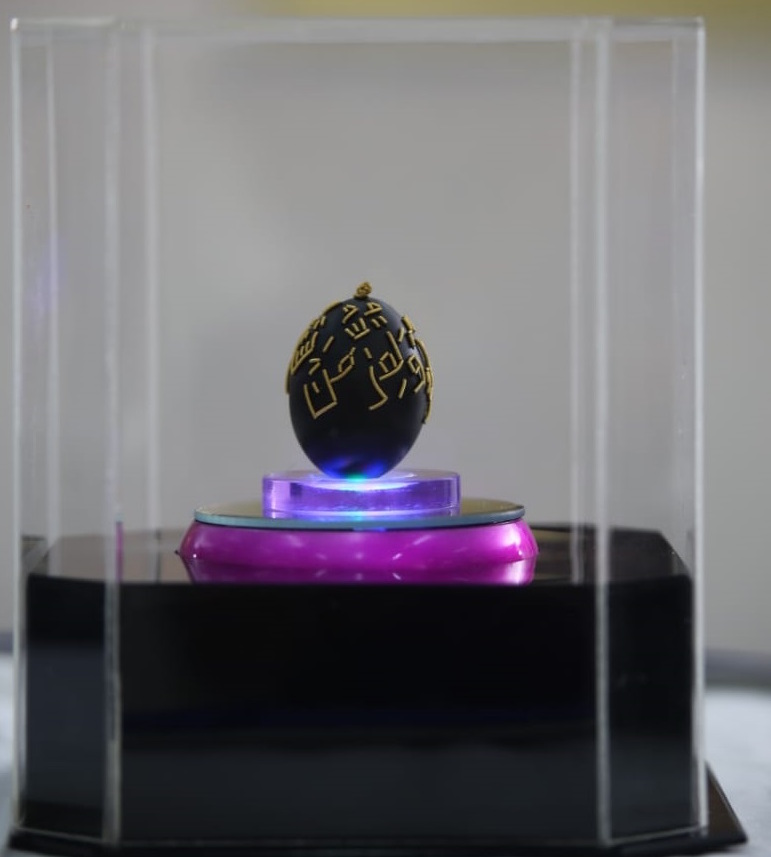


One of Adeel Uddin’s masterpieces, pictured on display on a special mount on May 8, 2019 (AN Photo)

“She was very keen to take it as it was about a husband and wife’s relationship,” Adeel said, smiling gently.
But not all eggs carry religious text.
“I have also written ‘happy marriage’ and other celebratory messages in English and Urdu on my eggs,” Adeel said, pushing his glasses up from the tip of his nose and adjusting the lamp on his desk, readying to begin work on a new piece. “If someone was to place an order for it, I would even write ‘Happy Valentine’s Day!”
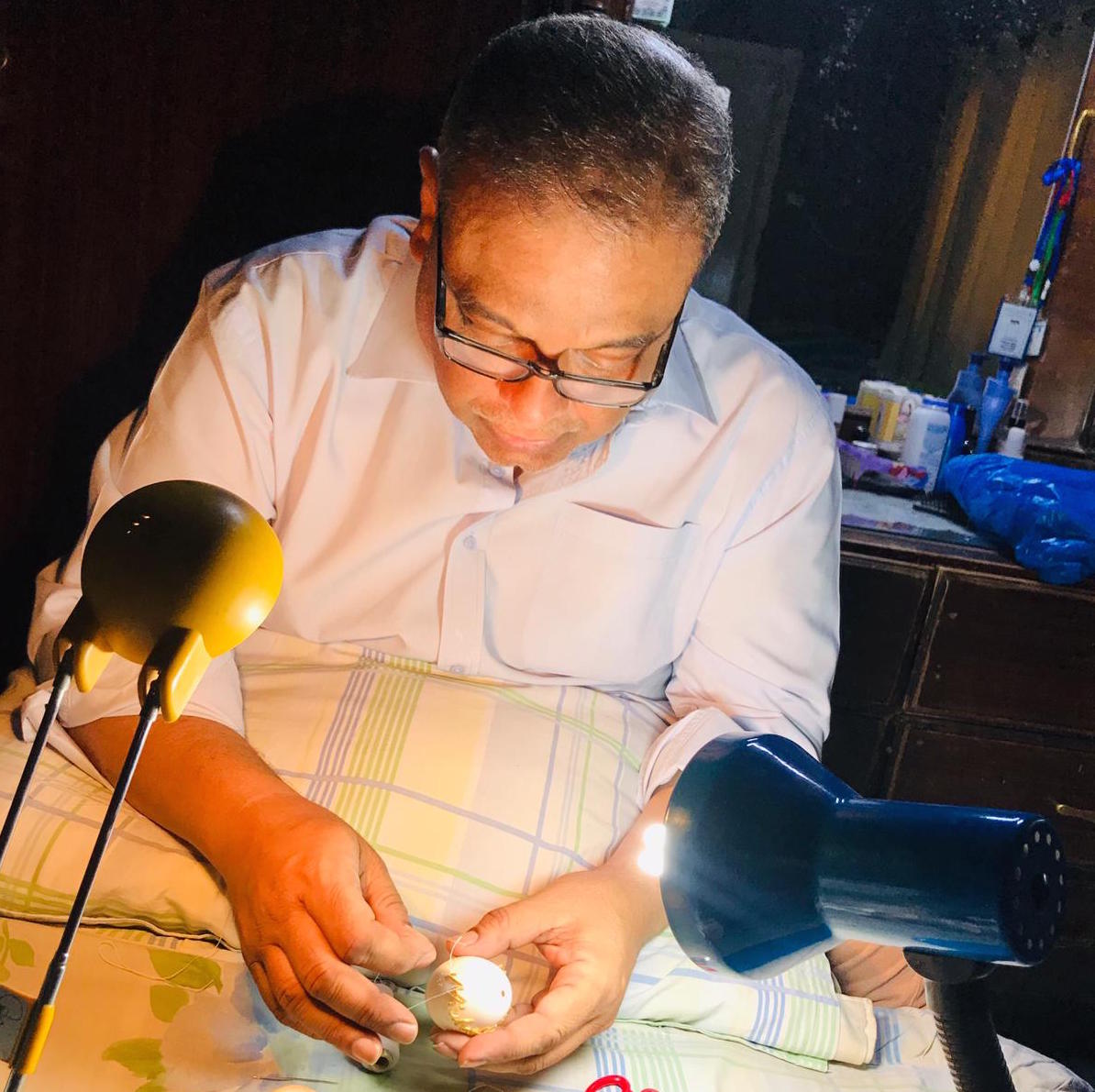


Karachi police officer Adeel Uddin hard at work creating ‘egg art’ at his home in Karachi on May 8, 2019 (AN Photo)


India favorites as T20 World Cup to begin after Pakistan, Bangladesh controversies

Updated 4 sec ago
Follow

India favorites as T20 World Cup to begin after Pakistan, Bangladesh controversies

  • Bangladesh were replaced by the ICC in this World Cup and Pakistan has refused to face India in group stage clash
  • The top two teams from each of the four groups of five teams will advance to the Super Eight stage of the World Cup

NEW DELHI: Cricket’s T20 World Cup begins Saturday after an acrimonious buildup overshadowed by political turmoil, with Bangladesh kicked out and Pakistan refusing to face arch-rivals and co-hosts India.

When the first ball is finally bowled after a chaotic lead-in, Pakistan will open the tournament against the Netherlands in Colombo.

Defending champions and tournament favorites India will make their tournament bow in the night match on day one against the United States in Mumbai, carrying the hopes of a billion-plus home cricket supporters.

Led by Suryakumar Yadav, India will start as firm tournament favorites and are expected to ease into the Super Eight stage from Group A.

But they will be wary of the United States, who are looking to take down another cricketing powerhouse, having shocked Pakistan to make the Super Eights in 2024.

Former champions Australia and England are also strong contenders to lift the trophy and deny holders India the title for a record second straight time.

The 2021 winners Australia have been hit hard by the absence of pace spearhead Pat Cummins, who was ruled out with a lower back injury.

Pace bowler Josh Hazlewood will miss the early stages as he recovers from hamstring and Achilles injuries.

Led by Mitchell Marsh, the Australians should still ease into the next round from Group B against Ireland, who they play first on Wednesday, plus co-hosts Sri Lanka Oman and Zimbabwe.

Harry Brook’s England, full of confidence after a 3-0 T20 series win in Sri Lanka this week, are expected to make the Super Eights from a Group C that also features two-time winners West Indies, debutants Italy, Nepal and Scotland.

Brook, under intense scrutiny after having to apologize for an incident with a night club bouncer in New Zealand last year, takes charge at a global tournament for the first time since he replaced Jos Buttler as white ball captain.

England, who start with a match against Nepal on Sunday in Mumbai, won the tournament in 2010 and 2022.

Scotland, after their 11th-hour call-up to replace Bangladesh, will take guard on the opening day when they face the West Indies in Kolkata.

Football powerhouse Italy will make an appearance at a cricket World Cup for the first time, and will kick off against the Scots in Kolkata on Monday.

South Africa, the runners-up in 2024, have never won a white ball World Cup, but are buoyed by winning the World Test Championship last year.

They will be a threat but must first emerge from a tough-looking Group D that contains dangerous opponents in New Zealand and Afghanistan.

They begin against Canada on Monday in Ahmedabad, with the UAE the other team in that group.

The top two teams from each of the four groups of five teams will advance to the Super Eights, with the top four making the semifinals.

POLITICS, PULLOUTS

There will be relief at the weekend when the action gets under way finally after weeks of political posturing that has dominated the build-up to 10th edition of the showpiece tournament.

Bangladesh refused to play in India, citing security concerns, as relations between the two countries soured and were kicked out by the International Cricket Council (ICC) from England’s Group C.

The ICC is led by Jay Shah, the former Indian cricket board secretary and son of the powerful Indian home minister Amit Shah.

Pakistan, who had backed Bangladesh’s plea to have their games moved to Sri Lanka, were cleared to play by the Islamabad government but they ordered the team not to play the marquee group clash against fierce rivals India on February 15.

According to media reports, the ICC is still waiting formal communication from the Pakistan Cricket Board on the boycott, leaving the door slightly ajar for a last-minute deal to get the game on.

If India are awarded a walkover, Pakistan will lose two points and take a big hit to their net run rate.
If any of their other three Group A games are lost to the weather then it could make it almost impossible for Pakistan to qualify.

Pakistan’s pullout will result in a loss of millions of dollars in revenue for broadcasters, and will be a huge letdown for fans on both sides.

The crisis was triggered last month when India’s cricket board ordered the IPL’s Kolkata Knight Riders to drop Bangladesh fast bowler Mustafizur Rahman, a move that deepened political strains between the neighbors.

The tournament will conclude with the final on March 8 in Ahmedabad or Colombo, depending on whether Pakistan go that far.