

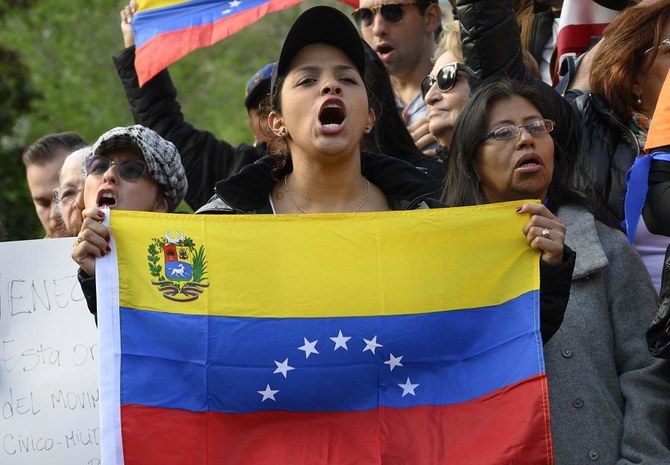
Venezuela braces for unrest as Maduro clamps down

Venezuela was plunged into turmoil in January when Guaido declared himself acting president in a direct challenge to Maduro’s authority. (File/AFP)
Updated 11 May 2019
Follow

Venezuela braces for unrest as Maduro clamps down

  • Venezuela has suffered more than four years of recession marked by shortages of basic necessities such as food and medicine
  • The UN says a quarter of its 30 million population are in urgent need of aid, and more than 2.7 million have fled the deprivation

CARACAS: Venezuela braced Saturday for another day of nationwide protests after President Nicolas Maduro clamped down further on opposition leader Juan Guaido, locking up his deputy in a military prison following a dramatic arrest.
Edgar Zambrano, deputy speaker of the opposition-majority National Assembly, is being held in preventive detention for “the flagrant commission of the crimes of treason, conspiracy and civil rebellion,” the Supreme Court said in a statement announcing the verdict of a lower court.
Zambrano was arrested by Maduro’s SEBIN intelligence service in dramatic circumstances on Wednesday for supporting the April 30 revolt organized by US-backed Guaido.
Maduro also accused his sacked intelligence chief of being a CIA “mole” and the architect of the failed military uprising.
He said General Christopher Figuera was “the one who orchestrated the coup d’etat” by contacting the group of around 30 members of the armed forces who joined Guaido’s mass demonstration.
“He was captured by the CIA a year ago and was working as a traitor, mole and infiltrator,” Maduro said of Figuera, whose defection to the opposition saw him rewarded earlier this week by the US, which removed him from its sanctions list.
The latest regime actions ratcheted up tensions ahead of a national demonstration Guaido called for Saturday to reject measures taken by the Supreme Court against opposition lawmakers.
Zambrano is one of 10 charged by the Supreme Court for participating in the April 30 movement.
He was transferred to the Caracas headquarters of the military police, Fort Tiuna, the court said.


One of the other charged lawmakers, Luis Florido, announced in a video on Friday that he had fled to neighboring Colombia, “sheltered from a regime that is willing to imprison deputies,” he said.
Three others — Richard Blanco, Mariela Magallanes and Americo De Grazia — have sought refuge in the Argentine and Italian embassies in Caracas.
Zambrano’s lawyer Lilia Camejo denounced the procedure under which Zambrano, a civilian, was sent to a military prison, and said his rights had been violated.
“From the moment of the arrest, they have violated the deputy’s rights. We did not have access to the file, nor could we be appointed in his defense,” Camejo told reporters.
Guaido said on Thursday the arrests were part of a bid by Maduro to dismantle the National Assembly legislature, Venezuela’s sole opposition-controlled institution but one which had already been rendered powerless by the pro-Maduro Supreme Court.
“If we can talk about a coup d’etat in Venezuela, here it is: the dismantling of the national parliament,” Guaido told a news conference, accusing Maduro’s regime of “state terrorism.”
The increase in regime repression “may be a precursor” to targeting Guaido himself, said Latin American analyst Risa Grais-Targow of Eurasia Group. “Zambrano’s arrest may be a test to gauge the response of the international community before it moves against Guaido.”
His arrest on Wednesday night was both bizarre and dramatic. The lawmaker commented on events live on Twitter as they unfolded.
The 64-year-old’s car was surrounded outside his Democratic Action Party’s headquarters before it was towed, with him still inside, to the notorious Helicoide prison inside SEBIN headquarters.
Guaido’s latest attempt to undermine armed forces support for the embattled Maduro fizzled out after two days of clashes between protesters and the security services that left several people dead.

Venezuela was plunged into turmoil in January when Guaido declared himself acting president in a direct challenge to Maduro’s authority.
He has since been recognized by more than 50 countries as he steps up the pressure to oust Maduro, whom he considers illegitimate after 2018 elections widely seen as fraudulent.
But through months of crisis, Maduro — supported by China, Russia and his armed forces — has stood firm.
“The existing external and internal pressures have not been enough to convince Maduro and his inner circle to negotiate their exit ramp. What happens next in Venezuela is highly uncertain,” said Moises Rendon of the Center for Strategic and International Studies in Washington.
Separately on Friday, Venezuela announced it was re-opening its land border with Brazil after Maduro ordered it shut in February, frustrating Guaido’s attempt to bring stockpiled mostly-US humanitarian aid across the border.
Vice President Tareck El Aissami said the frontier with Brazil was “once again restored,” and maritime links with the Caribbean island of Aruba were also reopened.
However, the border with Colombia and links with other parts of the former Dutch Antilles — closed at the same time on Maduro’s orders — will remain shut, El Aissami said.
Venezuela has suffered more than four years of recession marked by shortages of basic necessities such as food and medicine.
The United Nations says a quarter of its 30 million population are in urgent need of aid, and more than 2.7 million have fled the deprivation.


‘People will vote for us’: Bangladesh’s Tarique Rahman confident of win in landmark election

Updated 5 sec ago
Follow

‘People will vote for us’: Bangladesh’s Tarique Rahman confident of win in landmark election

  • In first 180 days, Tarique Rahman plans democratic reform, restoring law and order, focusing on job creation
  • He says he admires Vision 2030, wants to visit Kingdom as one of the first countries and perform Umrah

DHAKA: After almost two decades in self-exile, Tarique Rahman, the leader of the Bangladesh Nationalist Party, is expecting victory in Thursday’s election following a change in regime that for years restricted his supporters’ voting rights.

Rahman left Bangladesh in 2008 and settled in London, facing various convictions brought against him by the administration of Sheikh Hasina, the BNP’s archenemy who led the country until mid-2024, when she was toppled in a student-led uprising.

He returned in late December, received by millions of people who lined his route from the airport to the center of Dhaka. He believes they will back his party at the polls.

“BNP is the most popular party in the country. We have been struggling for the people’s voting rights for more than 17 years. We represent the people’s expectations and aspirations,” he told Arab News in Dhaka on Tuesday.

“I believe the people will vote for us and, inshallah, we will achieve a landslide victory.”

Rahman, 60, is the son of BNP’s founder, Ziaur Rahman, a 1971 Liberation War hero, who became president in 1977. After his assassination in 1981, Rahman’s mother, Khaleda Zia, took over the party’s helm and in 1991 became the country’s first woman prime minister.

Rahman assumed the BNP’s chairmanship following her death from a prolonged illness, just days after his return to Bangladesh.

In Thursday’s election, the BNP will race against another 50 parties, including Bangladesh Jamaat-e-Islami, which is forecast to emerge as the main opposition party in the next government. The Awami League, led by the ousted premier Hasina, has been banned from contesting, following deadly unrest that led to the party’s removal from power in August 2024.

An interim administration led by Nobel laureate Muhammad Yunus, which has been tasked with preparing the general election, banned Awami League’s activities, citing national security and a war crimes investigation against the party’s top leadership.

The UN Human Rights Office has accused the former government and its security apparatus of systematic rights violations to suppress the student-led protests between July 15 and Aug. 5, 2024. An estimated 1,400 people were killed.

If Rahman wins the election, he wants his administration to pursue accountability for the former leadership and meet the political and economic expectations of the youth movement that brought about the change.

Bangladesh Nationalist Party chairman Tarique Rahman speaks to Arab News in Dhaka on Feb. 10, 2026. (AN Photo)

In the first six months, his party’s immediate priorities include restoring law and order, democratic reform and creating a business-friendly environment.

“Our 180-day program includes development plans across key sectors, including employment for 10 million people,” he said.

“We will also accelerate private sector growth, ensure employment-oriented economic recovery and develop the blue economy. We will focus heavily on the ICT sector and AI-driven technological innovation.”

In international cooperation, he will prioritize partnerships with Gulf Cooperation Council countries, especially Saudi Arabia — home to more than 3 million Bangladeshis — with whom strong commercial relations were established during his father’s rule, and which is likely to be one of the first countries he would visit if he becomes prime minister.

“The highest number of Bangladeshi migrant workers are employed in Saudi Arabia, and the remittances they send significantly contribute to our economy,” he said.

“I admire the Saudi Vision 2030, and I am sincerely looking forward to working with the leadership of the Kingdom of Saudi Arabia ... I would definitely like to visit Saudi Arabia early in my term. Personally, I also wish to visit the holy mosque, Al-Masjid Al-Haram, Makkah, to perform Umrah.”

In relations with other countries, especially the regional powers India and Pakistan, the BNP government’s policy would be guided by national interest, which “is not about any specific country,” Rahman said.

“We want good relations with all our foreign friends, particularly our neighbors. We are committed to building relations of equality, cooperation and friendship with our neighbors. The foundation of that relationship will be mutual respect and understanding, which will ensure our collective progress.”

Exchanges with Pakistan, from which Bangladesh gained independence in 1971, have improved following Hasina’s removal — after decades of unease. At the same time, ties with India, where the former premier fled after the 2024 unrest, have since deteriorated.

In November, a special tribunal in Dhaka convicted the former prime minister of crimes against humanity, and Bangladesh requested that the Indian government extradite her.

“We want to establish justice in the country,” Rahman said. “No one is above the law. Anyone who has committed crimes must face trial. This is not about any specific political party; it is about justice and rule of law.”

During Hasina’s time in office, Rahman faced multiple corruption cases — allegations he has denied, saying they were politically motivated.

“There were so many false charges filed against me, and the situation in the country was not stable in terms of law and order,” he said. “Despite all the odds — as I have committed and communicated to my countrymen and women — I have returned back to my beloved Bangladesh before the historic national election and (I am) looking forward to it eagerly.”