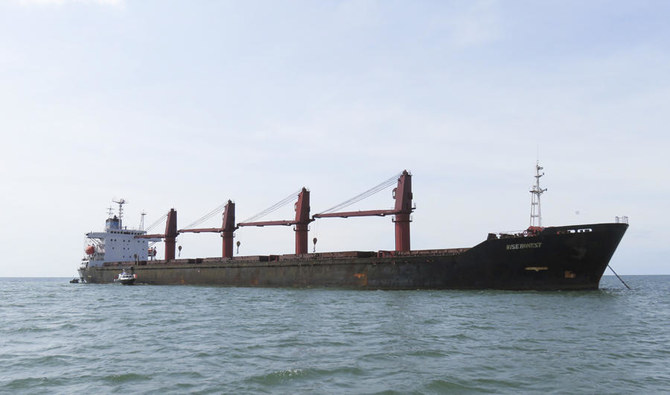
US seizes North Korean ship alleged used to violate international sanctions

This undated photo released by the US Justice Department on May 9, 2019, shows the North Korean cargo ship Wise Honest, which the Trump administration says it has seized because it was used to transport coal in violation of international sanctions. (US Department of Justice handout photo via AP)
Updated 10 May 2019
Follow

US seizes North Korean ship alleged used to violate international sanctions

  • The “Wise Honest,” North Korea’s second largest cargo ship, was detained in April 2018 as it traveled toward Indonesia
  • It’s now in the process of being moved to American Samoa, Justice Department officials said

WASHINGTON: The US said Thursday that it has seized a North Korean cargo ship that was used to violate international sanctions, a first-of-its kind enforcement action that comes amid a tense moment in relations between the two countries.
The “Wise Honest,” North Korea’s second largest cargo ship, was detained in April 2018 as it traveled toward Indonesia. It’s now in the process of being moved to American Samoa, Justice Department officials said.
Officials made the announcement hours after North Korea fired two suspected short-range missiles toward the sea, the second weapons launch in five days and a possible signal that stalled talks over its nuclear weapons program are in trouble. The public disclosure that the vessel is now in US custody may further inflame tensions, though US officials said the timing of their complaint was not a response to the missile launch.
Justice Department lawyers laid out the case for confiscating the ship in a complaint filed in New York, arguing that payments for maintenance and operation of the vessel were channeled through unwitting US financial institutions in violation of American law. The coal trade itself is also believed to fund the isolated country’s nuclear weapons and ballistic missile programs.
“This sanctions-busting ship is now out of service,” Assistant Attorney General John Demers, the Justice Department’s top national security official, told reporters. He later added: “The US sanctions against North Korea reflect the threat these programs pose to US national security.”
The 581-foot (177 meters) Wise Honest was used for coal transports to ports abroad, according to the complaint, generating badly needed revenue to a country that is under UN sanctions because of its nuclear weapons program. The ship also delivered heavy machinery back to North Korea.
The vessel was owned by a subsidiary of a North Korean shipping company that is controlled by the country’s military and is on a Treasury Department sanctions list, officials said.
North Korea sought to disguise the nationality of the ship and the origin of its cargo, according to the complaint. The ship, in what US officials say was a clear act of concealment, also turned off an automatic signal system intended to alert other ships of its course and location. The ship had not broadcast a signal since August 2017 despite having made at least one voyage since then, according to the complaint.
Indonesian authorities intercepted and seized the Wise Honest in the East China Sea a month after it was photographed at the port of Nampo, North Korea, where it took on a load of coal. The captain of the ship was charged in Indonesia with violating that country’s maritime laws and convicted, the complaint says. It was not immediately clear what happened to the rest of the crew, which at least at one time totaled two dozen members.
The US has prosecuted people and businesses for violating sanctions but has never before seized a North Korean ship. The country will have an opportunity to contest the seizure in court. If the US prevails, it will be able to sell the vessel.
“When nations who have stated an intent to do harm to the United States evade international sanctions, Americans become less safe,” said Geoffrey Berman, the United States attorney for the Southern District of New York.
Asked whether North Korea’s largest merchant ship was similarly involved in illegal coal exports, Demers said that he did not know, but added, “If it is, we’d love to get our hands on it.”
President Donald Trump and North Korean leader Kim Jong Un have held two summits focused on the North’s nuclear program but have made no discernible progress toward a deal that would eliminate its weapons. At the White House on Thursday, Trump said the US was looking “very seriously right now” at North Korea’s recent military tests.
“Nobody’s happy about it.”


Progress for Ukraine talks in Paris uncertain with US focus shifting to Venezuela

Updated 5 sec ago
Follow

Progress for Ukraine talks in Paris uncertain with US focus shifting to Venezuela

  • Ukraine’s allies are meeting in Paris to discuss security guarantees after a potential ceasefire with Russia. The Trump administration’s focus on Venezuela could complicate progress
  • France and the UK lead efforts to strengthen post-ceasefire defenses for Ukraine, possibly with European forces

PARIS: Ukraine’s allies are meeting Tuesday in Paris for key talks that could help determine the country’s security after a potential ceasefire with Russia. But prospects for progress are uncertain with the Trump administration’s focus shifting to Venezuela.
Before the US capture of Venezuelan leader Nicolás Maduro, French President Emmanuel Macron had expressed optimism about the latest gathering of so-called “coalition of the willing” nations. For months, they have been exploring how to deter any future Russian aggression should it agree to stop fighting Ukraine.
In a Dec. 31 address, Macron said that allies would “make concrete commitments” at the summit “to protect Ukraine and ensure a just and lasting peace.”
Macron’s office said Tuesday’s meeting will gather an unprecedented number of officials attending in person, with 35 participants including 27 heads of state and government. The US will be represented by President Donald Trump’s envoys, Steve Witkoff and Jared Kushner.
Macron’s office said the US delegation was initially set to be led by Secretary of State Marco Rubio, who changed his plans for reasons related to the military intervention in Venezuela.
Participants seek concrete outcomes on five key priorities once fighting ends: ways to monitor a ceasefire; support for Ukraine’s armed forces; deployment of a multinational force on land, at sea and in the air; commitments in case there’s another Russian aggression; and long-term defense cooperation with Ukraine.
But whether that’s still achievable Tuesday isn’t so clear now, as Trump deals with the aftermath of his decision to effect leadership change in Venezuela.
Ukraine seeks firm guarantees from Washington of military and other support seen as crucial to securing similar commitments from other allies. Kyiv has been wary of any ceasefire that it fears could provide time for Russia to regroup and attack again.
Recent progress in talks
Before the US military operation targeting Maduro, Witkoff had indicated progress in talks about protecting and reassuring Ukraine.
In a Dec. 31 post, Witkoff tweeted that “productive” discussions with him, Rubio, and Kushner on the US side and, on the other, national security advisers of Britain, France, Germany and Ukraine had focused on “strengthening security guarantees and developing effective deconfliction mechanisms to help end the war and ensure it does not restart.”
France, which with the United Kingdom has coordinated the monthslong, multination effort to shore up a ceasefire, has only given broad-brush details about the plan’s scope. It says Ukraine’s first line of defense against a Russian resumption of war would be the Ukrainian military and that the coalition intends to strengthen it with training, weaponry and other support.
Macron has also spoken of European forces potentially being deployed away from Ukraine’s front lines to help deter future Russian aggression.
Important details unfinalized
Ukraine’s President Volodymyr Zelensky said during the weekend that potential European troop deployments still face hurdles, important details remain unfinalized, and “not everyone is ready” to commit forces.
He noted that many countries would need approval from parliament even if leaders agreed to military support for Ukraine. But he recognized that support could come in forms other than troops, such as “through weapons, technologies and intelligence.”
Zelensky said that post-ceasefire deployments in Ukraine by Britain and France, Western Europe’s only nuclear-armed nations, would be “essential” because some other coalition members ”cannot provide military assistance in the form of troops, but they do provide support through sanctions, financial assistance, humanitarian aid and so on.”
“Speaking frankly as president, even the very existence of the coalition depends on whether certain countries are ready to step up their presence,” Zelensky said. “If they are not ready at all, then it is not really a ‘coalition of the willing.’”