KABUL: Humanitarian groups were reeling Thursday from yet another attack targeting aid workers in Afghanistan, as officials confirmed nine people had been killed in a Taliban attack in Kabul a day earlier.
Wednesday’s attack outside Counterpart International, a non-profit group working with marginalized people in Afghanistan, began with an immense blast from a car bomb in a busy commercial area in central Kabul.
Interior ministry spokesman Nasrat Rahimi said the death toll had risen to nine, including five members of the Afghan security forces, a guard at Counterpoint and three civilians.
Anti-poverty group CARE, which has offices close to Counterpart International, said three of its workers — a driver, a watchman and a technical adviser — were killed in the blast.
“This attack reflects the increasing dangers of humanitarian work in conflict-affected countries such as Afghanistan and the unfortunate daily reality of violence for many Afghan families,” CARE said in a statement.
In addition, 20 civilians were wounded in the attack, which saw several Taliban gunmen storm the Counterpoint compound after the blast. They were all killed after Afghan commandos led an hours-long clearance operation.
Wednesday’s massive explosion felled trees and toppled dense concrete blast walls on the street outside Counterpart.
The blast radius extended hundreds of meters (yards) in all directions, blowing out windows in nearby homes and businesses.
Dozens of workers could be seen sweeping debris and broken glass from streets in the popular Shahr-e-Naw neighborhood in central Kabul, which is home to shops, restaurants and hotels.
The Taliban claimed responsibility for the attack, saying Counterpart International was targeted because it promoted the “inter-mixing” of men and women.
Insurgent spokesman Zabihullah Mujahid said on Twitter the aid group had mentored “Kabul admin workers in various aspects of brutality, oppression, terror, anti-Islamic ideology & promotion of western culture.”
According to the UN Office for the Coordination of Humanitarian Affairs, 30 aid workers were killed last year in Afghanistan — one of the most dangerous countries for humanitarians.
Afghanistan was once a hub of foreign aid but deteriorating security has seen international groups downgrade their presence, making it even more difficult to deliver crucial help to the war-torn country’s most vulnerable citizens.
Several aid groups, including Save the Children, have been the target of terror attacks and have suspended operations in the wake of the assaults.
Wednesday’s attack came even as US and Taliban officials were meeting in Qatar for peace talks.


![]()


Kabul aid groups reel after nine killed in Taliban attack
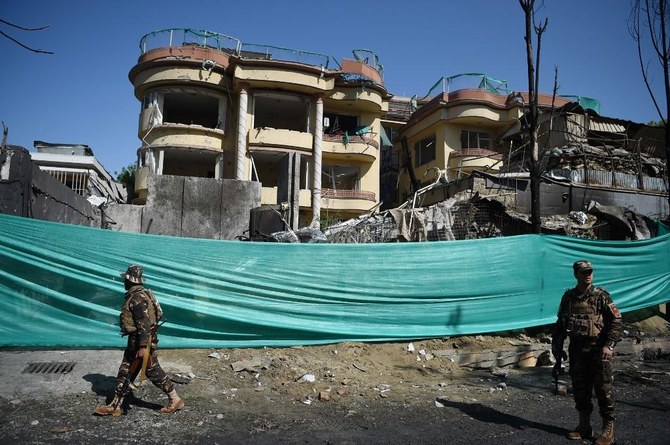
Kabul aid groups reel after nine killed in Taliban attack
- Three workers from an anti-poverty group died in the attack
- Afghan forces and Taliban militia engaged in a fight that lasted hours


Militants kill 6 officers and a civilian in ambushes on police vehicles in northwest Pakistan
- Assailants ambushed a police vehicle and killed one officer in Kohat — When police reinforcements arrived minutes later, they launched another attack and killed five more officers and a civilian
- No group claimed responsibility for this week’s attacks, but suspicion may fall on the Pakistani Taliban, also known as Tehrik-e-Taliban Pakistan, or the TTP
PESHAWAR, Pakistan: A pair of attacks on police vehicles by suspected militants killed at least six police officers and a civilian in northwest Pakistan on Tuesday, authorities said.
The assailants ambushed a police vehicle and killed one officer in Kohat, a district in Khyber Pakhtunkhwa province. When police reinforcements arrived minutes later, they launched another attack and killed five more officers and a civilian, police official Kamran Khan said.
Separately on Tuesday, a suicide bomber detonated explosives at a police post in Bukkur, a district in eastern Punjab province, killing two officers and wounding four others, police official Shahzad Rafiq said.
He provided no further details and only said officers were still investigating.
No group immediately claimed responsibility for the attacks, which have increased across the country in recent months.
President Asif Ali Zardari condemned the attacks in Kohat and Bukkur and offered condolences to the victims’ families.
The latest violence followed an attack on a paramilitary post in Karak on Monday, when a drone loaded with explosives wounded several officers. The attackers later ambushed two ambulances transporting the wounded, killing three officers and burning their bodies before fleeing. The driver of the second ambulance transported several wounded officers despite suffering burn injuries and authorities recovered the remains of the three officers.
No group claimed responsibility for this week’s attacks, but suspicion may fall on the Pakistani Taliban, also known as Tehrik-e-Taliban Pakistan, or the TTP. The TTP is separate from, but closely allied with, Afghanistan’s Taliban. Islamabad has accused the group of operating from inside Afghanistan, a claim the TTP and Kabul deny.
Pakistan’s military said it killed at least 70 militants on Sunday in strikes along the Afghan border, targeting hideouts of Pakistani militants blamed for recent attacks inside the country.
The assailants ambushed a police vehicle and killed one officer in Kohat, a district in Khyber Pakhtunkhwa province. When police reinforcements arrived minutes later, they launched another attack and killed five more officers and a civilian, police official Kamran Khan said.
Separately on Tuesday, a suicide bomber detonated explosives at a police post in Bukkur, a district in eastern Punjab province, killing two officers and wounding four others, police official Shahzad Rafiq said.
He provided no further details and only said officers were still investigating.
No group immediately claimed responsibility for the attacks, which have increased across the country in recent months.
President Asif Ali Zardari condemned the attacks in Kohat and Bukkur and offered condolences to the victims’ families.
The latest violence followed an attack on a paramilitary post in Karak on Monday, when a drone loaded with explosives wounded several officers. The attackers later ambushed two ambulances transporting the wounded, killing three officers and burning their bodies before fleeing. The driver of the second ambulance transported several wounded officers despite suffering burn injuries and authorities recovered the remains of the three officers.
No group claimed responsibility for this week’s attacks, but suspicion may fall on the Pakistani Taliban, also known as Tehrik-e-Taliban Pakistan, or the TTP. The TTP is separate from, but closely allied with, Afghanistan’s Taliban. Islamabad has accused the group of operating from inside Afghanistan, a claim the TTP and Kabul deny.
Pakistan’s military said it killed at least 70 militants on Sunday in strikes along the Afghan border, targeting hideouts of Pakistani militants blamed for recent attacks inside the country.
Latest updates


© 2026 SAUDI RESEARCH & PUBLISHING COMPANY, All Rights Reserved And subject to Terms of Use Agreement.