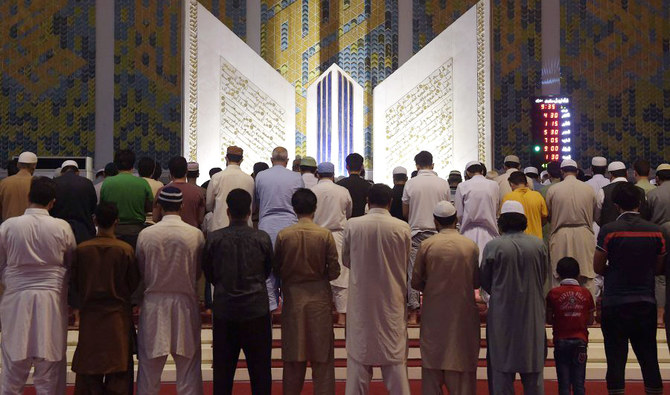

ISLAMABAD: Special lectures on the teachings of the Quran and Hadith and a serene environment have made Faisal Mosque the preferred place of worship for Islamabad denizens for decades and this year too, people turned towards the iconic house of prayer on the evening after the first fast.
At 54,000 square feet, Faisal Mosque, named after Saudi Arabia’s King Faisal bin Abdul Aziz who gave a $120 million grant for its construction, is the largest mosque in South Asia and the fourth largest in the world. It sits at the base of Islamabad’s crown jewel, the Margalla Hills, and can accommodate 250,000 worshippers at one time. The triangular prayer hall alone can squeeze in 100,000 people.
“We prefer to offer our prayers in this mosque during Ramadan because of special training lectures on Quran and Hadith,” said Jameel Ahmad, who was at the mosque with his family to offer Tarawih, or extra prayers performed in the month of Ramadan, on Tuesday night. “We cannot afford to go to Saudi Arabia for Umrah or Hajj,” he said, referring to two important Muslim pilgrimages to Mecca, “but we come here to get solace as this mosque itself has an affiliation with the holy land of the Kingdom.”
Hafiz Abdul Manan Zahidi, a senior official of Dawah Academy that looks after Faisal Mosque, told Arab News the number of worshippers thronging the mosque almost doubles in Ramadan.
In the last ten days of the month especially, citizens and clerics from across the country gathered in the mosque for a holy Quran recitation ritual, Zahidi said, adding that the mosque also made all arrangements to facilitate worshipers wanting to perform Itikaf, an Islamic practice consisting of a period of staying in a mosque for a certain number of days, devoting oneself to worship and avoiding worldly affairs altogether.
He said over 800 applications had been received thus far from people wanting to perform Itikaf at Faisal Mosque, out of which 500 would be chosen after complete screening and security clearance.
“We invite renowned religious scholars from across the country for lectures and training for worshippers during the last ten days of Ramadan,” Zahidi said.
Many worshippers said they particularly enjoyed praying at Faisal Mosque because it was beautiful, its interior covered in intricate mosaics and calligraphy by renowned Pakistani artist Sadequain.