

Myanmar frees two Reuters journalists in amnesty

1 / 5
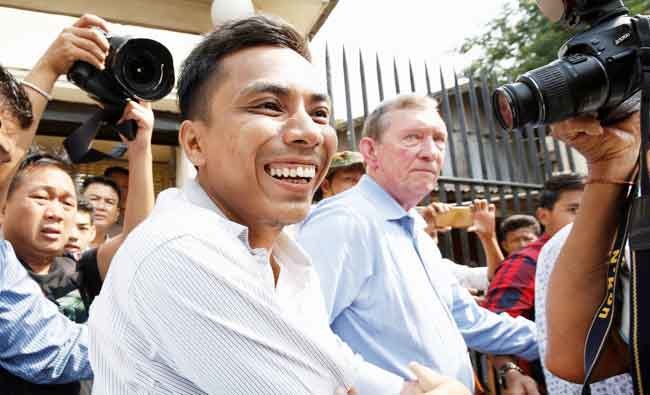
Reuters reporter Wa Lone reacts in a vehicle after being freed from Insein prison after receiving a presidential pardon in Yangon, Myanmar, May 7, 2019. (REUTERS)
2 / 5
Reuters reporter Kyaw Soe Oo reacts after being freed from Insein prison after receiving a presidential pardon in Yangon, Myanmar, May 7, 2019. (REUTERS)
3 / 5
Reuters reporters Wa Lone and Kyaw Soe Oo react in a vehicle after being freed from Insein prison after receiving a presidential pardon in Yangon, Myanmar, May 7, 2019. (REUTERS)
4 / 5
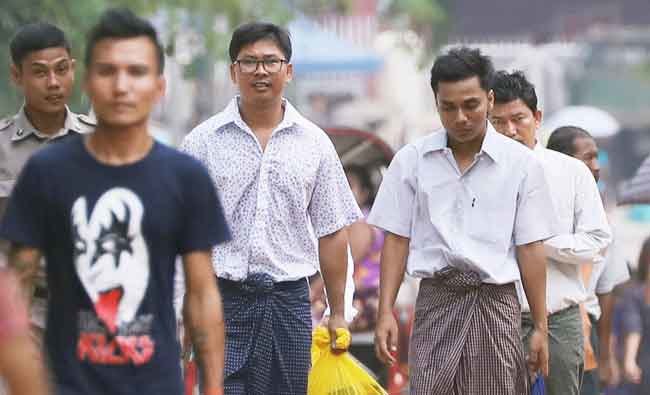
Reuters journalists Wa Lone (centre L) and Kyaw Soe Oo (centre R) gesture outside Insein prison after being freed in a presidential amnesty in Yangon on May 7, 2019. (AFP)
5 / 5
Reuters reporters Wa Lone and Kyaw Soe Oo walk free outside Insein prison after receiving a presidential pardon in Yangon, Myanmar, May 7, 2019. (REUTERS)
Updated 07 May 2019
Follow

Myanmar frees two Reuters journalists in amnesty

  • Before their arrest in December 2017, Wa Lone and Kyaw Soe Oo had been working on an investigation into the killing of 10 Rohingya Muslim men and boys by security forces
  • The operation sent more than 730,000 Rohingya fleeing to Bangladesh, according to U.N. estimates

YANGON: Two Reuters journalists jailed in Myanmar after they were convicted of breaking the Official Secrets Act walked free from a prison on the outskirts of Yangon on Tuesday after spending more than 500 days behind bars, witnesses said.
The two reporters, Wa Lone, 33, and Kyaw Soe Oo, 29, had been convicted in September and sentenced to seven years in jail, in a case that raised questions about Myanmar’s progress toward democracy and sparked an outcry from diplomats and human rights advocates.
President Win Myint has pardoned thousands of other prisoners in mass amnesties since last month. It is customary in Myanmar for authorities to free prisoners across the country around the time of the traditional New Year, which began on April 17.
Reuters has said the two men did not commit any crime and had called for their release.
Swamped by media and well wishers as they walked through the gates of Insein Prison, on the outskirts of the commercial capital of Yangon, a grinning Wa Lone gave a thumbs up and said he was grateful for the international efforts to secure their freedom.
“I’m really happy and excited to see my family and my colleagues. I can’t wait to go to my newsroom.”

Before their arrest in December 2017, Wa Lone and Kyaw Soe Oo had been working on an investigation into the killing of 10 Rohingya Muslim men and boys by security forces and Buddhist civilians in western Myanmar’s Rakhine State during an army crackdown that began in August 2017. The operation sent more than 730,000 Rohingya fleeing to Bangladesh, according to UN estimates.
The report the two men authored, featuring testimony from perpetrators, witnesses and families of the victims, was awarded the Pulitzer Prize for international reporting in May, adding to a number of accolades received by the pair for their journalism. (https://reut.rs/2KFTSgQ)
Calls to a spokesman for the Myanmar government were not immediately answered.
Myanmar’s Supreme Court had rejected the journalists’ final appeal in April. They had petitioned the country’s top court, citing evidence of a police set-up and lack of proof of a crime, after the Yangon High Court dismissed an earlier appeal in January.
The reporters’ wives wrote a letter to the government in April pleading for a pardon, not, they said, because their husbands had done anything wrong, but because it would allow them to be released from prison and reunited with their families.

“MONTHS OF DIALOGUE“
The Reuters journalists were released at the prison to Lord Ara Darzi, a British surgeon and health care expert who has served as a member of an advisory group to Myanmar’s government, and a Reuters representative. Darzi waited for Wa Lone and Kyaw Soe Oo at the gates of Insein prison on a street where a group of dozens of reporters and photographers expecting a release of prisoners were also waiting.
In a statement to Reuters, Darzi, 59, said the release of the two journalists came after “months of dialogue” with the government of Myanmar.
“I am delighted that the Reuters reporters, Wa Lone and Kyaw Soe Oo, have been granted a pardon, released from custody, and are with their loved ones once more. I know that it will come as a huge relief to their families, friends and colleagues,” Darzi said in the statement. “This outcome shows that dialogue works, even in the most difficult of circumstances.”
Darzi said discussions about the pardon for Wa Lone and Kyaw Soe Oo had involved the Myanmar government, Reuters, the United Nations and representatives of other governments but did not provide more detail on those closed-door talks.
Reuters had no immediate comment.
Darzi has been a member of an advisory commission that was formed to see through the advice from a panel headed by former UN chief Kofi Anan on solving the long-running conflict in Myanmar’s western region in the state of Rakhine.
Rakhine, on the Bay of Bengal, was the home to most Rohingya Muslims in Myanmar. Hundreds of thousands fled to Bangladesh after a military-led crackdown on the region in 2017.
Senior Myanmar government officials, diplomats and some international representatives are meeting in Yangon to discuss Rakhine this week.
“The power of dialogue must be turned toward securing a lasting peace in Rakhine State and the return of the hundreds of thousands of refugees, whose desperate plight continues. This is essential if Myanmar is to build on today’s progress so that all its citizens can live together in dignity in the hope of a better tomorrow,” Darzi said in the statement. 


Media watchdogs condemn Israeli airstrike that killed 3 journalists in Gaza, call for investigation

Updated 27 sec ago
Follow

Media watchdogs condemn Israeli airstrike that killed 3 journalists in Gaza, call for investigation

  • International Press Institute, Committee to Protect Journalists and Reporters Without Borders among organizations demanding urgent action

DUBAI: Media watchdogs including the International Press Institute, the Committee to Protect Journalists and Reporters Without Borders have spoken out against Israel’s treatment of media workers following an airstrike that killed 3 journalists in Gaza on Wednesday.

Those killed were Mohammed Salah Qashta, Abdul Raouf Shaat and Anas Ghneim.

The Israeli military said the attack targeted what it had identified as “several suspects” operating a drone and “affiliated with Hamas.”

According to eyewitnesses, the journalists were using a drone to record aid distribution by the Egyptian Relief Committee when the strike hit one of the committee’s vehicles.

The IPI called for an “immediate and credible investigation” and renewed pressure on the international community to take “concrete actions” to hold Israel accountable.

IPI executive director Scott Griffen said the Israeli government has “failed to credibly investigate attacks on journalists” and that the “international community has failed to hold Israel to account for its pattern of targeting and killing journalists.”

He urged strong action, saying that “it is long past time for the international community to take concrete steps to end the cycle of complete impunity for killings of journalists in Gaza.”

The International Federation of Journalists and the Palestinian Journalists Syndicate also condemned the killings and attacks on journalists, calling for an immediate investigation.

The IFJ appealed to all “combatants in this conflict to do their utmost to safeguard journalists and media professionals,” said IFJ general secretary Anthony Bellanger.

“Media workers in areas of armed conflict must be treated and protected as civilians and allowed to perform their work without interference,” he added.

The PJS said that the direct shelling of the journalists’ vehicle constitutes a war crime and a crime against humanity under international humanitarian law, in violation of the Geneva Conventions and UN resolutions that guarantee the protection of journalists during armed conflicts.

The syndicate called on the International Criminal Court to open “urgent and serious investigations” and to “issue arrest warrants against those responsible for the killing of journalists.”

It also urged the UN and other international organizations to take action “rather than limiting their response to statements of condemnation.”

The CPJ condemned the strike, which took place amid a ceasefire, said regional director Sara Qudah.

“Israel, which possesses advanced technology capable of identifying its targets, has an obligation under international law to protect journalists,” she said.

On Thursday, CPJ and RSF called on the 29 member states of the Media Freedom Coalition, in a joint letter, to take concrete steps toward guaranteeing media access to the Gaza Strip.

The move comes ahead of the Israeli Supreme Court hearing on Jan. 26 that will determine whether the press will have independent access to Gaza.

The signatories asked governments to send official representatives to the Jan. 26 hearing and to prioritize press freedom in their engagement with the new technocratic government, formed under a US-backed plan to govern Gaza.

They also urged states to ensure that the International Stabilization Force applies UN Security Council Resolution 2222, which recognizes journalists as civilians during armed conflict and affirms their right to protection and access.

“The inaction of states around the world encourages censorship and sets a dangerous precedent for other conflicts, to the detriment of civilian populations, humanitarian aid and political decisions based on verified facts,” said RSF director general Thibaut Bruttin.

More than 200 Palestinian journalists and media workers have been killed since the start of the war in October 2023, according to multiple reports.