

Pilot says lightning caused deadly Russian crash landing

1 / 3
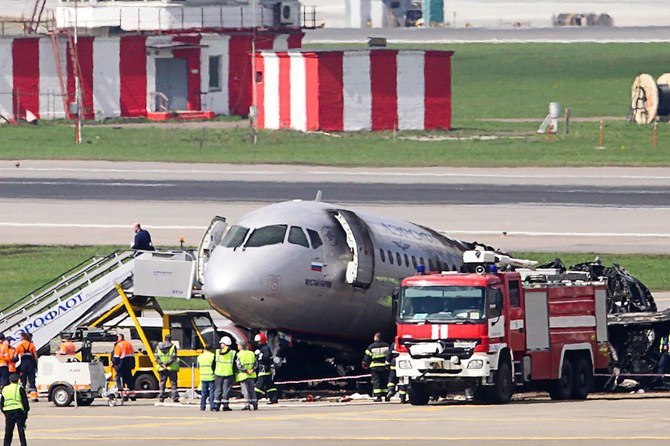
Members of emergency services and investigators work at the scene of an incident involving an Aeroflot Sukhoi Superjet 100 passenger plane at Moscow's Sheremetyevo airport, Russia May 6, 2019. (Reuters)
2 / 3
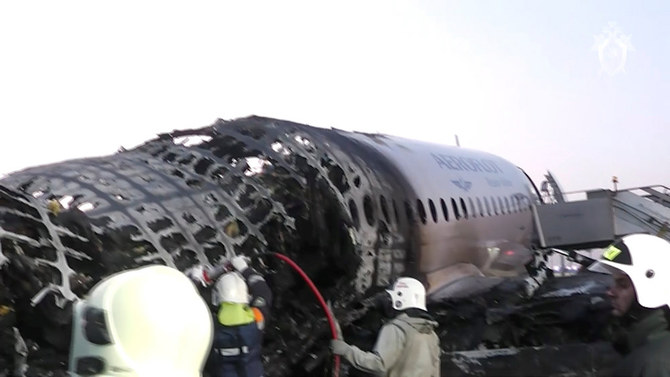
A still image, taken from a video footage and released by Russia’s Investigative Committee on May 6, 2019, shows members of emergency services work at the scene of an incident involving an Aeroflot Sukhoi Superjet 100 passenger plane at Moscow’s Sheremetyevo airport, Russia. (The Investigative Committee of the Russian Federation via Reuters)
3 / 3
This photo taken from a video distributed by Russian Investigative Committee on Monday, May 6, 2019, shows employees of the Russian Investigative Committee working at the wreckage of the Sukhoi SSJ100 aircraft of Aeroflot Airlines at Sheremetyevo airport outside Moscow, (The Investigative Committee of the Russian Federation via AP)
Updated 06 May 2019
Follow

Pilot says lightning caused deadly Russian crash landing

  • The plane that burst into flames was without radio communications because of a lightning strike
  • The Sukhoi SSJ100 reportedly did not jettison any fuel before landing, as is common procedure to reduce the weight of an aircraft that must land shortly after takeoff

MOSCOW: The pilot of a Russian passenger plane that erupted in a ball of fire on the runway of Moscow’s busiest airport, killing 41 people, said lightning led to the emergency landing.
Investigators were on Monday working to understand the causes of the blaze after the Sukhoi Superjet-100 had to return to Sheremetyevo airport shortly after take-off Sunday evening.
Pilot Denis Yevdokimov told Russian media the aircraft lost communication and needed to switch to emergency control mode “because of lightning” on the Aeroflot flight to the Arctic city of Murmansk.
He did not specify if the plane was struck directly.
“We managed to restore communication through the emergency frequency on our radio connection. But the link was only for a short time and kept cutting out... it was possible to say only a few words,” he told the Komsomolskaya Pravda newspaper.
Videos on social media showed the plane crash-landing and then speeding along the runway with flames pouring from its fuselage.
People could be seen leaping onto an inflatable slide at the front and running from the blazing plane as columns of black smoke billowed into the sky.

Another video shot inside the cabin showed roaring flames outside the window and passengers crying out in panic.
Yevdokimov said he believed the plane burst into flames on landing, most likely because of full fuel tanks.
Aside from the dead, nine people were in hospital, three of them seriously injured, authorities said.
US Secretary of State Mike Pompeo said an American citizen had died as he expressed “sincere condolences” to the families of the victims.
Russian President Vladimir Putin offered his condolences to the victims’ loved ones and said the investigation into the disaster “should be as thorough as possible.”
The jet — carrying 73 passengers and five crew members — took off from Sheremetyevo at 6:02pm (1502 GMT) and the crew issued a distress signal shortly afterwards, officials said.
Flight tracking site Flightradar24 showed the plane circling near the capital before landing.
Transport Minister Yevgeny Dietrich said there were no plans to ground the Superjet-100 model.
The charred aircraft surrounded by vehicles and a crane could still be seen from the terminal on Monday afternoon.
The Russian Investigative Committee later said the fragments were moved into a hangar and black boxes handed to experts.
Flight schedules at the airport were disrupted by the accident due to one of the two runways being closed.
Several people on board said they witnessed the lightning strike.

Passenger Pyotr Yegorov told media: “We had just taken off when the plane was hit by lightning... the landing was very hard, we almost passed out from fear.
“The plane bounced on the tarmac like a grasshopper and burst into flames on the ground.”
“We had taken off, we were in a cloud, there was heavy hail,” flight attendant Tatyana Kasatkina told the Rossiya 24 news channel.
“Then it was like a slap, a flash, like electricity. It all happened very fast.”
Vladimir Yevmenkov, another passenger, told TV news he saw lightning striking the right engine of the plane twice from his seat after take off.
“There were two very loud bangs and two flashes, but the engine did not catch fire.
Aviation expert and former construction engineer at Sukhoi, Vadim Lukashevich, said a lightning strike is “does not lead to any catastrophic consequences” for modern planes.
The plane ignited when “the chassis pierced the fuel tank” during a hard blow against the runway, causing a “heavy leak,” he told AFP.
Russia’s national carrier Aeroflot was once notorious for a poor safety record but in recent years its image has improved and it has not had a fatal accident in more than a decade.
The Russian Sukhoi Superjet-100 however has been dogged with problems since its launch in 2011.
In 2012, a Superjet performing at an Indonesian air show slammed into a volcano, killing all 45 people on board. Indonesia blamed the crash on pilot error.
Technical problems with the plane have been reported in recent years and Russia has struggled to convince foreign carriers to purchase it.
The government offered subsidies to encourage Russian airlines to buy the Superjet and Aeroflot has became its main operator.
In 2018, it announced a record order of 100 Superjet-100s.
Russian regional airline Yamal said Monday it had canceled an order for 10 of the jets but said this was to do with servicing costs rather than the crash.
The Murmansk region — where many of those killed or injured are believed to be from — went into a three-day period of mourning from Monday.


Missiles pound Ukraine capital ahead of Russian invasion anniversary

Updated 6 sec ago
Follow

Missiles pound Ukraine capital ahead of Russian invasion anniversary

  • Kyiv has faced waves of overnight strikes in recent weeks as Moscow has intensified its winter assaults
  • The strikes also prompted heightened vigilance across Ukraine’s western border
KYIV: Explosions rocked Kyiv before dawn on Sunday after officials warned of a ballistic missile attack, just two days before the fourth anniversary of Russia’s invasion.
AFP journalists in the capital heard a series of loud blasts beginning around 4:00 a.m. (0200 GMT), shortly after an air raid alert was issued.
“The enemy is attacking the capital with ballistic weapons,” the head of Kyiv’s military administration Tymur Tkachenko said on Telegram, urging people to remain in shelters.
The air force later extended the alert nationwide, warning of a broader missile threat.
Kyiv, regularly targeted by Russian missile and drone attacks since the start of the invasion on Feb. 24, 2022, has faced waves of overnight strikes in recent weeks as Moscow has intensified its winter assaults on energy and military infrastructure.
Temperatures had plunged to nearly minus 10C when the capital was struck again, with emergency services deployed across the city.
Tkachenko later said the attacks had caused a fire on the roof of a residential building.
The strikes also prompted heightened vigilance across Ukraine’s western border.
Poland’s Operational Command said early Sunday it was scrambling jets after detecting “long-range aviation of the Russian federation conducting strikes on the territory of Ukraine.”
It also came hours after blasts in Lviv, a western city near the Polish border that rarely sees deadly attacks.
Explosions ripped through a central shopping street around 12:30 am (2230 GMT Saturday), killing a policewoman and injuring 15 people after officers responded to a reported break-in.
“This is clearly an act of terrorism,” mayor Andriy Sadovyi said, offering no details on perpetrators.
Such attacks far from the front line have become more frequent over the past two years.
Four years of war
Ukraine will mark four years since Russia’s assault on Feb. 24, 2022, a withering war that has shattered towns, uprooted millions and killed large numbers on both sides.
Moscow occupies close to a fifth of Ukrainian territory and continues to grind forward in places, especially in the eastern Donbas region, despite heavy losses and repeated Ukrainian strikes on logistics.
Ukrainian President Volodymyr Zelensky said on Friday that Ukraine “is definitely not losing” the war and that victory remains the goal.
He said Ukrainian forces had clawed back about 300 square kilometers (116 square miles) of territory in recent counterattacks, gains AFP could not immediately verify.
If confirmed, they would be Kyiv’s most significant advances since 2023.
Sweeping outages of Starlink Internet terminals across the Ukraine front, shut down by owner Elon Musk following a plea from Kyiv, have enabled the push, according to Zelensky.
The bombardment also came amid a diplomatic push by Washington to end the four-year war.
Ukrainian, Russian and US envoys have met several times since January, but without a breakthrough.
Zelensky, under mounting pressure from Washington to consider concessions, plans consultations with European leaders in the coming days and wants deeper involvement from Middle Eastern states and Turkiye.