

Lebanon stock trading suspended over central bank strike

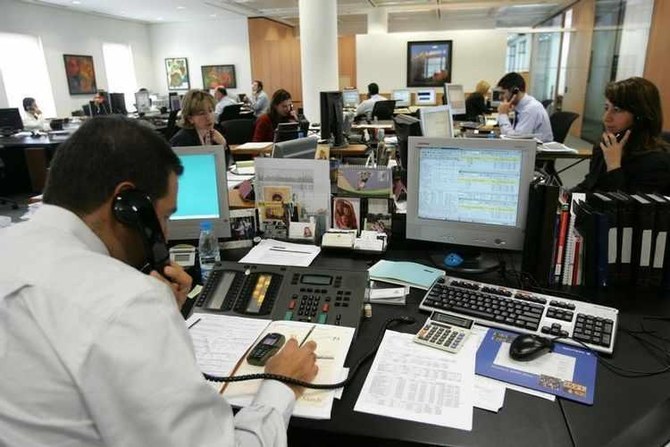
BEMO Bank’s dealing room before the end of a trading session at the Beirut Stock Exchange. (Reuters)
Updated 06 May 2019
Follow

Lebanon stock trading suspended over central bank strike

  • Hundreds of Lebanese public employees are on strike amid concerns that their salaries and benefits might be cut as the government discusses an austerity budget
  • Employees of the Lebanese central bank will decide their next step regarding the strike at a meeting on Tuesday

BEIRUT: The Beirut Stock Exchange suspended trading on Monday due to the open strike declared by employees of Lebanon’s central bank.

Hundreds of Lebanese public employees are on strike amid concerns that their salaries and benefits might be cut as the government discusses an austerity budget.

A statement posted on the stock market’s website Monday said the clearance and settlement of transactions cannot be done on time “during the period of open strike.”

“In order to protect the interest of all investors, the Beirut Stock Exchange declares the suspension of trading in its markets till further notice,” it said.

Employees of the Lebanese central bank will decide their next step regarding the strike at a meeting on Tuesday, the head of their syndicate Abbas Awada said.

In an interview with the Lebanese broadcaster Al-Jadeed, Awada said “a positive decision” may be taken to “facilitate matters” but added that if the government approved the budget in its existing form “we will proceed in an open strike.”

Awada said there had been negative effects and pressure “on the market, on the governor of the central bank, and on all Lebanese,” so “we might have a little positivity to relieve the matter.”

He said central bank governor Riad Salameh opposed the strike action and had asked for it to be lifted.

The draft budget has proposed annulling performance-linked bonuses paid in some state-run institutions including the central bank. In some cases, these have amounted to several months extra salary a year.


European gas prices soar almost 50% as Iran conflict halts Qatar LNG output

Updated 02 March 2026
Follow

European gas prices soar almost 50% as Iran conflict halts Qatar LNG output

  • Analysts warn prolonged disruption could push prices higher
  • Some shipments of oil, LNG through Strait of Hormuz suspended
  • Benchmark Asian LNG price up almost 39 percent

LONDON: ​Benchmark Dutch and British wholesale gas prices soared by almost 50 percent on Monday, after major liquefied natural gas exporter Qatar Energy said it had halted production due to attacks in the Middle East.

Qatar, soon to cement its role as the world’s second largest LNG exporter after the US, plays a major role in balancing both Asian and European markets’ demand of LNG.

Most tanker owners, oil majors and ‌trading houses ‌have suspended crude oil, fuel and liquefied natural ​gas shipments ‌via ⁠the ​Strait of ⁠Hormuz, trade sources said, after Tehran warned ships against moving through the waterway.

Europe has increased imports of LNG over the past few years as it seeks to phase out Russian gas following Russia’s invasion of Ukraine.

Around 20 percent of the world’s LNG transits through the Strait of Hormuz and a prolonged suspension or full closure would increase global competition for other ⁠sources of the gas, driving up prices internationally.

“Disruptions to ‌LNG flows would reignite competition between ‌Asia and Europe for available cargoes,” said ​Massimo Di Odoardo, vice president, gas ‌and LNG research at Wood Mackenzie.

The Dutch front-month contract at the ‌TTF hub, seen as a benchmark price for Europe, was up €14.56 at €46.52 per megawatt hour, or around $15.92/mmBtu, by 12:55 p.m. GMT, ICE data showed.

Prices were already some 25 percent higher earlier in the day but extended gains ‌after QatarEnergy’s production halt.

Benchmark Asian LNG prices jumped almost 39 percent on Monday morning with the S&P Global ⁠Energy Japan-Korea-Marker, widely used ⁠as an Asian LNG benchmark, at $15.068 per million British thermal units, Platts data showed.

“If LNG/gas markets start to price in an extended period of losses to Qatari LNG supply, TTF could potentially spike to 80-100 euros/MWh ($28-35/mmBtu),” Warren Patterson, head of commodities strategy at ING, said. The British April contract was up 40.83 pence at 119.40 pence per therm, ICE data showed.

Europe is also relying on LNG imports to help fill its gas storage sites which have been depleted over the winter and are currently around 30 percent full, the latest data from Gas Infrastructure ​Europe showed. In the European carbon ​market, the benchmark contract was down €1.10 at €69.17 a tonne