


KARACHI: Pakistan appointed Reza Baqir as its new governor for State Bank to replace Tariq Bajwa, who was suddenly removed from the post on Saturday.
Bajwa has resigned, the state bank said on Saturday, as the government pushed to overhaul its financial team in a move in which local media reported the country’s tax collection chief had also been removed.
The exit of the two senior officials, which local media reported had been sacked, comes only weeks after a major cabinet shakeup that saw Finance Minister Asad Umar step down amid vital bailout negotiations with the International Monetary Fund, weakening growth rates and soaring inflation.
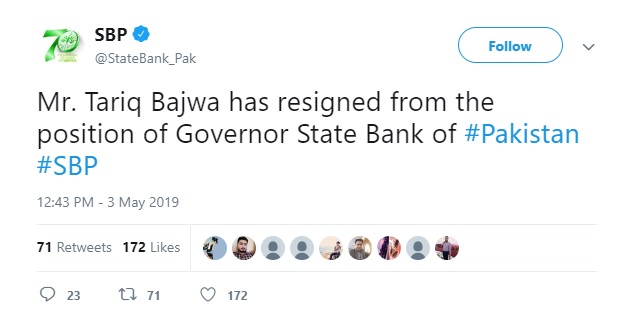
“Mr. Tariq Bajwa has resigned from the position of Governor State Bank of #Pakistan #SBP,” the Bank said on its official Twitter account.
Central bank spokesman Abid Qamar told Reuters that Bajwa had “resigned” and that it was unclear who would replace him.
Dawn newspaper said Bajwa had confirmed to the paper that he was asked to resign while he was in Islamabad for IMF talks.
Bajwa was a key figure in Pakistan’s ongoing talks with the IMF mission, which is currently in Islamabad to evaluate the country’s crippled economy and finalize a financial assistance package.
He was appointed the central bank governor in July 7, 2017 for three years under the last government of Prime Minister Nawaz Sharif and was considered close to the then finance minister Ishaq Dar.
Dar had maintained a “strong rupee” policy that many observers have blamed for Pakistan’s current economic woes, including ballooning budget and current account deficits. The IMF is pushing Pakistan to embrace a more flexible rupee policy.
As per rules, deputy state bank governor Jameel Ahmed is expected to take charge as acting governor until the slot is officially filled by the government.
Local media also reported on Saturday that the chairman of the Federal Board of Revenue, Dr. Jahanzeb Khan, had been removed late Friday night.
The government was allegedly dissatisfied with low tax collection rates during its first year in office, unacceptable to premier Imran Khan who came to power in July polls last year promising to build a welfare state for the poor.
The FBR is on course to register one of the highest shortfalls in tax collection in the Bureau’s history, expected at Rs350 billion.
Local media reports also suggested the FBR chief had been sacked for refusing to own a new tax amnesty scheme being finalized by the federal cabinet.
Last month, the government urged all Pakistanis to declare their unreported income and assets and bring their money into the tax base after paying a 5 percent one-off penalty. Those living overseas would pay a 2 percent one-time fine.
Ending a culture of rampant tax evasion is high on the agenda in IMF negotiations. PM Khan has also vowed to double tax collection by reforming the FBR. In fact, one of Khan’s first acts as premier was to replace the FBR chief with Jahanzeb Khan, who was reportedly sacked on Friday night.
Pakistan’s history is littered with statements by incoming governments pledging tax reforms that fizzle out because of a lack of political will to force the rich and powerful to pay up.
As of last year, only 1.6 million people in Pakistan filed tax returns.
In March, the central bank said Pakistan’s economic growth was set to slow to between 3.5-4.0 percent in the 2019 fiscal year from 5.2 percent in 2018, with a fiscal deficit of 6.0-7.0 percent. The IMF paints a gloomier picture, predicting growth of 2.9 percent in 2019 and 2.8 percent next year.
Pakistan’s consumer price inflation in March rose to its highest since November 2013, hitting 9.41 percent year-on-year, before easing to 8.82 percent in April.


