

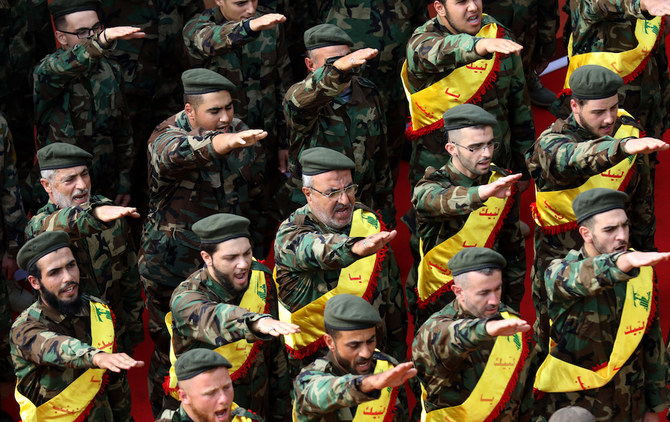
Guterres calls on Lebanese government to prevent Hezbollah holding weapons

UN Secretary-General Antonio Guterres called on the Lebanese government to prevent Hezbollah and other groups from owning weapons in a report issued by the UN on Friday. (File/ AFP)
Updated 03 May 2019
Follow

Guterres calls on Lebanese government to prevent Hezbollah holding weapons

  • Hezbollah has a large militia that has taken part in Syria's civil war alongside President Bashar Al-Assad's government
  • In May 2018, Guterres strongly criticized Hezbollah for operating as the most heavily armed militia and a political party in Lebanon

LONDON: UN Secretary-General Antonio Guterres called on the Lebanese government to prevent Hezbollah and other groups from owning weapons in a report issued by the UN on Friday. 

The report added that the presence of armed militias threatened Lebanon's stability and security. 

It also stressed the need for the state to monopolize weapons and the use of force. 

In May 2018, Guterres strongly criticized Hezbollah for operating as the most heavily armed militia and a political party in Lebanon and urged the militant group to halt military activities inside and outside the country, including in Syria.

In a report to the Security Council, Guterres also called on Lebanon’s government and armed forces “to take all measures necessary to prohibit Hezbollah and other armed groups from acquiring weapons and building paramilitary capacity” outside the authority of the state.

“In a democratic state, it remains a fundamental anomaly that a political party maintains a militia that has no accountability to the democratic, governmental institutions of the state but has the power to take that state to war,” he said. 

Hezbollah, which is mainly financed by Iran, is considered a terror group by the US, Canada, Israel and the Arab League.

The heavily armed group has a large militia that has taken part in Syria's civil war alongside President Bashar Al-Assad's government, and also has elected members of parliament and positions in Lebanon's national unity government.

The group's influence over Lebanese state institutions has expanded in the last year. Together with allies that view its arsenal as an asset to Lebanon, it won more than 70 of parliament's 128 seats in an election last year.

The group has taken three of the 30 portfolios in the government formed by the Western-backed Prime Minister Saad Al-Hariri in January, including the health ministry - the first time it has held a ministry with a significant budget.


Hamas official says group in final stage of choosing new chief

The official said the race for Hamas’s leadership is now between Khaled Meshaal (L) and Khalil Al-Hayya (R). (File/AFP)
Updated 51 min 30 sec ago
Follow

Hamas official says group in final stage of choosing new chief

  • Hayya, 65, a Gaza native and Hamas’s chief negotiator in ceasefire talks, has held senior roles since at least 2006
  • Meshaal, who led the political bureau from 2004 to 2017, has never lived in Gaza

CAIRO: A senior Hamas official told AFP on Sunday that the Palestinian movement was in the final phase of selecting a new leader, with two prominent figures competing for the position.
Hamas recently completed the formation of a new Shoura Council, a consultative body largely composed of religious scholars, as well as a new political bureau.
Members of the council are elected every four years by representatives from Hamas’s three branches: the Gaza Strip, the occupied West Bank and the movement’s external leadership.
Hamas prisoners in Israeli jails are also eligible to vote.
The council subsequently elects the political bureau, which in turn selects the head of the movement.
“The movement has completed its internal elections in the three regions and has reached the final stage of selecting the head of the political bureau,” the official said, speaking on condition of anonymity as he was not authorized to speak publicly.
He added that the race for the group’s leadership is now between Khaled Meshaal and Khalil Al-Hayya.
A second Hamas source confirmed the development within the organization, which fought a devastating war with Israel following its October 7, 2023 attack.
Hayya, 65, a Gaza native and Hamas’s chief negotiator in ceasefire talks, has held senior roles since at least 2006, according to the US-based NGO the Counter Extremism Project (CEP).
Meshaal, who led the political bureau from 2004 to 2017, has never lived in Gaza. He was born in the West Bank in 1956.
He joined Hamas in Kuwait and later lived in Jordan, Syria and Qatar. The CEP says he oversaw Hamas’s evolution into a political-military hybrid.
He currently heads the movement’s diaspora office.
Last month, a Hamas source told AFP that Hayya enjoys backing from the group’s armed wing, the Ezzedine Al-Qassem Brigades.
After Israel killed former Hamas leader Ismail Haniyeh in Tehran in July 2024, the group chose its then-Gaza chief Yahya Sinwar as his successor.
Israel accused Sinwar of masterminding the October 7 attack.
He too was killed by Israeli forces in the southern Gaza city of Rafah, three months after Haniyeh’s assassination.
Hamas then opted for an interim five-member leadership committee based in Qatar, postponing the appointment of a single leader until elections, given the risk of the new chief being targeted by Israel.