

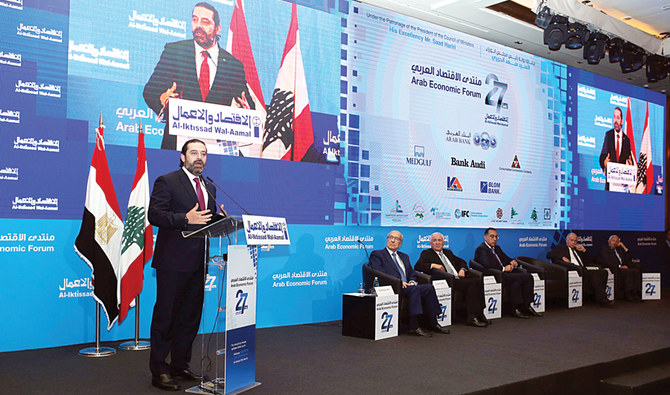

BEIRUT: Lebanon is committed to “carrying out the required economic reforms despite the existing difficulties,” Prime Minister Saad Hariri said in his opening address at the 27th Arab Economic Forum in Beirut.
The task is “not easy, especially if we want to fight corruption and waste,” he added. His speech came after Lebanon’s labor union called a strike to protest austerity measures.
“Waste is a huge calamity in Arab countries, and the real waste lies in the time we’re wasting every day without developing our laws. When our energy bill reaches $40 billion, this too is waste,” said Hariri, who spoke of “optimistic reform plans.”
He added: “These reforms are in the interest of Lebanese citizens and the youth who can’t find jobs.” He promised to rebuild the country as his father did when he was prime minister.
There is a need to “tighten the belt because our financial situation is worn out, so either we all sink or we put an end to the economic decline for everyone’s sake,” Hariri said at a Cabinet session this week.
“Any action in this sense isn’t against any Lebanese group, but aims to protect all the people of Lebanon.”
Addressing the Arab Economic Forum, he said: “Today, we have a choice to make in Lebanon: Do we want to reach a point of economic collapse, or do we want to look at a country like Egypt and say this is the experience we must implement? This is the change we must make.”
He added: “There are changes and openness (in the Arab Gulf states), which we also see in Egypt. We hope this change is contagious and expands to the entire Arab world so that we all work together as one team.”
At the forum, Egypt’s Prime Minister Mostafa Madbouli outlined his country’s efforts in recent years to implement economic reforms in order to achieve comprehensive and sustainable economic, social and environmental growth.
“Egypt has begun to reap the fruits and positive results of the reforms, the most important of which was achieving an annual economic growth rate of 5.3 percent during the fiscal year 2017/2018, the highest in 10 years,” he said.
“The balance of payments has generated a surplus of about $12.8 billion, and the extent of foreign exchange reserves held rose from $14.9 billion in June 2014 to $44 billion in February 2019, covering about eight months of commodity imports after it used to cover three months only.”
Arab League Secretary-General Ahmed Aboul Gheit spoke of the region’s need for about 50 million more jobs by the middle of the century.
 “We need to create jobs that are suitable for the education and expertise of the youth,” he said. “Unemployment rates are dramatically rising among the educated youth, and we can’t remain indifferent toward this phenomenon.”
Mohamed Abdo Saidou, president of the Federation of Arab Chambers of Commerce, said: “Strengthening reliance on the digital economy would contribute more than $3 trillion to the growth of Arab GDP (gross domestic product).”
He urged Arab governments to strengthen the private sector’s role so that it acts as the driver and largest employer of Arab talent. He also called for inter-Arab alliances to provide parallel development.
Joseph Torbey, chairman of the Association of Banks in Lebanon and the World Union of Arab Bankers, said: “In light of current and forthcoming developments, the pressures on Arab banks and the challenges facing them, including the continuing slowdown in deposit growth and the decline in asset quality, are expected to continue.”
He called for “formulating economic development and reform plans in our region through diversifying sources of economic growth, entering into a new generation of reforms, promoting entrepreneurship, strengthening sources for financing SMEs (small and medium enterprises) and start-ups, and developing the knowledge economy as a key growth engine.”
Torbey said: “The banking sector in Lebanon is a key player in Lebanon’s economic life, and has helped maintain monetary stability over the past quarter-century, curbed inflation, and protected the purchasing power of salaries, wages and low-income groups. Therefore, the banking system and its deposits shouldn’t be subject to seasonal tax on every occasion.”


