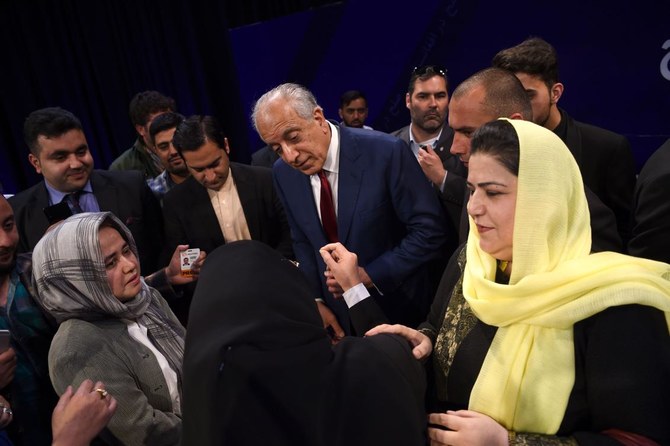
KABUL: American and Taliban officials resumed talks in Qatar on Wednesday aimed at ending a 17-year war in Afghanistan, while the Afghan government hosted a rare assembly in Kabul to ensure its interests are upheld in any peace deal.
The Taliban issued a statement saying the US special envoy for peace in Afghanistan, Zalmay Khalilzad, had met the Taliban’s political chief Mullah Abdul Ghani Baradar, who is heading the militants’ delegation.
“Views were exchanged about key aspects for a peaceful resolution of the Afghan issue,” its spokesman Zabihullah Mujahid said.
The talks are part of US President Donald Trump’s efforts to end America’s longest war, which began when US-backed forces ousted the Taliban weeks after the Sept. 11, 2001, attacks on the United States.
Since October, US and Taliban officials have held several rounds of talks aimed at ensuring a safe departure for US forces in return for a Taliban guarantee that Afghanistan will not be used by militants to threaten the rest of the world.
“It is absolutely vital that the two key agenda points — full withdrawal of foreign forces from Afghanistan and preventing Afghanistan from harming others — be finalized,” Mujahid said. “This will open the way for resolving other aspects of the issue and we cannot enter into other topics before this,” he said.
In this round, Khalilzad and his delegation are expected to focus on a declaration of a cease-fire as a first step to end the fighting, said a western diplomat in Kabul.
An official working closely with Khalilzad said he is expected to encourage the insurgent group to engage in Afghan-to-Afghan talks to find a political settlement to end the war, but Mujahid said the Afghan representatives were not allowed to attend the ongoing talks. “No other side except the US and Taliban representatives in the meeting, but some Qatari officials will remain present as hosts,” he told Reuters.
This week, Afghan President Ashraf Ghani convened a rare grand assembly known as the Loya Jirga to set out Kabul’s conditions for peace talks with the Taliban.
The Jirga has a purely consultative function, but it carries significance in Afghan politics and society.
An intra-Afghan meeting involving the Taliban was scheduled to take place in Doha last month but a dispute about who should participate and in what capacity prompted the extremist group to pull out at the last minute.
The Taliban has so far refused to talk to Kabul and have labeled the Afghan government as a “US puppet.”
Ghani believes that backing from members of the Loya Jirga will strengthen his bid to be recognized as Afghanistan’s legitimate representative in the peace talks.
The assembly includes 3,200 tribal elders, politicians and community and religious leaders from all 34 provinces.
But opposition politicians and government critics, including former president Hamid Karzai, are boycotting the meeting. They accuse Ghani of using it as a platform to boost his status as a leader in an election year.
Omar Daudzai, Ghani’s special envoy for peace, said at the assembly he welcomed the US-Taliban talks in Qatar but Afghan voices should be heard at the negotiating table.
“The Loya Jirga is the rational and logical start of the peace talks,” he told reporters, adding that the assembly would also examine the role of foreign powers in Afghanistan.
The United States has about 14,000 troops in Afghanistan as part of a NATO-led mission, known as Resolute Support, that is training and assisting the Afghan government’s security forces in their battle against Taliban fighters and extremist groups such as Daesh and Al-Qaeda.
Intense fighting is still going on all over the country, and while the Taliban are negotiating, they now control and have influence over more territory than at any point since 2001.


![]()

US and Taliban resume talks as Kabul seeks role in peace process
US and Taliban resume talks as Kabul seeks role in peace process
- The talks are part of US President Donald Trump’s efforts to end America’s longest war
- Khalilzad has been tasked with finding a negotiated end to Afghanistan’s 17-year war and America’s longest military confrontation


Latest updates


Recommended


© 2026 SAUDI RESEARCH & PUBLISHING COMPANY, All Rights Reserved And subject to Terms of Use Agreement.