GENEVA: The UN human rights chief says thousands of lives are at risk in parts of conflict-ridden Libya, decrying an escalation of attacks in residential areas with artillery, rockets and airstrikes.
Michelle Bachelet’s office highlighted her “grave concern” about thousands of civilian men, women and children stuck in conflict-hit areas of Tripoli, the capital, in a statement Tuesday.
She also expressed concerns about some 3,350 migrants and refugees held in detention centers near the conflict zones. She pointed to reports of food and water shortages that some face.
The statement said some “are reportedly being forced to work for militias controlling their detention centers.”
Bachelet called for efforts to allow trapped civilians to leave conflict areas, and urged an immediate cease-fire and a resumption of political talks.

UN rights chief: Libya fighting endangers thousands of lives
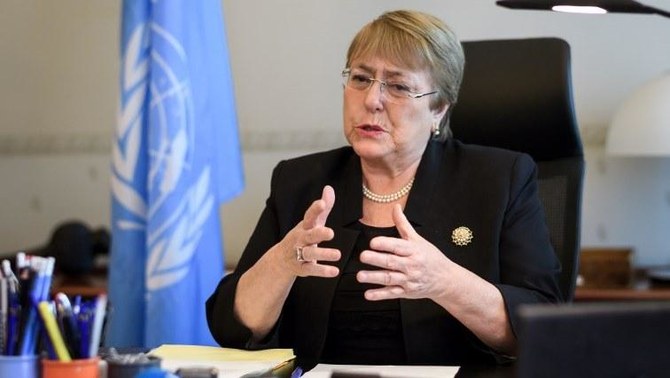
- Michelle Bachelet expressed her “grave concern” about thousands of civilian men, women and children stuck in conflict-hit areas of Tripoli
Algeria parliament approves amended law criminalizing French rule
- “Algeria, which sacrificed millions of martyrs for its freedom, independence and sovereignty, will never bargain away its memory or its sovereignty for any material advantage,” he told the lower house
ALGIERS: Algeria’s parliament on Monday approved an amended law criminalizing French colonial rule, removing earlier provisions that called for official apologies and broad reparations from France after Senate demanded the changes.
The law, approved by the lower house in December, had declared France’s colonization of Algeria from 1830 to 1962 a crime and demanded an apology and reparations, with Paris calling it “hostile.”
But in January the Senate said some articles of the text did not fully reflect the official approach set out by President Abdelmadjid Tebboune, who had said Algeria did not need financial reparations from France.
A clause seeking compensation for victims of French nuclear tests in Algeria remains unchanged.
Fawzi Bendjaballah, rapporteur of the joint committee tasked with revising the bill, said the changes reflected the “principled and unwavering position of the Algerian state.”
“Algeria, which sacrificed millions of martyrs for its freedom, independence and sovereignty, will never bargain away its memory or its sovereignty for any material advantage,” he told the lower house.
France called the bill “clearly hostile,” coming at a time of diplomatic friction between the two countries.
Relations soured in late 2024 when France officially backed Moroccan sovereignty over the disputed Western Sahara, where Algeria backs the pro-independence Polisario Front.
Algeria says the war with colonial France killed 1.5 million people. French historians put the death toll lower at 500,000, 400,000 of them Algerian.
The bill states that France holds “legal responsibility for its colonial past in Algeria and the tragedies it caused.”
It lists the “crimes of French colonization,” including nuclear tests, extrajudicial killings, “physical and psychological torture,” and the “systematic plundering of resources.”
However, Tebboune had said in a speech in December 2024 that Algiers was “not tempted by money, neither euros nor dollars.”
“We demand recognition of the crimes committed in the country” by France, he said. “I am not asking for financial compensation.”
Before taking office, French President Emmanuel Macron had acknowledged that his country’s colonization of Algeria was a “crime against humanity,” but Paris has yet to offer Algiers a formal apology.