

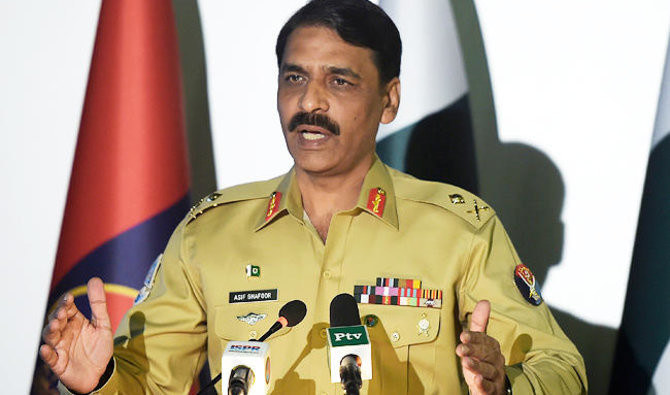

ISLAMABAD: Pakistan army spokesman Maj. Gen. Asif Ghafoor on Monday warned the leaders of ethnic Pashtun Tahaffuz Movement (PTM) of legal action against them for inflammatory speeches against state institutions while accusing them of links with Indian and Afghan spy agencies and questioning their sources of funding.
Addressing a press conference in Rawalpindi, the director general of Inter Services Public Relations (ISPR) said the army had details of PTM's covert funding received from National Directorate of Security (NDS) in Afghanistan and the Indian Research and Analysis Wing (RAW) along with the trail of PMT leaders' secret visits to Indian consulates in Afghanistan.
“How much money did you get from the NDS to keep your protest running? How much money did RAW give you for your first sit-in in Islamabad?"
The PTM was founded in January 2017 to protest alleged extrajudicial killings, arbitrary detentions and disappearance of young ethnic Pashtun men under the guise of operations against the Pakistani Taliban and other militants in the country’s northwestern tribal regions. Leaders of the movement blame Pakistan’s military for these abuses, which the army strongly denies.
Talking to the media at the General Head Quarters (GHQ), Ghafoor said the army heeded PTM's demands, which were only three in the beginning including clearance of mines from the tribal districts, abolition of check posts, and recovery of missing persons.
De-mining the area was a "genuine demand" of which 45 percent work has been completed while "101 soldiers were lost in the process," disclosed Ghafoor. He said the check-posts were required to monitor the area and that for the missing persons, a judicial commission was formed to probe the list of 8,000 handed over by the PTM. "There are around 2,500 unsolved cases left from that list," he continued, adding that many of the people in the list may have likely become part of Taliban's foot soldiers in Afghanistan and joined other militant outfits fighting in conflict-riddled countries.
Accusing the PTM of violating the country's law and constitution, Ghafoor said, “Nobody can fight the state. We care about the people that you're trying to instigate otherwise it is not difficult to deal with you.”
“Why does TTP [Tehrik-e-Taliban Pakistan] speak in favour of PTM? Why is your narrative similar,” he asked the PTM leaders.
He said that PTM leaders were exploiting the sufferings of terror-hit people of the tribal belt to run a campaign against the army, which will be duly dealt with according to the law.
“Their time is up! We will not bother the people. No illegal course will be adopted. Everything will be done under the law but you have taken all the liberty that you wanted,” said Ghafoor.
Meanwhile, he warned arch-rival India against nuclear sabre-rattling.
“Don’t test our resolve. The army with the support of 207 million Pakistanis will respond to any aggression with full force," he said while taking a jibe at India for its “repeated lies” against Pakistan after Pulwama incident in the Indian-held Kashmir on February 14 wherein around 40 Indian paramilitary troops were killed in a suicide attack.
Talking about Pakistan’s education system, he said over 25 million children were out of schools who at some state get enrolled in madrassas [religious seminaries]. "There are 30,000 of such madrassas in Pakistan at the moment out of which less than 100 were found to be the kind that were pushing children towards extremism,” he said.
Stressing equal job opportunities for all students, he said the government had decided to "mainstream all the madrasahs where children will be taught contemporary subjects” and new teachers would be employed in this regard to ensure equal opportunities of job and career options. Clerics of all schools of thoughts had been taken on board for this purpose and the process will be completed in three different phases, he added.
“Initially two billion rupees will be required to run this program and then one billion rupee will be required each year for the program’s upkeep,” he said.
The spokesman said that overall security situation has improved in the country due to 1,237 kinetic operations carried out by the armed forces to flush out the militants. However, to say that there are no remnants of terror at all would be incorrect. "There are people who keep switching the bandwagon but we can say with confidence that no organized structure of any terrorist organization, including Daesh, exists in Pakistan today.”


