LONDON: Officials in London are trying to determine if a stenciled mural that appeared at a base camp for climate protests was created by the street artist Banksy.
The mural is on a wall at Marble Arch, where the group Extinction Rebellion had an encampment for 10 days until Thursday and disrupted transportation in the British capital with daily, targeted non-violent protests.
The artwork shows a child holding an Extinction Rebellion sign beside the words “From this moment despair ends and tactics begin.”
Nickie Aiken, the leader of Westminster Council, a local authority that oversees the area, said “we believe it’s genuine and are working to confirm that it is the case.”
“This street art has clearly captured the public mood and imagination, and so we’re looking to keep it in a public place for people to enjoy,” she said.
There was no mention of the work Friday on Banksy’s website or Instagram account, where he typically confirms authorship. Banksy’s spokeswoman did not immediately respond to a request for comment.
More than 1,100 people were arrested for blocking roads and bridges during more than a week of Extinction Rebellion protests aimed at alerting the public and politicians to the “climate emergency.”
Banksy, who has never disclosed his full identity, began his career spray-painting buildings in Bristol, England. He has become one of the world’s best-known artists through works tinged with satire and social commentary.
Last year his painting “Girl With Balloon” sold for 1 million pounds ($1.3 million) at a Sotheby’s auction — and was immediately partially destroyed by a shredder that the artist had concealed in the frame.
The buyer went ahead with the purchase.

Climate mural emerges after London protests; Is it Banksy?
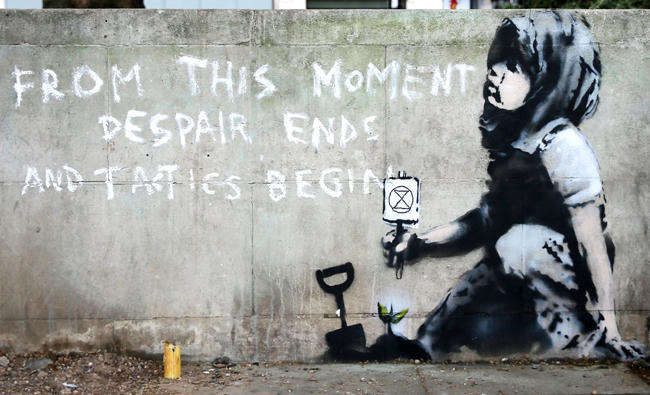
- More than 1,100 people were arrested for blocking roads and bridges during more than a week of Extinction Rebellion protests aimed at alerting the public and politicians to the “climate emergency”
What Bangladesh’s election means for India, China and Pakistan ties
- Bangladeshis will vote on Feb. 12, almost two years after the 2024 student-led uprising
- After nearly 2 years of tensions, experts expect a thaw with India under elected government
DHAKA: As Bangladesh prepares to hold its first elections since the 2024 ouster of Sheikh Hasina, its longest-serving prime minister, the outcome will define Dhaka’s relations with the most important regional powers — China, India, and Pakistan.
Nearly 128 million Bangladeshis will head to the polls on Feb. 12 to bring in new leadership after an 18-month rule of the current caretaker administration.
The interim government, led by Nobel laureate Muhammad Yunus, took control following a student-led uprising that ended 15 years in power of Hasina and her Awami League party.
The two main parties out of the 51 competing for power are the Bangladesh Nationalist Party and Jamaat-e-Islami. The Awami League, which for decades has had close ties with India, was excluded from the election ballot over its role in the deadly crackdown on the 2024 student-led protests, in which 1,400 people were killed.
While Bangladesh’s relationship India has deteriorated since the fall of Hasina, who has been in self-exile in New Delhi, the period of diplomatic strain is expected to ease when the new government takes office.
“Whoever comes to power in Bangladesh, due to domestic pressure in the country, relationships with India need a resetting,” Humayun Kabir, former ambassador to the US, told Arab News.
“It’s anticipated that India will also engage with the new government, but they will protect their interests, and we also have to do the same. It’s most likely that the India-Bangladesh relationship will be normalized under the new, elected, government.”
Since 2024, India has suspended key transshipment access that allowed Bangladeshi exports to go via Indian ports and airports. It also put on hold most normal visa services for Bangladeshis, who were among its largest groups of medical tourists.
From Hasina’s heavy pro-India orientation, the interim government has tried to rebalance Bangladesh’s foreign policy toward the two other key regional players — China and Pakistan — who at the same time are India’s main rivals.
If New Delhi regains its importance, it should not deal a blow to the newly expanded relations with Pakistan, with whom Bangladesh has recently increased exchanges, especially economic, and last month resumed direct flights — after a 14-year gap.
Since the relations have been expanded under the caretaker government, Prof. Delwar Hossain from the International Relations Department at Dhaka University forecast that they would only further improve, no matter who comes to power, and there is no likelihood of a sudden change.
“For Pakistan, any political coalition — whether BNP or Jamaat — will be positive. The BNP has a long history of having good relations with Pakistan during their rule ... Jamaat also has a strong and very positive influence in Pakistan,” he said.
“For Pakistan, the new regime or new government is not the issue. The issue is what the (India) policy of the new government would be and to what extent it would actually support Pakistan’s view.”
Both the BNP and Jamaat have repeatedly said they wanted friendly relations with India, and Hossain expected that they would, at the same time, continue the balanced approach introduced by the caretaker administration.
“India is a reality as a neighbor. At the same time, India is also showing interest in mending relations or adopting a more cooperative approach after the vote, with the government that will be elected ... I think there will be pragmatism from both sides,” he said.
“I don’t see there is a long-term threat to Bangladesh-India relations ... When China and Pakistan were trying to create a trilateral cooperative system or some kind of coalition — China, Bangladesh and Pakistan — we have seen that Bangladesh opted out. It seems that Bangladesh is going to continue its policy of maintaining a balance among these great powers.”
Bangladesh’s relations with China have not changed since the ouster of Hasina, whose government signed several economic agreements with Beijing. Yunus’s administration has continued this cooperation, and China was among the very few countries he officially visited during his term.
During the visit, he secured about $2.1 billion in Chinese investments, loans and grants, including funding for infrastructure like Mongla Port and a special economic zone in Chattogram — Bangladesh’s largest port. China has also eased visa rules for Bangladeshi businesspeople, medical travelers and tourists.
According to Munshi Faiz Ahmed, Bangladesh’s former ambassador to Beijing, China’s importance for Bangladesh cannot be substituted by any other country, especially as over the past few years it has emerged not only as its key investor, but also the largest trade partner.
In the fiscal year 2024-25, Bangladesh’s trade with China was over $21.3 billion, according to National Board of Revenue data. With India, it was about $11.5 billion.
The trade — especially import — dependence on Beijing started long before the regime change. In terms of trade volume, China overtook India already in 2018.
“Even when people thought that we had very close relations with India, our relations with China continued to grow in terms of trade and commerce ... Our trade with China has surpassed India’s, and China is a much bigger investor in Bangladesh’s development projects,” Ahmed said.
“Bangladesh will continue to cooperate with China for a long time to come because what China can provide, no other country can.”


