WASHINGTON: For the past three years, virtually nothing has hatched at Antarctica’s second biggest breeding grounds for emperor penguins and the start of this year is looking just as bleak, a new study found.
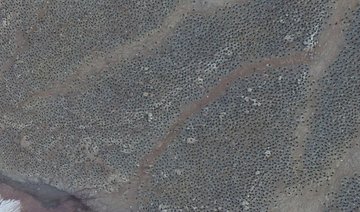
Usually 15,000 to 24,000 breeding pairs of emperor penguins flock yearly to a breeding site at Halley Bay, considered a safe place that should stay cold this century despite global warming. But almost none have been there since 2016, according to a study in Wednesday’s Antarctic Science.
The breeding pair population has increased significantly at a nearby breeding ground, but the study’s author said it is nowhere near the amount missing at Halley Bay.
“We’ve never seen a breeding failure on a scale like this in 60 years,” said study author Phil Trathan, head of conservation biology at the British Antarctic Survey. “It’s unusual to have a complete breeding failure in such a big colony.”
Normally about 8% of the world’s emperor penguin population breeds at Halley Bay, Trathan said.
Black-and-white with yellow ears and breasts, emperor penguins are the largest penguin species, weighing up to 88 pounds (40 kilograms) and living about 20 years. Pairs breed in the harshest winter conditions with the male incubating their egg.
Scientists blame the sharp decline on climate and weather conditions that break apart the “fast ice” — sea ice that’s connected to the land — where the emperor penguins stay to breed. They incubate their eggs and tend to their chicks — one per pair — on ice. After breeding and tending to the chicks, the penguins move to open sea.
In 2016 and 2017, there was no breeding in Halley Bay and last year there was just a bit, the study found.
The nearby Dawson-Lambton breeding area, which had been home to a couple thousand pairs, increased to 11,117 pairs in 2017 and 14,612 pairs in 2018, the study said.
While that’s encouraging, it doesn’t make up for all that was lost at Halley Bay, Trathan said. “Not everybody has gone to Dawson Lambton yet,” he said.
What’s troubling isn’t that part of the colony has moved to Dawson-Lambton, it is that scientists thought of Halley Bay as a climate change refuge in one of the coldest areas of the continent “where in the future you expect to always have emperors,” Trathan said.
David Ainley, a marine ecologist and penguin expert at the consulting firm H.T. Harvey & Associates, worried that some people will be more alarmed than they need to be because many of the penguins didn’t disappear, but just moved. While not as scary as it may sound initially, with climate change “long term, it’s another question as alternate breeding sites likely will become harder to find,” said Ainley, who was not part of the study.
The study makes sense, and sometimes dramatic environmental change can cause a breeding failure like this, said Stephanie Jenouvrier, a penguin expert at Woods Hole Oceanographic Institution who wasn’t part of the study.
Trathan said a super strong El Nino — a natural cyclical warming of the central Pacific that changes weather worldwide — melted sea ice more than usual and exposed the fast ice to wind and waves, making the breeding home less stable. He said it’s not possible to say yet if human-caused warming — from fossil fuel burning that creates heat-trapping gases globally — is a factor.
A 2014 study by Jenouvrier projected that because of climate change the global population of emperor penguins will likely fall by at least 19% by the year 2100.
The breeding colony failure, Trathan said, “is a warning of things that might become important in the future.”
___
Follow Seth Borenstein on Twitter: @borenbears .
___
The Associated Press Health and Science Department receives support from the Howard Hughes Medical Institute’s Department of Science Education. The AP is solely responsible for all content.

Major emperor penguin breeding ground gone barren since 2016
- Usually 15,000 to 24,000 breeding pairs of emperor penguins flock yearly to a breeding site at Halley Bay
- The place is considered a safe place that should stay cold this century despite global warming
US allows oil majors to broadly operate in Venezuela, new energy investments
- Treasury Department issues general license allowing Chevron, BP, Eni, Shell and Repsol to operate oil and gas operations in Venezuela
- Move is the most significant relaxation of sanctions on Venezuela since US forces captured and removed President Nicolas Maduro
WASHINGTON: The US eased sanctions on Venezuela’s energy sector on Friday, issuing two general licenses that allow global energy companies to operate oil and gas projects in the OPEC member and for other companies to negotiate contracts to bring in fresh investments. The move was the most significant relaxation of sanctions on Venezuela since US forces captured and removed President Nicolas Maduro last month.
The Treasury Department’s Office of Foreign Assets Control issued a general license allowing Chevron, BP, Eni, Shell and Repsol to operate oil and gas operations in Venezuela. Those companies still have offices in the country and stakes in projects, and are among the main partners of state-run company PDVSA.
The authorization for the oil majors’ operations requires payments for royalties and Venezuelan taxes to go through the US-controlled Foreign Government Deposit Fund.
The other license allows companies around the world to enter contracts with PDVSA for new investments in Venezuelan oil and gas. The contracts are contingent on separate permits from OFAC.
The authorization does not allow transactions with companies in Russia, Iran, or China or entities owned or controlled by joint ventures with people in those countries.
The licenses “invite American and other aligned companies to play a constructive role in supporting economic recovery and responsible investment, ” the US State Department said in a release. Additional authorizations may be issued “as necessary,” it said.
A spokesperson for Chevron, the only US oil firm currently operating in Venezuela, said the company welcomed the new licenses.
“The new General Licenses, coupled with recent changes in Venezuela’s Hydrocarbons Law, are important steps toward enabling the further development of Venezuela’s resources for its people and for advancing regional energy security,” the spokesperson said in a statement.
Eni said it is assessing the opportunities in Venezuela that the authorization opens up.
Oil law reform
The US licenses follow a sweeping reform of Venezuela’s main oil law approved last month, which grants autonomy for foreign oil and gas producers to operate, export and cash sale proceeds under existing joint ventures with PDVSA or through a new production-sharing contract model.
The US has had sanctions on Venezuela since 2019 when President Donald Trump imposed them during his first administration. Trump is now seeking $100 billion in investments by energy companies in Venezuela’s oil and gas sector. US Energy Secretary Chris Wright said on Thursday, during his second day of a trip to Venezuela, that oil sales from the country since Maduro’s capture have hit $1 billion and would hit another $5 billion in months.
Wright said the US will control the proceeds from the sales until Venezuela stands up a “representative government.” Since last month, the Treasury issued several other general licenses to facilitate oil exports, storage, imports and sales from Venezuela. It also authorized the provision of US goods, technology, software or services for the exploration, development or production of oil and gas in Venezuela.
The Venezuelan government expropriated assets of Exxon Mobil and ConocoPhillips in 2007 under then-President Hugo Chavez. The Trump administration is trying to get those companies to invest in Venezuela as well. At a meeting at the White House with Trump last month, Exxon Mobil CEO Darren Woods said Venezuela was “uninvestable” at the moment.
Wright said on Thursday that Exxon, which no longer has an office in Venezuela, is in talks with the government there and gathering data about the oil sector. Exxon did not immediately comment.
The Treasury Department’s Office of Foreign Assets Control issued a general license allowing Chevron, BP, Eni, Shell and Repsol to operate oil and gas operations in Venezuela. Those companies still have offices in the country and stakes in projects, and are among the main partners of state-run company PDVSA.
The authorization for the oil majors’ operations requires payments for royalties and Venezuelan taxes to go through the US-controlled Foreign Government Deposit Fund.
The other license allows companies around the world to enter contracts with PDVSA for new investments in Venezuelan oil and gas. The contracts are contingent on separate permits from OFAC.
The authorization does not allow transactions with companies in Russia, Iran, or China or entities owned or controlled by joint ventures with people in those countries.
The licenses “invite American and other aligned companies to play a constructive role in supporting economic recovery and responsible investment, ” the US State Department said in a release. Additional authorizations may be issued “as necessary,” it said.
A spokesperson for Chevron, the only US oil firm currently operating in Venezuela, said the company welcomed the new licenses.
“The new General Licenses, coupled with recent changes in Venezuela’s Hydrocarbons Law, are important steps toward enabling the further development of Venezuela’s resources for its people and for advancing regional energy security,” the spokesperson said in a statement.
Eni said it is assessing the opportunities in Venezuela that the authorization opens up.
Oil law reform
The US licenses follow a sweeping reform of Venezuela’s main oil law approved last month, which grants autonomy for foreign oil and gas producers to operate, export and cash sale proceeds under existing joint ventures with PDVSA or through a new production-sharing contract model.
The US has had sanctions on Venezuela since 2019 when President Donald Trump imposed them during his first administration. Trump is now seeking $100 billion in investments by energy companies in Venezuela’s oil and gas sector. US Energy Secretary Chris Wright said on Thursday, during his second day of a trip to Venezuela, that oil sales from the country since Maduro’s capture have hit $1 billion and would hit another $5 billion in months.
Wright said the US will control the proceeds from the sales until Venezuela stands up a “representative government.” Since last month, the Treasury issued several other general licenses to facilitate oil exports, storage, imports and sales from Venezuela. It also authorized the provision of US goods, technology, software or services for the exploration, development or production of oil and gas in Venezuela.
The Venezuelan government expropriated assets of Exxon Mobil and ConocoPhillips in 2007 under then-President Hugo Chavez. The Trump administration is trying to get those companies to invest in Venezuela as well. At a meeting at the White House with Trump last month, Exxon Mobil CEO Darren Woods said Venezuela was “uninvestable” at the moment.
Wright said on Thursday that Exxon, which no longer has an office in Venezuela, is in talks with the government there and gathering data about the oil sector. Exxon did not immediately comment.
© 2026 SAUDI RESEARCH & PUBLISHING COMPANY, All Rights Reserved And subject to Terms of Use Agreement.


