PARIS: South Africa’s first all-race vote 25 years ago turned the page on an oppressive system of racial segregation called apartheid that for roughly 50 years privileged whites over blacks.
Here is a reminder.
Apartheid — an Afrikaans-language word meaning the state of “apartness” — became official government policy in 1948 when the conservative National Party took power.
It formalized a system of white-minority domination in place soon after European settlers started arriving on the southern tip of Africa more than 300 years before, most coming from The Netherlands and Britain.
Apartheid was built on laws that classified people as black, colored (mixed race), Indian or white.
The races were separated in every aspect including at school, work and hospitals, and where they could live and shop.
Jobs were reserved for certain races; marriage and sex across the color bar was forbidden; even beaches, buses and park benches were allotted according to skin color.
Whites — who made up less than 20 percent of the population — had ownership of more than 80 percent of the land. They controlled the economy, including the lucrative mining sector, and all political levers.
Blacks had no right to vote and were relegated to inferior jobs, education and services.
They were made to live in neglected townships on the outskirts of urban areas or in various disadvantaged ethnic-based homelands called “Bantustans.”
Until 1986 black South Africans were obliged to carry a passport-like document called a pass book which restricted their movements.
To maintain the system, the apartheid government imposed severe censorship and relied heavily on its security forces, with compulsory conscription for white males between 1967 and 1993.
The African National Congress (ANC) led the resistance to apartheid, first adopting non-violent tactics such as strikes, boycotts and civil disobedience campaigns.
Among the first major protests was a boycott of government buses in the Alexandra township in 1957.
In 1960 a march in Sharpeville against the hated pass books became a massacre when police opened fire on the crowd, killing 69 blacks.
In 1960 the government banned the ANC and other black opposition, and imposed a state of emergency. Underground and in exile, the ANC turned to armed struggle.
In 1964 one of its leaders, Nelson Mandela, was sentenced with others to life in prison for sabotage. He was behind bars for 27 years, becoming the world’s best-known political prisoner of the time and an icon of the anti-apartheid struggle.
The Sharpeville massacre brought world attention to the regime’s brutal repression, leading to the start of its international isolation.
South Africa was excluded from the Olympic Games, expelled from the United Nations, put under arms and trade embargoes.
Internationally renowned personalities became activists against apartheid, with a major rock concert at London’s Wembley Stadium in 1988 honoring Mandela.
It came as a shock when in 1990 President F.W. de Klerk, in power for just five months, announced the legalization of the black opposition.
Within days Mandela walked free after 27 years in jail; within a year and a half, apartheid was over, its discriminatory laws undone.
Its dismantling was celebrated with the 1993 Nobel Peace Prize awarded to Mandela and de Klerk.
The transition to democracy was not without hurdles with white extremists violently resistant and rivalry between ANC militants and the Zulu party Inkhata breaking into deadly violence.
The first all-race elections were held in 1994 and black South Africans queued for hours to cast a vote for the first time in their lives.
The ANC won by a landslide and Mandela became the country’s first black president. Apartheid was over.

Apartheid, the race-based system ended 25 years ago
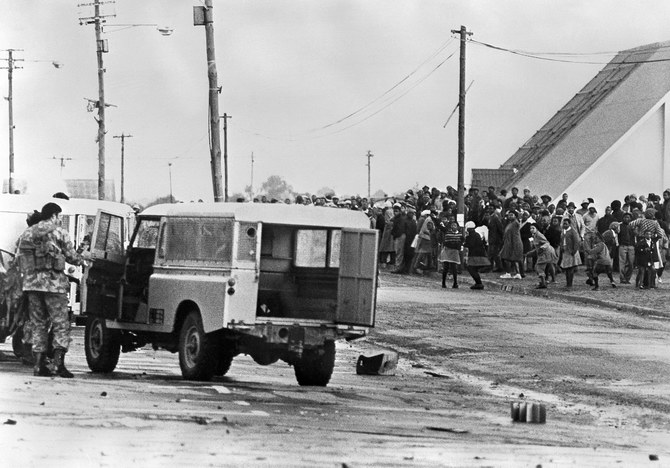
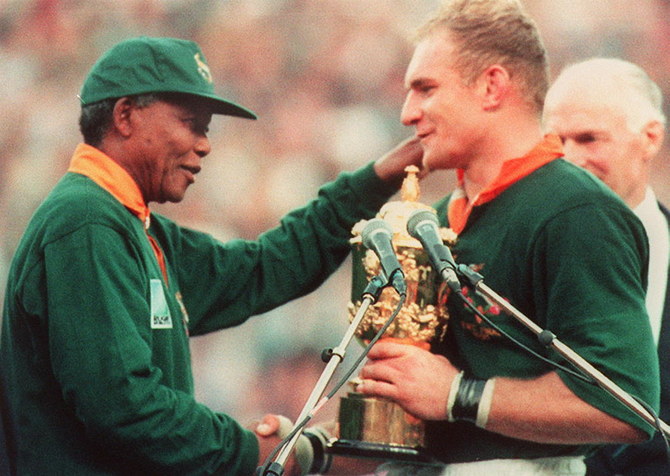
- Apartheid — an Afrikaans-language word meaning the state of apartness — became official government policy in 1948
- It formalized a system of white-minority domination in place soon after European settlers started arriving on the southern tip of Africa more than 300 years before
US intel did not suggest a preemptive strike from Iran before US-Israeli attacks, AP sources say
- The official said a variety of factors created a golden opportunity to take out much of Iran’s leadership
WASHINGTON: Trump administration officials told congressional staff in private briefings Sunday that US intelligence did not suggest Iran was preparing to launch a preemptive strike against the US, three people familiar with the briefings said.
The administration officials instead acknowledged there was a more general threat in the region from Iran’s missiles and proxy forces, two of the people said. The third person, however, said the administration emphasized that Iran’s missiles and proxy forces posed an imminent threat to US personnel and allies in the region.
The officials did not provide any clarity about what would happen next in Iran after the joint US-Israeli operation, the two people said. All three people insisted on anonymity to discuss details that have not been made public.
The information conveyed to the congressional staff contrasts with the message from President Donald Trump. “Our objective is to defend the American people by eliminating imminent threats from the Iranian regime. A vicious group of very hard, terrible people,” he said in a video message after launching strikes on Iran.
Senior Trump administration officials, who like others were not authorized to comment publicly and spoke on condition of anonymity, had told reporters Saturday that there were indicators that the Iranians could launch a preemptive attack.
The White House and Pentagon did not immediately reply to requests for comment on Sunday night. Details of the briefing were first reported by Politico.
On Tuesday, Secretary of State Marco Rubio, Defense Secretary Pete Hegseth, CIA Director John Ratcliffe and Gen. Dan Caine, chairman of the Joint Chiefs of Staff, will brief the full membership of Congress on the US military operation against Iran, the White House said Sunday. Rubio also was slated to brief Hill leadership Monday, the same day Hegseth and Caine are planning a press conference about the operation.
Three strikes, three locations, within a single minute
The military operation came after authorities from Israel and the US spent weeks tracking the movements of senior Iranian leaders, including Supreme Leader Ayatollah Ali Khamenei, and shared information that allowed the strikes to be carried out in a surprise daylight attack, according to an Israeli military official and another person familiar with the operation.
The eventual barrage of US-Israeli attacks on Iran came so quickly that they were nearly simultaneous — with three strikes in three locations hitting within a single minute — killing Khamenei and some 40 senior figures, including the head of the paramilitary Revolutionary Guard and the country’s defense minister, the Israeli military official said Sunday.
The official said a variety of factors created a golden opportunity to take out much of Iran’s leadership, like weeks of training and monitoring the movements of senior figures as well as intelligence in real-time before the attack began that key targets were gathered together.
Striking by day also gave an additional element of surprise, said the official, who said so many major, rapid-fire strikes were critical to keep key officials from fleeing after the first strike. The official said Israel closely cooperated with its US counterparts and had used a similar tactic at the beginning of last June’s war — which resulted in the killing of several senior Iranian figures.
The official also noted Khamenei having posted defiant tweets taunting President Donald Trump in the days before the attack.
The details about the strikes came as the conflict entered its second day, with Trump saying in a video message Sunday that he expected it would continue until “all of our objectives are achieved.” He did not spell out what those objectives were.
The Republican president also said the US military and its partners hit hundreds of targets in Iran, including Revolutionary Guard facilities, Iranian air defense systems and nine warships, “all in a matter of literally minutes.”
CIA had long tracked top Iranian leaders
Before the attacks, the CIA had for months tracked the movements of senior Iranian leaders, including Khamenei.
The intelligence was shared with Israeli officials, and the timing of the strikes was adjusted in part because of that information about the Iranian leaders’ location, according to the person familiar with the planning.
The intelligence-sharing between US and Israel reflects the preparation that went into the strikes, which threw the future of the Islamic Republic into uncertainty and raised the risk of escalating regional conflict.
The US regularly shares intelligence with allies including Israel. Those partnerships, and the accuracy of the intelligence they yield, is often critical not only to the success of a military operation but also to the public’s support for it.
Virginia Sen. Mark Warner, the senior Democrat on the committee, told The Associated Press that, historically, “our working relationship with the Mossad and Israel is really strong.” Mossad is the Israeli spy agency.
Warner said he has serious concerns about the justification for the strikes, Trump’s long-term plans for the conflict and the risks that US service members will face. The military announced Sunday that three American troops had been killed in the Iran operation.
“No tears will be shed over their leadership being eliminated, but always the question is: OK, what next?” Warner said.
Iran has signaled it’s open to talks with the US
A senior White House official said Iran’s “new potential leadership” has suggested it is open to talks with the United States. That official, who spoke on condition of anonymity to discuss internal administration deliberations, said Trump has indicated he’s “eventually” willing to talk but that for now the military operation “continues unabated.”
The official did not say who the potential new Iranian leaders are or how they made their alleged willingness to talk known. Separately, Trump told The Atlantic that he planned to speak with Iran’s new leadership.
“They want to talk, and I have agreed to talk, so I will be talking to them,” he said Sunday, declining comment on the timing.



