NEW DELHI: India’s poll watchdog Saturday ordered producers to stop streaming a web series on Prime Minister Narendra Modi, weeks after it banned a Bollywood film and clamped down on a TV channel devoted to the right-wing premier.
The Election Commission of India — an autonomous body tasked with overseeing the world’s biggest democratic exercise — said the online web series was in violation of its rules.
Under Indian election regulations, the publication of any content which is deemed as campaign material or propaganda is not allowed during the voting period.
Any political advertising must also be approved by the election authorities so that all spending is accounted for.
India’s mammoth six-week vote began on April 11 and will run until May 19, with results due on May 23.
When it ordered a halt to the streaming of the online series, the commission said any biopic material which has the “potential to disturb the level playing field” should not be displayed until after the polls have closed.
The series, titled “Modi: Journey of a Common Man” is produced by Eros Now and traces Modi’s journey from childhood to becoming the prime minister of the world’s largest democracy.
Earlier this month, the commission banned the release of a flattering movie about Modi until after voting finishes.
Days later it ordered a clampdown on NaMo TV, a channel showing 24-hour programs on Modi rallies, speeches, and even rap songs and dance routines devoted to the leader.
The Election Commission said NaMo TV had to submit all of its content for approval.
The Hindu nationalist Modi, 68, is seeking a tough re-election after storming to power in 2014.
He often uses his humble upbringing as a tea-seller’s son to strike a chord with millions of poor voters.
The election commission — often accused of being ineffective — has been flooded with complaints since campaigning started in March.
Last week, the Supreme Court told it to act tough on complaints of poll violations by political leaders.

Indian poll watchdog stops web series on Modi
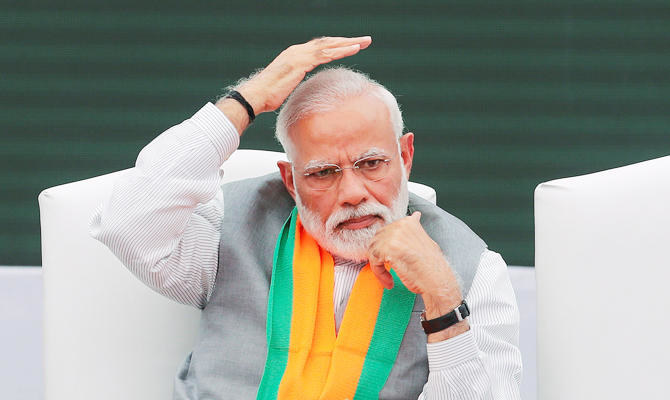
- India’s mammoth six-week vote began on April 11 and will run until May 19, with results due on May 23
- Last week, the Supreme Court told it to act tough on complaints of poll violations by political leaders
‘I admire Vision 2030’: Bangladesh’s new PM aims for stronger Saudi, GCC ties
- Saudi Arabia congratulates Tarique Rahman on assuming Bangladesh’s top office
- Relations between Bangladesh and Kingdom were formalized during his father’s rule
DHAKA: After 17 years in exile, Tarique Rahman has taken office as prime minister of Bangladesh, inheriting his parents’ political legacy and facing immediate economic and political challenges.
Rahman led his Bangladesh Nationalist Party to a landslide victory in the Feb. 12 general election, winning an absolute majority with 209 of 300 parliamentary seats and marking the party’s return to power after two decades.
The BNP was founded by his father, former President Ziaur Rahman, a 1971 Liberation War hero. After his assassination in 1981, Rahman’s mother, Khaleda Zia, took over the party’s helm and served two full terms as prime minister — in 1991 and 2001.
Rahman and his cabinet, whose members were sworn in alongside him on Tuesday, take over from an interim administration which governed Bangladesh for 18 months after former premier Sheikh Hasina — the BNP’s archrival who ruled consecutively for 15 years — was toppled in the 2024 student-led uprising.
As he begins his term, the new prime minister’s first tasks will be to rebuild the economy — weakened by uncertainty during the interim administration — and to restore political stability. Relations with the Middle East, particularly Saudi Arabia and other GCC states, are also high on his agenda.
“Saudi Arabia is one of our long-standing friends,” Rahman told Arab News at his office in Dhaka, two days before his historic election win.
“I admire the Saudi Vision 2030, and I am sincerely looking forward to working with the leadership of the Kingdom of Saudi Arabia. BNP always had a great relationship with the Muslim world, especially GCC nations — UAE, Qatar, Bahrain, Kuwait and Oman — and I look forward to working closely with GCC countries and their leadership to build a long-term trusting partnership with mutual interest,” Rahman said.
The Saudi government congratulated him on assuming the top office on Tuesday, wishing prosperity to the Bangladeshi people.
Bangladesh and Saudi Arabia established formal diplomatic relations in August 1975, and the first Bangladeshi ambassador presented his credentials in late 1976, after Rahman’s father rose to power. That year, Bangladesh also started sending laborers, engineers, doctors, and teachers to work in the Kingdom.
Today, more than 3 million Bangladeshis live and work in Saudi Arabia — the largest expat group in the Kingdom and the biggest Bangladeshi community outside the country.
“I recall that when my father, President Ziaur Rahman, was in office, bilateral relations between our two nations were initiated,” Rahman said. “During the tenure of my mother, the late Begum Khaleda Zia, as prime minister, those relations became even stronger.”
Over the decades, Saudi Arabia has not only emerged as the main destination for Bangladesh’s migrant workers but also one of its largest development and emergency aid donors.
Weeks after Rahman’s mother began her first term as prime minister in 1991, Bangladesh was struck by one of the deadliest tropical cyclones in its history. Riyadh was among the first who offered assistance, and Zia visited Saudi Arabia on her earliest foreign tour and performed Hajj in June 1991.
For Rahman, who had been living in London since 2008 and returned to Bangladesh in December — just days before his mother’s death — the Kingdom will also be one of the first countries he plans to visit.
“I would definitely like to visit Saudi Arabia early in my term,” he said. “Personally, I also wish to visit the holy mosque, Al-Masjid Al-Haram, Makkah, to perform Umrah.”


