ISTANBUL, PARIS: Four Turkish soldiers were killed on Friday in clashes with the outlawed Kurdistan Workers Party (PKK) near the border with Iraq, Turkey’s Defense Ministry said on Saturday.
Demiroren News Agency said a military base had been attacked in the mountainous Cukurca district of Turkey’s southeastern province of Hakkari, prompting the Turkish military to respond with a “large-scale” military operation.
“As part of ongoing operations on the Turkey-Iraq border, two soldiers were killed in clashes with terrorists despite all efforts to save them,” the ministry said, adding a total of four soldiers were killed and six wounded.
“Terrorists are under intense fire with the air operation and fire support vehicles in the region,” it said.
The PKK, which has waged an insurgency for autonomy in Turkey’s largely Kurdish southeast since 1984, is deemed a terrorist organization by Turkey, the US and the EU.
A day earlier, French President Emmanuel Macron hosted representatives of the Kurdish-led force that defeated Daesh extremists in Syria, drawing a sharp rebuke from Turkey’s Foreign Ministry.
Macron assured the Kurdish envoys of French support in their fight against the remaining militants, but Ankara accused the French leader of “seeking to confer artificial legitimacy on a faction of terrorist groups.”
“We condemn the reception by French President Emmanuel Macron of a delegation of so-called ‘Syrian Democratic Forces’ (SDF),” Turkish Foreign Ministry spokesman Hami Aksoy said in the statement.
In late March the US-backed SDF flushed out Daesh militants from their last bastion in Syria but the Kurdish-led force still warns that the militants remain a threat in places.
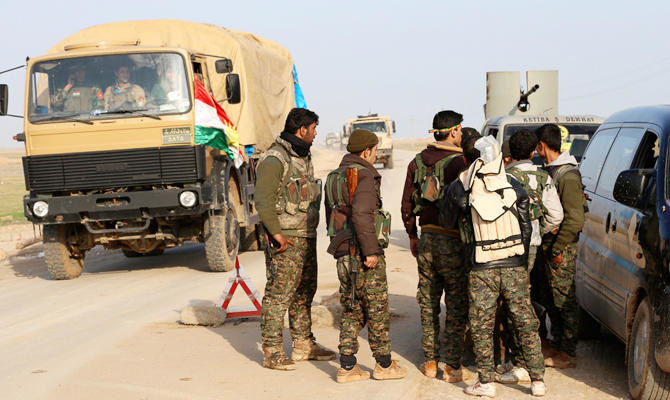
The SDF is an umbrella Kurdish-Arab force dominated by Kurds from the People’s Protection Units (YPG). It is regarded with huge distrust by neighboring Turkey which sees the YPG as a terror group.
Macron assured the visiting SDF representatives, who were not named, of the “active support of France in the fight against Daesh which continues to be a menace for collective security,” the presidency said in a statement.
Particularly important is the support in the “handling of terrorist fighters held as prisoners along with their families.”
European capitals are keeping a careful eye on the Daesh prisoners held by the SDF after the defeat of the militants, given many are dual nationals.
Macron also vowed that financial support would be allocated to “respond to the humanitarian needs and the socio-economic stabilization of civilian populations in Syria.”
The SDF were the West’s key ally in defeating Daesh and waged the bulk of the fighting on the ground.
But they fear being abandoned by their patrons now Daesh has been beaten, after US President Donald Trump announced the withdrawal of American forces from Syria.
France’s past contacts with the SDF’s Syrian Kurds had already angered Turkey which regards the YPG as the Syrian branch of the PKK, which has waged a 35-year insurrection against the Turkish state.
Macron on Friday made clear of the importance to Paris of “the security of Turkey and a de-escalation along the Syrian-Turkish border,” the French presidency said.
But Aksoy said Macron’s move did not sit well with the French-Turkish alliance, and warned that “Turkey will not hesitate to take measures deemed necessary to protect its national security.”


![]()

Four Turkish soldiers killed in clashes with PKK, says ministry
Four Turkish soldiers killed in clashes with PKK, says ministry
- Macron on Friday made clear of the importance to Paris of “the security of Turkey and a de-escalation along the Syrian-Turkish border,” the French presidency said


Latest updates


Recommended


© 2026 SAUDI RESEARCH & PUBLISHING COMPANY, All Rights Reserved And subject to Terms of Use Agreement.