Arab News at 44: Online Pakistan edition has formed its own regional identity

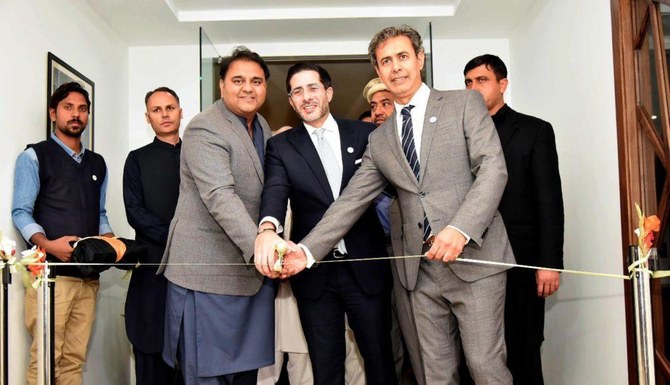
Former Minister of Information and Broadcasting Fawad Chaudhry, who on Thursday was appointed minister for science and technology, officially inaugurated the newspaper’s Pakistan bureau earlier this year - seen here with Arab News EIC Faisal J. Abbas (C) and journalist Baker Atyani (R). (AN Photo)
Updated 20 April 2019
Follow

Arab News at 44: Online Pakistan edition has formed its own regional identity

  • Arab News expanded its footprint entering Pakistan in mid 2017
  • Its Pakistan Edition was founded on February 2018 and has been a major success

ISLAMABAD: Arab News’ online Pakistan edition, which launched on Feb. 8, 2018, has established itself as a credible extension of the Riyadh-based newspaper, which today marks its 44th anniversary.
Arab News entered Pakistan as part of the newspaper’s ongoing global and digital expansion, and to tap news from other parts of Asia, hiring skilled journalists and freelance contributors.
An exclusive interview in October 2018 with Shahid Khaqan Abbasi, who was newly elected as prime minister at the time, catapulted Arab News in Pakistan.
Realizing the news potential in the country, Arab News capitalized on its success and set up a bureau, but not before landing more special reports that grabbed the local media’s attention and attracted a larger readership.
The website www.arabnews.pk became the parent organization’s first in a series of country-specific online editions that the newspaper is planning to launch, and is part of its “more digital, more global” strategy.
Former Minister of Information and Broadcasting Fawad Chaudhry, who on Thursday was appointed minister for science and technology, officially inaugurated the newspaper’s Pakistan bureau earlier this year.
Led by award-winning veteran journalist Baker Atyani, and under the guidance of Arab News Editor-in-Chief Faisal J. Abbas, the team at the Pakistan edition has worked diligently to penetrate the country’s vibrant news market.
As such, followership of the newspaper’s Pakistan social media account has quickly ballooned.
Its online coverage of the first visit of Saudi Crown Prince Mohammed bin Salman to Pakistan in February was widely praised.
Arab News published special reports and features on the deep-rooted and diversifying ties between Pakistan and Saudi Arabia.
Also a major hit was Abbas’s exclusive, lengthy sit-down with President Dr. Arif Alvi during the crown prince’s visit.
Another exclusive that garnered a serious online buzz was on Egyptian billionaire Naguib Sawiris offering to build 100,000 housing units in Pakistan.
The Pakistan edition has kept a special focus on business and finance, and has spoken with movers and shakers, including those in the corridors of power.
In August 2018, it exposed the ruling party’s hit single “Rok Sako To Rok Lo Tabdeeli Aayi Re,” produced for the last general election, as being suspiciously similar to a remixed version of the Indian religious song “Bankya Maa Re Nach. The report was instantly picked up by Pakistani media.
Days before the election, Atyani conducted a one-on-one exclusive with Prime Minister Imran Khan.
Arab News’ Pakistan edition is part of the regional publishing giant Saudi Research and Marketing Group (SRMG). With the edition’s success, the SRMG is looking to replicate the model across Asia.


‘No Other Land’ director’s home, family attacked by Israeli soldiers in West Bank

Updated 7 sec ago
Follow

‘No Other Land’ director’s home, family attacked by Israeli soldiers in West Bank

  • Hamdan Ballal’s brother held ‘round his neck,’ filmmaker says
  • Other relatives handcuffed, blindfolded, detained, reports say

DUBAI: Hamdan Ballal, one of the four directors of the Oscar-winning documentary “No Other Land,” said that his home was attacked by Israeli soldiers and that several members of his family were injured and detained, according to media reports.

Settler attacks on Masafer Yatta, a cluster of villages in the southern West Bank, had intensified, the filmmaker said.

Ballal said he called the police on Sunday to enforce a ruling that prohibited non-residents from entering the area around his home in the village of Susya, but was instead visited by soldiers and a local settler leader.

The director, who was not at home at the time, said the soldiers raided his property and attacked everyone inside, including his brother, Mohammed Ballal, who was held “round his neck,” which caused him to turn blue and left him struggling to breathe.

Several other family members, including two brothers, a nephew and a cousin, were stopped by soldiers while traveling from a nearby village. They were handcuffed, blindfolded and detained for three hours at an army base, before being released later the same night, Ballal said.

A spokesperson for the army said that “a number of Palestinians adjacent to the area of Susya” were detained for refusing to identify themselves to soldiers but emphasized that “IDF soldiers did not assault them and did not raid their home.”

Ballal said that he was attacked last year by the same Israeli settler who attacked his family on Sunday. He said he was released the following day with injuries to his head and stomach.

“Two weeks ago we managed to get a decision from the Israeli court that the area around my home is closed to non-residents, but the settlers break that order and still come with their flocks almost every day,” the filmmaker said in a statement.

The ruling “was supposed to make things a bit quieter for us,” but the “opposite has been true,” as settlers have “ramped up their harassment and the Israeli authorities have done nothing to enforce the decision and today they joined the settlers in the attack,” he said.

In recent days, Israel has introduced a set of measures aimed at deepening its control over the West Bank.

On Sunday, the government approved a plan that allows Israelis to register land in the West Bank for the first time since the registration process was frozen following the 1967 war, when Israel captured the territory from Jordan.

The move has been widely condemned by humanitarian and advocacy groups.

UN Secretary-General Antonio Guterres called on Israel to reverse its decision, which he said could “lead to the dispossession of Palestinians of their property and risks expanding unlawful Israeli control over land in the area.”

In a joint statement on Tuesday, more than 80 UN member states said they strongly condemned “unilateral Israeli decisions and measures aimed at expanding Israel’s unlawful presence in the West Bank.”

“Such decisions are contrary to Israel’s obligations under international law and must be immediately reversed,” it said.

Legal advocacy group Adalah said it had sent an urgent letter to Israeli ministers demanding the “immediate cancellation” of the land registry decision.

Adalah’s legal director Dr. Suhad Bishara said that Israel’s decision “deepens the gravest violations of international law, including the continued commission of war crimes (settlements), crimes against humanity (apartheid) and the crime of aggression (de facto and de jure annexation).”