

Sudan attorney general orders formation of committee to oversee corruption probe

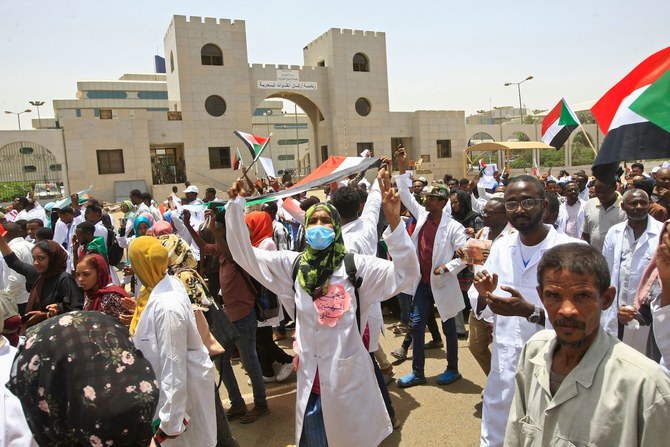
Sudanese protestors wave signs and flags as they continue to protest outside the army complex in the capital Khartoum on April 17, 2019. (AFP)
Updated 20 April 2019
Follow

Sudan attorney general orders formation of committee to oversee corruption probe

  • Al-Walid Sayed Ahmed had submitted a request to lift the immunity of a number of officers suspected of killing a teacher who died in custody in February
  • Protest leaders are to hold talks Saturday with Sudan’s military rulers who have so far resisted calls to transfer power to a civilian administration

CAIRO: Sudan's attorney general on Saturday ordered the formation of a committee to oversee investigations into crimes involving public funds, corruption and criminal cases related to recent events, the state news agency SUNA said, citing a statement from the attorney general.
SUNA also said that attorney general Al-Walid Sayed Ahmed had submitted a request to the director of the country's National Intelligence and Security Services to lift the immunity of a number of officers suspected of killing a teacher who died in custody in February.

Earlier on Saturday, a judicial source said that Sudan's public prosecutor has begun investigating ousted President Omar Al-Bashir on charges of money laundering and possession of large sums of foreign currency without legal grounds. 
The source said that military intelligence had searched Bashir's home and found suitcases loaded with more than $351,000 and six million euros, as well as five million Sudanese pounds.
"The chief public prosecutor... ordered the (former) president detained and quickly questioned in preparation to put him on trial," a judicial source told Reuters.
"The public prosecution will question the former president in Kobar prison," the source added.
Relatives could not be immediately reached on Saturday for comment about the investigation.
Bashir, who is also being sought by the International Criminal Court over allegations of genocide in the country's western Darfur region, was ousted on April 11 by the military following months of protests against his rule and had been held at a presidential residence.
Bashir's family said this week that the former president had been moved to the high-security Kobar prison in Khartoum.
As president Bashir often played up his humble beginnings as the child of a poor farming family in Hosh Bannaga, a small village consisting mainly of mud houses on the eastern bank of the Nile some 150 km (93 miles) north of Khartoum.
The Sudanese Professionals' Association, leading the protests, has called for holding Bashir and members of his administration to account, a purge of corruption and cronyism and easing an economic crisis that worsened during Bashir's last years in power.
On Wednesday, Sudan's transitional military council ordered the central bank to review financial transfers since April 1 and to seize "suspect" funds, according to state news agency SUNA.
The council also ordered the "suspension of the transfer of ownership of any shares until further notice and for any large or suspect transfers of shares or companies to be reported" to authorities.

Meanwhile, protest leaders are to hold talks Saturday with Sudan’s military rulers who have so far resisted calls to transfer power to a civilian administration, a head figure in the protests told AFP.
“The military council will hold talks with the Alliance for Freedom and Change at 8:00 p.m. (1800 GMT) today,” said Siddiq Yousef, a senior member of the umbrella group leading the protest movement.


Turkiye’s Kurdish party says Syria deal leaves Ankara ‘no excuses’ on peace process

Updated 2 sec ago
Follow

Turkiye’s Kurdish party says Syria deal leaves Ankara ‘no excuses’ on peace process

ANKARA: Turkiye’s pro-Kurdish DEM Party said on Monday that the Turkish government had no more “excuses” to delay a peace process with the Kurdistan Workers Party (PKK) now that a landmark integration deal was achieved in neighboring Syria.
On Sunday in Syria, the Kurdish-led Syrian Democratic Forces (SDF) agreed to come under the control of authorities in Damascus — a move that Ankara had long sought as integral to ‌its own peace ‌effort with the PKK. “For more than a ‌year, ⁠the ​government ‌has presented the SDF’s integration with Damascus as the biggest obstacle to the process,” Tuncer Bakirhan, co-leader of the DEM Party, told Reuters, in some of the party’s first public comments on the deal in Syria.
“The government will no longer have any excuses left. Now it is the government’s turn to take concrete steps.” Bakirhan cautioned President Tayyip Erdogan’s ⁠government against concluding that the rolling back Kurdish territorial gains in Syria negated the need ‌for a peace process in Turkiye. “If the ‍government calculates that ‘we have weakened ‍the Kurds in Syria, so there is no longer a ‍need for a process in Turkiye,’ it would be making a historic mistake,” he said in the interview.
Turkish officials said earlier on Monday that the Syrian integration deal, if implemented, could
advance the more than year-long process with the ​PKK, which is based in northern Iraq. Erdogan urged
swift integration of Kurdish fighters into Syria’s armed forces. Turkiye, the strongest ⁠foreign backer of Damascus, has since 2016 repeatedly sent forces into northern Syria to curb the gains of the SDF — which after the 2011–2024 civil war had controlled more than a quarter of Syria while fighting Islamic State with strong US backing.
The United States has built close ties with Damascus over the last year and was closely involved in mediation between it and the SDF toward the deal.
Bakirhan said progress required recognition of Kurdish rights on both sides of the border.
“What needs to be done is clear: Kurdish rights must be recognized ‌in both Turkiye and Syria, democratic regimes must be established, and freedoms must be guaranteed,” he said.