

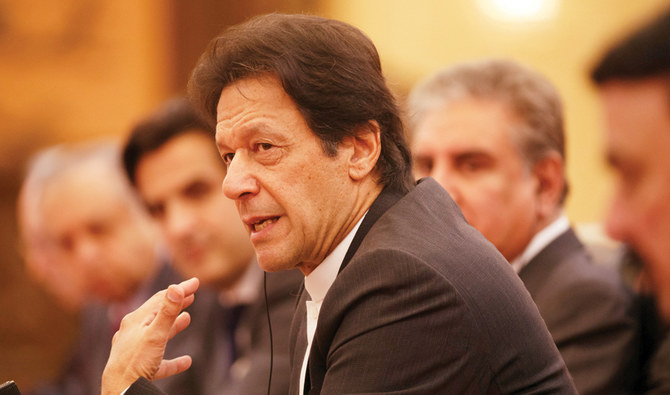
Pakistan’s Imran Khan defends cabinet shakeup as political uncertainty looms

Khan said whoever was not beneficial for his country, he would bring in someone who was. (Reuters)
Updated 19 April 2019
Follow

Pakistan’s Imran Khan defends cabinet shakeup as political uncertainty looms

  • Analysts warn reshuffle will not immediately restore public trust

ISLAMABAD: Pakistani Prime Minister Imran Khan defended his decision to make sweeping changes to his Cabinet on Friday, as analysts warned of a prolonged period of political uncertainty.

The reshuffle, announced late on Thursday night, comes just eight months into his party’s five-year term, and saw key appointments of political veterans widely criticized for their roles in previous administrations.

Khan said he had the right as leader of the country to remove anyone from office if they did not perform.

“I want to tell all ministers: Whoever isn’t beneficial for my country, I will bring (in) someone who is,” the former cricket star said at a rally in Orakzai in northwestern Pakistan. “If a player isn’t performing, we either change the batting order or we change him.

“The prime minister has one mission: To make his team win, and my mission is to lead my nation to victory. For that, I have changed the batting order of my team, and I will do again in the future.”

Abdul Hafeez Shaikh, the main beneficiary of the reshuffle, has been made finance minister. He previously held the role from 2010-2013 under the opposition Pakistan Peoples Party when it was in power, and was minister for privatization under former military ruler General Pervez Musharraf.

Khan also elevated Information Minister Fawad Chaudhry, another former Musharraf supporter. Chaudhry will now serve as minister for science and technology, while Firdous Ashiq Awan has replaced him at the Ministry of Information.

The reshuffle had been expected for weeks amid reports Khan had become disenchanted with Finance Minister Asad Umar over delays in securing a bailout package from the International Monetary Fund.

Inflation, at its highest for five years, has shocked many Pakistanis who voted for Khan. Pakistan’s central bank lowered growth forecasts last month, and the rupee has lost 35 percent of its value since December 2017.

But analysts warned the shakeup was ill-timed, and would not immediately improve the government’s performance or restore the public’s trust.

“This reshuffle may help settle some internal wrangling and power struggles in the ranks of the government, but in the long run it won’t have any positive impact on its performance,” journalist Zebunnisa Burki told Arab News. “The political chaos created by the reshuffle won’t raise much confidence.”

Columnist and political consultant Mosharraf Zaidi stated a reshuffle just eight months into the government’s term revealed a “dangerous lack of patience” on the part of the prime minister.

“The Cabinet assignments that have been moved around show a contempt for performance. If the problem was poor performance, then why were Cabinet members just reshuffled and not simply removed? This is (now) a government essentially of the Musharraf era.”

Umair Javed, a writer and sociology professor at the Lahore University of Management Sciences, said the changes had increased “political uncertainty.”

“This sudden and drastic change is not well received,” he said. “It seems like this was not a well thought out strategy … it shows the government itself is unsure about its long-term planning and strategy to deal with chronic issues like the economy.”

It was unfair to assess the performance of any ministry after a mere eight months, Javed added, especially when the government had promised major structural reforms to steer the country out of crisis.

“The government still has time to decide its direction,” he said. “Otherwise the people will have no choice but to pour onto the streets against it.”


France’s screen siren Brigitte Bardot dies at 91

Updated 5 sec ago
Follow

France’s screen siren Brigitte Bardot dies at 91

  • French PM Emmanuel Macron hails the actor as a legend who 'embodied a life of freedom'
  • Film star also courted controversy, embracing far-right views in her later years
PARIS: French film sensation Brigitte Bardot, a symbol of sexual liberation in the 1950s and 1960s who reinvented herself as an animal rights defender and embraced far-right views, died on Sunday aged 91, her foundation said.
She died in her Saint-Tropez home, La Madrague, on the French Riviera.
“The Brigitte Bardot Foundation announces with immense sadness the death of its founder and president, Madame Brigitte Bardot, a world-renowned actor and singer, who chose to abandon her prestigious career to dedicate her life and energy to animal welfare and her foundation,” it said in a statement sent to AFP.
The cause of death was not given. But Bardot was briefly hospitalized in October for what her office called a “minor” procedure. Bardot at the time had lambasted “idiot” Internet users for speculation that she had died.
Tributes were immediately paid to the star who was known as “BB” in her home country, with President Emmanuel Macron calling her a “legend” of the 20th century.
Born on September 28, 1934 in Paris, Bardot was raised in a well-off traditional Catholic household. Married four times, she had one child, Nicolas-Jacques Charrier, with her second husband, actor Jacques Charrier.
Bardot became a global star after appearing in “And God created Woman” in 1956, and went on to appear in about 50 more movies before giving up acting in 1973.
She turned her back on celebrity to look after abandoned animals, saying she was “sick of being beautiful every day.”

Far-right leanings

“With her films, her voice, her dazzling glory, her initials (BB), her sorrows, her generous passion for animals, and her face that became Marianne, Brigitte Bardot embodied a life of freedom,” Macron wrote on X, referring to the Marianne image used as the female symbol of the French republic.
His tribute, though, made no reference of Bardot’s alignment with far-right views in her post-cinema years, which alienated many of her fans.
Bardot was convicted five times for hate speech, mostly about Muslims, but also the inhabitants of the French island of Reunion whom she described as “savages.”
A supporter of far-right politician Marine Le Pen, Bardot declared herself “against the Islamization of France” in a 2003 book, citing “our ancestors, our grandfathers, our fathers have for centuries given their lives to push out successive invaders.”
The head of Le Pen’s far-right National Rally party, Jordan Bardella, was among the first to pay homage.
“Today the French people have lost the Marianne they so loved,” he wrote on X, calling her an “ardent patriot.”
Le Pen, who has been barred from public office pending an appeal trial in January, also paid tribute to Bardot as “incredibly French: free, untamable, whole.”
In her final book, Mon BBcedaire (“My BB Alphabet“), published weeks before her death, Bardot fired barbs at what she described as a “dull, sad, submissive” France and at her home town of Saint-Tropez, now packed with the wealthy tourists she helped attract.
The book also contained derogatory remarks about gay and transgender people.

Saint-Tropez retreat

After retiring from cinema, Bardot withdrew to her home in the Riviera resort of Saint-Tropez where she devoted herself to fighting for animals.
Her calling apparently came when she encountered a goat on the set of her final film, “The Edifying and Joyous Story of Colinot.” To save it from being killed, she bought the animal and kept it in her hotel room.
Bardot went on to found the Brigitte Bardot Foundation in 1986, which now has 70,000 donors and around 300 employees, according to its website.
“I’m very proud of the first chapter of my life,” she told AFP in a 2024 interview ahead of her 90th birthday.
“It gave me fame, and that fame allows me to protect animals — the only cause that truly matters to me.”
She added that she lived in “silent solitude” in her home “La Madrague,” surrounded by nature and content to be “fleeing humanity.”
On the subject of death, she warned that she wanted to avoid the presence of “a crowd of idiots” at her funeral and wished for a simple wooden cross above her grave, in her garden — the same as for her animals.