

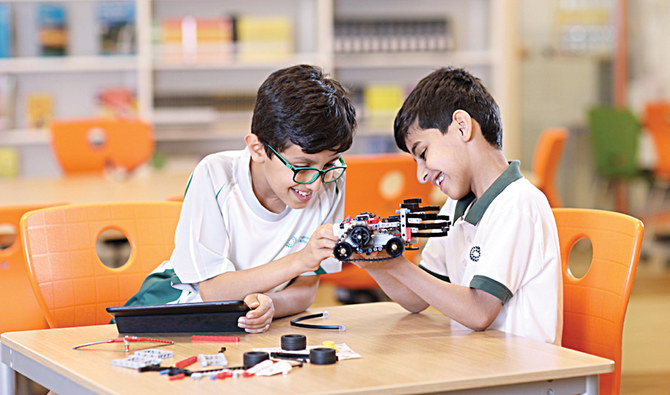

JEDDAH: Saudi students will soon be learning with the aid of artificial intelligence, as Riyadh’s leading Misk Schools become the first in the country to introduce AI into the classroom.
From this September, students at Misk Schools will learn through and be assessed by artificial intelligence, providing a personalized education for each child and giving teachers greater insights into their performance. The school will use CENTURY, an award-winning teaching and learning platform that uses AI to adapt learning to each student’s individual strengths, weaknesses, behaviors and habits.
Founded by Prince Mohammad Bin Salman’s Misk Foundation, Misk Schools is a state-of-the-art day school in Riyadh offering a new paradigm in education based on the best practices of international and progressive education.
Misk Schools says that the move will ensure that students are learning with the aid of the world’s most pioneering classroom technology, while empowering teachers to deliver an even stronger education.
Artificial intelligence — where machines are programmed to perform tasks traditionally associated with humans — is transforming education across the world. It is used to tailor learning to each student, while freeing teachers’ time to teach by automating admin tasks such as marking and planning. It also provides them with extensive data on each child’s performance, allowing for more effective targeted interventions to support or stretch students.
While Misk Schools is the first school in Saudi Arabia to adopt AI, the Middle East is leading the way internationally in using AI and technology to improve education.
Director General of Misk Schools Peter Hamilton said that they were excited to be partnering with CENTURY as its breaks new ground in ways to embed technology to transform the learning experience for students. “We seek to both support and challenge our learners, and by partnering with CENTURY we will empower our students to take ownership of their learning. Moreover, CENTURY will allow our teachers to have better insight into the daily work of each student, and to better plan future work in the classroom.” Hamilton said.
Founder and CEO of CENTURY Tech Priya Lakhani said: “AI is transforming schools across the world by providing a more personalized education to students, while simultaneously empowering teachers with precise data so that they can perform even better as educators.
“AI is the only way we can move from the failed, outdated ‘one-size-fits-all’ approach to ‘one-size-fits-one.’ It allows each student to learn at their own pace, with lessons and tests tailored to maximize their strengths and rapidly address their weaknesses,” she said.
“I am delighted to welcome Misk Schools to the CENTURY family. From children in leading independent schools to Syrian refugees in the Middle East, CENTURY is being used across the world to improve the lives of children and young adults from all backgrounds.”
Saleh Al-Ghamdi, an English language teacher, told Arab News that introducing AI into classrooms was a major leap forward in the Saudi education system.
“It seems that we will earlier than expected reap the fruits of the promising Saudi Vision before 2030 falls. It is an important step that will entirely change education in Saudi Arabia. I see the step as a road map to a bright education future,” Al-Ghamdi said.
He added that Saudi Arabia is looking forward to putting its citizens on the path toward first-world countries. “Introducing AI in our schools is one of the ways that can significantly help in achieving our Vision 2030 goals. It is true that this process may require big efforts, but with determination nothing is impossible,” Al-Ghamdi said.
Introducing AI in schools would greatly help students to feel successful and educators more productive. “It will also assist in promoting active learning and deeper engagement. What is more, it will make educators’ jobs more focused and much easier,” he said.
Al-Ghamdi said that some teachers might fear that the introduction of AI in education would threaten their jobs, but “the truth is that this revolution in education will hopefully make robots and computer programs and technology, in general, a supporting element to their indispensable profession,” he said.
Research involving more than 11,000 students using CENTURY showed that the platform improves understanding of a topic by an average of 30 percent. It also frees teachers from admin tasks such as marking and planning — saving an average of six hours a week and allowing them to focus on teaching itself.
Last month CENTURY Tech agreed a landmark agreement with the Belgium government. As a leading teaching and learning platform that uses artificial intelligence in its design, CENTURY Tech is rapidly spreading across the world, from English independent schools to schools in Lebanon educating large numbers of Syrian refugees.


