

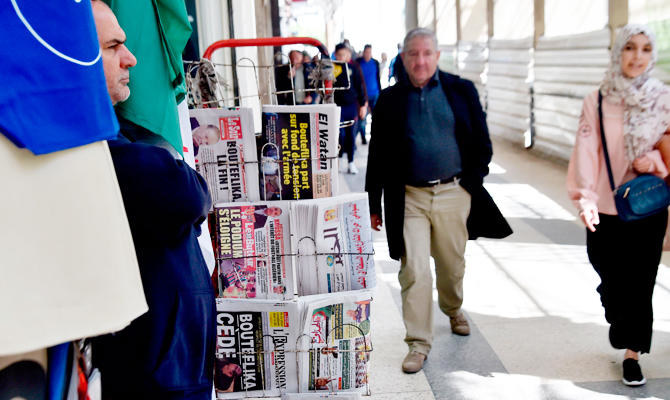

ALGIERS: Weeks of anti-government protests have helped Algerian journalists shake off the chokehold of state-imposed censorship but their work remains complicated and is often contested by demonstrators.
After the first protests erupted in February, journalists working for state media complained that their bosses had imposed a news blackout on the rallies against Abdelaziz Bouteflika’s bid to seek a fifth presidential term.
The protests have since become headline news on both private and public television channels, with live footage of nationwide demonstrations.
On a recent Friday, the main day of protests, however, television crews were shouted down and cursed by demonstrators as “arse kissers.”
“It reflects the hatred” protesters feel for the main private television channels because they totally ignored the first rallies, said Khaled Drareni of Reporters Without Borders (RSF).
The lack of coverage triggered shock in Algeria where private channels are usually quick off the mark and often run live reports.
But they are mostly owned by businessmen close to Bouteflika.
These media outlets “have tried to redeem themselves” by zooming in on the protests, said Drareni, who himself is a journalist, but they also report on alleged “manipulation” of the protest movement.
A small revolt has been brewing within the public sector media, with many journalists saying they refuse to be silenced.
Over the past week, dozens of journalists employed by state radio and television have staged their own sit-in demanding more freedom.
Journalists from EPTV, the public television company, gather weekly, chanting “free television” or covering their mouths with their hands to denounce censorship.
“There has been change, there are small windows that have opened,” said Imene Khemici of EPTV at a protest.
“We now have two specialized programs where we can invite people from different political persuasions, people from the opposition who can speak openly.”
Opposition figures and former officials who had been banned for the past quarter of a century are back on the airwaves.
“The most striking thing is how the public media have evolved, especially radio,” said Omar Belhouchet, director of the private newspaper El Watan.
As an example, the French-language radio station Chaine 3 now broadcasts live debates several times a week, a feature that was previously banned.
In the late 1980s, Algeria saw the emergence of dozens of privately-owned media outlets but their freedoms were quickly stifled by the outbreak of the country’s bloody civil war in 1992.
Several journalists were killed by Islamist groups during the decade of conflict, and the army imposed strict censorship on the media.
During Bouteflika’s 20-year rule, Algeria’s ranking on the press freedom index deteriorated dramatically.
In its latest report, the media watchdog RSF ranked Algeria in 136th place out of 180 countries, mainly due to “political and financial pressure” imposed by the authorities.
Newspapers in Algeria largely depend for their survival on revenues from state-funded advertising.
Private advertising comes mostly from businesses linked to stalwarts of the regime, said media sociologist Redouane Boudjemaa.
The media “reflect the diversity of the clans within the political system rather than the diversity of the Algerian population,” said Boudjemaa.
He cautioned that the changes in Algeria will not necessarily pave the way for greater media independence.
“In some ways we’ve moved from censorship to disinformation, especially on private channels,” he said.
But a group of journalists from state media are trying to build on the gains they have made in recent weeks.
They have drafted a charter consisting of 40 articles defining rules and regulations and have submitted the text to the new head of national television hoping it will be adopted.
Communication Minister Hassane Rahebi, for his part, has set up a committee to ensure “transparency” in state-funded advertising to avoid its use to exert pressure.
“This popular movement will open up new perspectives, including for freedom of the press,” said El Watan’s Belhouchet.


